Tuesday, June 7, 2016

#1613 (6/7)"The Key Economic Facts Obama’s Recovery Narrative Ignores"

"THE KEY ECONOMIC FACTS OBAMA'S RECOVERY NARRATIVE IGNORES"James Sherk / June 02, 2016 / http://dailysignal.com/2016/06/02/the-key-economic-facts-obamas-recovery-narrative-ignores/

President Barack Obama at Concord Community High School in Elkhart, Indiana, on June 1. (Photo: Kamil Krzaczynski/UPI/Newscom)

President Barack Obama took an economic victory lap in Elkhart, Indiana, on Wednesday. In a major speech he argued his policies have brought the economy back. He blamed remaining economic weaknesses on trends preceding his administration.

This analysis has the economic facts precisely backwards: Economic growth benefited Americans up and down the income distribution until the Great Recession. Since then, Americans have struggled considerably.

Obama argued his policies have brought the economy back. While labor market conditions have certainly improved from the depths of the recession—the official unemployment rate has even returned to pre-recession levels—these numbers do not tell the whole story.

Millions of working-age Americans stopped looking for work during the recession. Many have not returned to the labor market. The working-age labor force participation rate remains 2 percentage points below pre-recession levels. The government does not count these ex-workers as unemployed— even if they would have jobs in a stronger economy. This explains why the unemployment rate has officially recovered in the Elkhart metropolitan area despite it still having fewer jobs today than in 2007.

Workers also take significantly longer to find new jobs today. The average jobless worker still spends over six months unemployed. This recovery has gone far slower than the White House promised when proposing Obama’s recovery plan.

Obama argues pre-existing trends caused this economic weakness:"… where we haven’t finished the job, where folks have good reason to feel anxious, is addressing some of the longer-term trends in the economy—that started long before I was elected—that make working families feel less secure. These are trends that have been happening for decades now and that we’ve got to do more to reverse."

This argument rewrites economic history.
     Until the recession family incomes were growing up and down the income ladder. Congressional Budget Office data show market incomes for the middle quintile of (non-elderly) households grew by a third between 1979 and 2007.Other academic economists estimate higher middle class income growth over that period. Market incomes for families in the bottom quintile grew even faster—by more than 50 percent.

Unsurprisingly, most Americans were happy with the state of the economy then. In February 2007, Gallup polled Americans‘ perceptions of the state of the economy. Forty-three percent said “excellent” or “good.” Only 16 percent answered “poor.”

Then the recession hit and the recovery dragged on. Between 2007 and 2011, middle class households’ market incomes dropped by a tenth (the Congressional Budget Office data only goes through 2011). More Americans today tell Gallup they think the economy is in poor shape than in excellent or good condition. It’s hard to blame this new found dissatisfaction on long-term trends.

The president argued his administration deserves credit for the recovery thus far. If so, he has engineered the weakest recovery of the post-war era.

[bold, italics, and colored emphasis mine]

James Sherk - As a research fellow in labor economics at The Heritage Foundation, James Sherk researches ways to promote competition and mobility in the workforce rather than erect barriers that prevent workers from getting ahead.
-------------------------------------------------------------------------------------
"Jobs Report Numbers at Odds With Obama’s Economic Spin"James Sherk / @JamesBSherk / June 03, 2016; http://dailysignal.com/2016/06/03/jobs-report-numbers-at-odds-with-obamas-economic-spin/
"One Day After Obama Touts Economy in Big Speech, Worst Jobs Report in Five Years Posted For May" - Katie Pavlich Katie Pavlich |Posted: Jun 03, 2016; http://townhall.com/tipsheet/katiepavlich/2016/06/03/two-days-after-obama-touts-economy-in-big-speech-may-posts-worst-jobs-report-in-five-years-n2173059
Monday, June 6, 2016

#1612 (6/6) "72nd D-Day Anniversary: All Who Serve Are a Part of the Greatest Generation"

"72ND D-DAY ANNIVERSARY: ALL WHO SERVE A A PART OF THE  GREATEST GENERATION"James Carafano / June 05, 2016 / http://dailysignal.com/2016/06/05/72nd-d-day-anniversary-all-who-serve-are-a-part-of-the-greatest-generation/

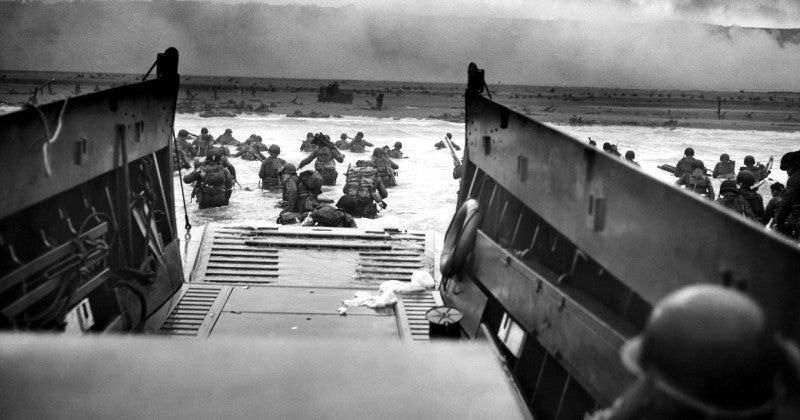
D-Day at Omaha Beach. U.S. Army troops wade ashore on Omaha Beach during the D-Day landings on June 6, 1944, during the Allied invasion of German-occupied France. (Photo: CPHOM Robert F. Sargent/U.S. Coa/UPI/Newscom)

Stop your average American on the street and ask them “what happened on June 6?” Surprisingly—a few might recall that on a dreary morning while the low-tide lapped lazily on the rocky coast of Normandy, France, brave men in battle armor no thicker than a khaki shirt grimly headed toward Hitler’s Atlantic wall.

There is nothing special to mark the 72nd anniversary of the D-Day invasion during World War II. Nothing special—other than the men themselves.

That 18-year-old struggling up the steep bluffs of Omaha Beach while tracer rounds flashed overhead would be 90 years old now, eyes flickering still alive with the memories of that unforgettable day.

About 73,000 Americans landed onto the beaches on June 6, 1944. Almost 2,500 of our boys were killed.
Troops watch activity ashore on Omaha Beach as their LCVP landing craft approaches the shore on D-Day, June 6, 1944, during the Allied invasion of German-occupied France. (Photo: U.S. Army Signal Corps/National Archives/UPI/Newscom)

Often forgotten is that the fight for Normandy did not end there. Some of the toughest fighting in World War II happened in the six weeks after D-Day as the allies battled to gain a foothold in France and set the stage for the campaign that liberated Western Europe.

These were battles and a war worth winning. If there was ever a war for freedom’s sake, World War II was certainly it.

Dictators never dreamed larger. Germany’s Adolf Hitler planned to colonize all of Eastern Europe, after exterminating or expelling the local population. He would rule the Reich from “Germania,” the world’s largest city, and construct the greatest bridge ever built by man, making San Francisco’s Golden Gate bridge look like a freeway overpass.

Hitler would cleanse his lands of the handicapped, mentally challenged, gypsies, homosexuals, and Jews. They would all be killed. He would bring German immigrants back from America to repopulate the homeland.

The appetites of others were only slightly more modest. The fascist dictator of Italy Bonito Mussolini longed for a vast a Mediterranean empire mirroring ancient Rome.

Japanese Prime Minister General Hideki Tojo envisioned an imperium that stretched the width of the Pacific to Alaska and the coasts of Canada and the Northwest United States, a conception laid out in the “Land Disposal Plan in the Greater East Asia Co-Prosperity Sphere,” a 1941 document prepared by the Imperial Ministry of War.

If they had their way, all of humanity would have lived under an iron yoke.In saving freedom’s future, the men and women who served in World War II justly earned the moniker the “greatest generation.”

But truth be told, every generation of Americans that serves in the armed forces to protect our safety and liberty are the greatest generation.

Last week nine American soldiers died during a driving accident at Fort Hood, Texas. Their vehicle rolled over in high-water. The soldiers we lost in a stateside accident are every bit part of the greatest generation as the kids that clamored up the cliffs in Normandy. They died serving us.

We have Memorial Day to remember the honored dead. We have Veterans Day to remember the living. But every day, on the anniversary of great moments of history like D-Day, and unremarkable days not recorded on stone monuments anywhere, Americans wear their nation’s uniform in defense of us.

We should remember them every day. 

[bold, italics, and colored emphasis mine]

James Jay Carafano, a leading expert in national security and foreign policy challenges, is The Heritage Foundation’s vice president for foreign and defense policy studies, E. W. Richardson fellow, and director of the Kathryn and Shelby Cullom Davis Institute for International Studies. Read his research 
---------------------------------------------------------------------------
"June 6th, 1944" - Justin Holcomb|Jun 06, 2016; http://townhall.com/tipsheet/justinholcomb/2016/06/06/june-6th-1944-dday-n2173993

Sunday, June 5, 2016

#1611 (6/5) SUNDAY SPECIAL:"Making an Atheist Cry - YOU NEVER KNOW WHAT MEANS GOD MIGHT USE"

"Making an Atheist Cry - YOU NEVER KNOW WHAT MEANS GOD MIGHT USE"By: John Stonestreet| Brekpoint.org: June 2, 2016;
http://www.breakpoint.org/bpcommentaries/entry/13/29362 [AS I SEE IT: "Evangelism" can seem like a scary concept until we simply realize that - as has been well said - it's just taking the initiative to present Jesus to people as best we can in the power of the Holy Spirit and leaving the results to God. We don't persuade or convict; God does. [I Jn. 5:6b] - Stan]
daily_commentary_06_02_16
Can a self-satisfied atheist become a Christian? Of course she can. But sometimes, it might come through tears.

Nicolle Cliffe might have been named “the person least likely to become a Christian.” It’s not that she was hostile to Christians or Christianity, like Richard Dawkins or the apostle formerly known as Saul. No, Nicolle had become an atheist since her college years, and thought her Christian friends suffered a benign delusion that probably helped them deal with life.

Nicolle wasn’t afraid of dying, either. She actually found the idea of life ending at death “mildly reassuring in its finality.” She had no deep sense of untapped longing. In fact, she seemed to have it all—a good marriage, children, a budding vocation as cofounder and coeditor of a website. Nicolle Cliffe just wasn’t a likely candidate for conversion.

But then one day, she became worried about one of her children, and found herself saying aloud to no one in particular, “Be with me.” She quickly shook it off as an aberration, and the situation with her child resolved itself. But then other strange things in Nicolle’s life, detailed in an article in a recent Christianity Today, started happening as well. One day she was surfing the Web and came across an obituary for Christian philosopher and author Dallas Willard. It was written by Pastor John Ortberg, who is the father of two of Nicolle’s friends. Intrigued, she clicked on it and read this passage:

Somebody once asked Dallas if he believed in total depravity.

“I believe in sufficient depravity,” he responded immediately.

What’s that?

“I believe that every human being is sufficiently depraved that when we get to heaven, no one will be able to say, ‘I merited this.’”

The words brought Nicolle to tears. And that was the start of a pattern. “Later that day,” she writes, “I burst into tears again. And the next day. While brushing my teeth, while falling asleep, while in the shower, while feeding my kids, I would burst into tears.”

Stunned by these sudden, uncontrollable emotions, Nicolle tried to get to the bottom of them. So she bought a book by Willard—and cried again. She read another one, by Lewis Smedes—and wept. Knowing that this couldn’t go on, Nicolle emailed a Christian friend to talk about Jesus, who of course said yes.

In the days leading up to the appointment, Nicolle regretted asking. But in the hour before the two would talk, she knew that she believed in God, in fact—that she was a Christian. When the call came, Nicolle told her friend what had happened, the two laughed and prayed, and the atheist who was, was no more.

“What happened during that hour was the natural culmination of my coming to faith,” Nicolle says. “I had been cracked open to the divine, I read books that I would have laughed at before the cracking, and the stars lined up and there was God, and then I knew, and then I said it out loud to a third party, and then I giggled.”

Nicolle came to Jesus without apologetics or heavy theology. God uses all kinds of means, and all kinds of people to draw unbelievers to Himself. Augustine’s long journey through philosophies and life experiences, for example, came to a culmination in faith when his pagan heart was touched by a child who chanted the simple words, “Take up and read.”

Oxford professor C.S. Lewis came when he could no longer shut out the “Hound of Heaven.” As Lewis wrote, “You must picture me alone at that room at Magdalen, night after night, feeling, whenever my mind lifted even for a second from my work, the steady, unrelenting approach of Him whom I so earnestly desired not to meet. That which I greatly feared had at last come upon me . . . I gave in, and admitted that God was God, and knelt and prayed: perhaps, that night, the most dejected and reluctant convert in all England.”

With God, no one’s unbelief is safe. So take courage. Reach out to others with the love of Jesus. Share the Gospel, because even the most unlikely people are not immune to God’s grace. Our job isn’t to convert people ourselves, but to be faithful. God will do the rest.

[bold, italics, and colored emphasis mine]

RESOURCES
"How God Messed Up My Happy Atheist Life" - Nicole Cliffe | Christianity Today | May 20, 2016;http://www.christianitytoday.com/ct/2016/june/nicole-cliffe-how-god-messed-up-my-happy-atheist-life.html 
"The Hound of Heaven"Francis Thomas (1859-1907)| Bartleby.com; http://www.bartleby.com/236/239.html
"The Conversion of Augustine"Midwestaugustinians.org; http://midwestaugustinians.org/conversion-of-st-augustine/
AVAILABLE AT THE ONLINE BOOKSTORE
Why I Am a Christian- John Stott | InterVarsity Press | January 2004
The Sacrament of Evangelism- Jerry Root, Stan Guthrie, Lyle Dorsett | Moody Publishers | April 2011

Saturday, June 4, 2016

#1610 (6/4) PRO-LIFE SAT: "How Should Pro-Life People Respond to the Death of Harambe the Gorilla?"

"HOW SHOULD PRO-LIFE PEOPLE RESPOND TO THE DEATH OF HARAMBE THE GORILLA?"R.J. McVeith, Jun 2, 2016| http://www.lifenews.com/2016/06/02/how-should-pro-life-people-respond-to-the-death-of-harambe-the-gorilla/
HarambeGorilla
Harambe’s death was a terrible tragedy. Many have mourned and been saddened that the 17-year-old gorilla had to die in order to save a human child who had fallen into the gorilla’s pen at the Cincinnati Zoo [last] weekend. This has been an especially sad situation for those who feel passionately about animal rights and the lives of animals. However, this situation may actually provide an opportunity for deep philosophical insight. It may even be an opportunity for Pro-Life Advocates to reach people who do not consider themselves pro-life on abortion but do feel passionate about the rights of animals – but only if Pro-Life Advocates approach it correctly.

Why is Harambe’s death tragic? The only possible answer is that Harambe had value as a living creature. Some might even take this so far as to say Harambe was a near-person, like us human beings. For the sake of this article and conversation, I am willing to concede that suggestion. I believe the moral intuitions of any normal person would tell you that Harambe was not a worthless creature, and that his life had some level of value.

Next question: Why did Harambe’s life have value? The most common answer would likely focus somehow on his ability to do complex thinking, or his complex social skills, or maybe even his ability for some level of empathy. Again, I am willing to agree (to an extent). As a Pro-Life Apologist who spends most of my time focused on advocating the value of human beings, I must admit honestly that when I see highly intelligent and highly empathetic animals that my intuitions tell me they are valuable creatures, too. I believe that many animals, such as Harambe, do deserve at least some rights as living creatures.

This is likely the point on this train of thought where many Animal Advocates stop. To any Animal Advocates reading, I invite you to dive a little deeper with me.

If Harambe’s value comes from his abilities to think/socialize/empathize/etc., I strongly argue that it cannot be from his abilities as an individual. If his value comes from his abilities as an individual, this is highly problematic when you consider the implications. If Harambe’s abilities give him his value, then it only makes sense that it is also human being’s abilities that give us our value (no double-standards here!). But if our value is determined by our individual abilities, the implication is that there really is no such thing as equality amongst humans. If your ability to think/socialize/empathize/etc. gives you value as a living creature, but I have a greater ability to think/socialize/empathize/etc than you do, then the logical conclusion is that I am literally more valuable than you. The implication is that some humans are literally more valuable than others. This would mean that human children and human beings with disabilities or diseases are lesser beings than healthy adult humans. Anyone with a functioning moral conscience rejects this notion.

An alternative train of thought for a typical Animal Advocate might be to suggest that the amount of these abilities to think/socialize/empathize do not matter – only that a creature has some minimal capacity for them. For example, both the human adult and a disabled toddler can think to some degree, and so (you might say) that makes them equals. However, a new problem now arises. All sorts of living things have minimal capacities for these abilities. For example, my pet goldfish can think to some degree. So can the squirrel outside my window right now. The logical implication now is that the life of that squirrel is literally of the same value as my life. Some might be willing to admit to this absurd notion out of stubbornness, but virtually no one is willing to act consistently with it in real life. To act consistent with this belief would mean doing things like holding funerals for road-kill animals, killing hunters in self-defense of animals, sentencing people to life-in-prison for having a hotdog over Memorial Day Weekend, etc.

So then, back to our earlier question: Why does Harambe’s life have value? I still agree that it has to do with his abilities to think/socialize/empathize/etc., but not in either of the two ways mentioned above. His value cannot come from his abilities as an individual – his value must come from the abilities of his kind.

It’s not that Harambe can empathize, individually. It is that Harambe is a gorilla, and gorillas are rational, social, empathetic creatures. To determine Harambe’s value, and the value of any other living creature, there must be two questions in sequence. First, what kind of creature is it? Second, what are the levels of rationality/socialization/empathy/etc of this kind of creature?

With this stance, you can whole-heartedly embrace a belief that animals, such as Harambe are very valuable and deserve some rights (such as the right to not be treated inhumanely). But you can also adequately explain why some animals are more valuable than others – such as why Harambe deserves these rights, but why the squirrel outside my window doesn’t deserve the same amount of rights. You can simultaneously give out rights based upon abilities to think/socialize/empathize AND have equality amongst creatures of the same species, despite variables like disabilities and age amongst members of the same species. This explanation seems to fit perfectly with the intuitions most of us have about the lives of animals. You avoid all the problems described above, but end up with exactly what you wanted to defend in the first place.

Additionally, if we value Harambe for what kind of creature he is, then we must consistently value human beings for the type of creature we are. Again, this sounds good to many of us – it explains why we’re all equals despite differences in things like race, gender, identity, abilities, intelligence, abilities, disabilities, income, etc. These things don’t change our value as human beings because we’re all still human creatures. This also means that human lives are still more valuable than the lives of highly intelligent animals – although, we could explain why we’d be “close” in value. To many reading this, I would venture to guess I am providing you with an incredibly strong argument to defend almost everything you believe about equality – you’re welcome.

But wait.

There is one implication you might not intuitively agree with. That implication is that you must treat all living humans as fundamentally equal. No exceptions. And currently, there is one particular group of living humans that modern society is completely rejecting as equals: preborn humans.

Scientifically, there is no doubt that human embryos and fetuses are biologically alive and that they are the same type of creature as you or me. Despite their lack of virtually all the abilities you and I have, they are still the same type of creature as us. Like Harambe, their value cannot come from their abilities as individuals, but rather from the abilities of their kind (a.k.a., you and me). Yet, they have virtually no rights. Is it a coincidence that one of the strongest arguments for explaining animals’ value and human value compels us to include even preborn humans in our explanations of value? Or could it be that this is a logical conclusion that our society is avoiding? Is there any other “down-side” to this stance other than having to admit that preborn humans are people like you and me?

The death of Harambe does not have to be an either-or dilemma – you can adequately (and strongly) defend the great value of Harambe without belittling the value of humans. But if you choose this best-available explanation for the situation, think hard and long about the implications. If you do, your passion for the lives of animals just might lead you to become pro-life, too.

[bold, italics, and colored emphasis mine]

LifeNews Note: R.J. McVeigh serves as the Director of Apologetics for Students for Life of America. He is a former youth minister and holds a Bachelor’s degree in Biomedical Sciences and Chemistry from Grand Valley State University. He also serves as the Great Lakes Regional Director for Students for Life of America, mentoring and guiding campus Students for Life groups in Michigan, Indiana, and Ohio.

Friday, June 3, 2016

#1609 (6/3) "Why Steph Curry’s Faith Matters"

"WHY STEPH CURRY'S FATIH MATTERS"Mike Gonzalez / June 02, 2016 / http://dailysignal.com/2016/06/02/why-steph-currys-faith-matters/ [AS I SEE IT: It is interesting that rather than attack this athlete's Christian faith in some way, the media seems to have chosen to disregard it unlike it has those of others. It sounds cynical, but based on their past actions, you can be sure they are ready to blow up ANY "slip up" he makes. So sad that our media sees "news" as tearing down good people that applauding their goodness, esp. so if they are Christians. - Stan]

So far, journalists have spared Steph Curry of the mockery and disdain they poured on Tim Tebow, the last athlete to publicly display flashes of morality. (Photo: Michael McElroy/Zuma Press/Newscom)

Whatever happens in the NBA finals, Steph Curry should be on every box of Wheaties. His example is just the antidote to many of the ills currently holding America back. In an age of vulgarity, he’s humble; in a season of cynicism, he’s a religious family man; in a time of grievance mongering, he peddles grace.

Of course, it is first and foremost his prowess on the court that has earned Curry accolades. Just this week, he scored 36 points in game seven of the conference finals to finally put away Oklahoma City, a team to which Curry’s Golden State Warriors had fallen down 3-1.

But the reason he should be is that he is a much-needed counterbalance to a culture that is increasingly trashy. Whether Curry leads this Golden State Warriors to victory over the Cleveland Cavaliers or not in the NBA Finals, he has shown us that virtue can trump vice.

Curry’s family is intact, and his daughters, 4-year-old Riley and 1-year-old Ryan, were born after Curry married his wife Ayesha (to whom he proposed on the same spot he first gave her a kiss). He grew up under the watchful eye of his father, Dell, also an NBA player in his time. Dell and his wife Sonya, Steph’s mom, are often at games.

At events like awards presentations, Steph thanks his family, right down to sister Sydel and his brother Seth (who are on hand when they are not engaging in their own busy sports careers). But before doing all that, the deeply religious Curry thanks God for his talents, which he knows are a gift that he must nurture.

Many Americans may not know this wholesome story because the media doesn’t really tell it. Yes, so far, journalists have spared Curry of the mockery and disdain they poured on Tim Tebow, the last athlete to publicly display flashes of morality. But Google “Steph Curry and God” and you get next to nothing outside the religious press.

And yet this is a story, if we still define what makes one as anything that is “man bites dog.” The athlete that beats up his girlfriend, uses drugs for recreation or athletic enhancement, is arrogant and self-important, and has children out of wedlock, is sadly more “dog bites man.” And yet, those are the stories the media harp on incessantly.

Granted, Curry does have a tattoo—of 1 Corinthians 13:8. When he scores, he points to heaven to remind himself he is playing for God. When he makes three pointers, he donates nets to help prevent malaria in Africa.

He explained the impact of his family and faith in a 2013 Fellowship of Christian Athletes magazine article. Here’s part of it:
     "Our whole family was very close in fact, even when it came to school. My mom started a Christian Montessori school when I was in first grade, so we all went there together—Mom was in charge as the head mistress, our aunt was our teacher, and our grandmother was the cook. My brother and sister and I were blessed to have such great influences in our lives, and I can honestly say that my mom and dad were the best. They raised us to believe in God, and we were at church every Wednesday for youth Bible studies and every Sunday for services."

In his acceptance speech after winning the 2014-15 NBA Most Valuable Player award, he laid out his secret formula for success as faith, family, and perseverance. “Work your butt off,” he said. “I hope I inspire people all around the world to just be themselves, be humble, and be grateful for all the blessings in your life.”

This is a mix that time and again leads to success, and yet we seldom celebrate it.

Curry, at 28, shows a wisdom lacking in many of his peers. And although he could still disappoint us someday, at least thus far, the answer to Simon and Garfunkel’s 1968 haunting question can be answered, “Don’t worry, America. Joltin’ Joe is in the Bay Area, playing basketball.”

[bold and italics emphasis mine]

Mike Gonzalez, a senior fellow at The Heritage Foundation, is a widely experienced international correspondent, commentator and editor who has reported from Asia, Europe and Latin America. He served in the George W. Bush Administration first at the Securities and Exchange Commission and then at the State Department, and is the author of, "A Race for the Future: How Conservatives Can Break the Liberal Monopoly on Hispanic Americans,". 

Thursday, June 2, 2016

#1608 (6/2) "Ticketing Children for Selling Lemonade Highlights Overcriminalization Problem"

"TICKETING CHILDRREN FOR SELLING LEMONADE HIGHLLIGHTS OVERCRIMINALIZATION PROBLEM"John-Michael Seibler/ June 01, 2016 / http://dailysignal.com/2016/06/01/ticketing-children-for-selling-lemonade-highlights-overcriminalization-problem/

"Why would you ticket a child for an activity that promotes entrepreneurship and a work ethic?" a Louisiana state senator asks. (Photo: Frank Van Delft Cultura/Newscom)

Some Louisianan children recently opened a lemonade stand and were ticketed for operating a business without an occupational license or paying taxes on their earnings.

This not only highlights the absurdity of criminalizing children who were too young to obtain an occupational license or to even pay taxes—but also illustrates how unpredictable enforcement of arcane criminal laws and regulations are just part of doing business for many long-time business owners.

State legislators rushed a responsive bill to the governor’s desk to exempt minors “earning less than $500” a year from the regulatory hurdles. Because, state Sen. Gary Smith asked, “Why would you ticket a child for an activity that promotes entrepreneurship and a work ethic?” The question should be: Why would we want to ticket an activity that promotes entrepreneurship and work ethic for any American?

A recent symposium hosted by the U.S. Chamber of Commerce’s Institute for Legal Reform and the National Association of Criminal Defense Lawyers furthered the national conversation on how overcriminalization threatens economic opportunity—from children with lemonade stands to bakers with a 100-year-old family business, custodians to engineers—and harms, sometimes ruins, innocent people’s lives in the process.

Overcriminalization describes the trend to use the criminal law rather than the civil law to solve every problem, to punish every mistake, and to compel compliance with regulatory objectives. Criminal law should be used only if a person intentionally flouts the law or engages in conduct that is morally blameworthy or dangerous. As symposium participants affirmed, government officials too often abuse the criminal law. 

Honest workers are “dazed and confused,” said attorney Reginald J. Brown; dazed because they are paying through the nose to remain compliant, and confused because “they want to do the right thing, but they don’t know what that is.” Part of their peril is that Congress passes vague laws, regulators play fast and loose with the details, and prosecutors can bend the meaning of laws to fit acts that Congress may not have intended to criminalize.

A family of bakers in Connecticut, for example, “had no idea what structuring was” until IRS agents stormed their business, seized the cash in their bank accounts, and charged them with the criminal offense.

After engineer Kurt Mix spent 90 days capping the flow of oil in BP’s Deepwater Horizon spill, armed federal agents raided his home and investigators poured through his emails, text messages, and voice messages, all to drum up criminal charges in the wake of the clean-up. After five years and millions of tax dollars, federal prosecutors charged Mix and his colleagues with dozens of felony charges, but failed to obtain a conviction. Prosecutors ultimately pressured Mix into pleading guilty to a single misdemeanor charge.

When asked what he learned from his experience with the Justice Department, Mix answers: It gives me great concern for the future, especially a future crisis. Will the best people respond? Will the safest and most expedited solution be found? Will they be allowed to work as we did in an open, transparent, collaborative, spontaneous environment? Or will they spend all of their time looking over their shoulder and creating a record for when the Department of Justice comes calling?”

Current government practices of overregulation and overcriminalization are destroying chances for opportunity and prosperity. Just ask any of these individuals who faced the threat of criminal prosecution and substantial fines for their actions:
     An 11-year-old girl who saved a baby bird;
     A farmer who built a stock pond;
     Or a lobsterman who shipped lobster in plastic instead of cardboard in alleged violation of Honduran law.

At the symposium, former federal prosecutor turned criminal defense lawyer John F. Lauro said that “with enough time, subpoenas, [and] FBI investigators,” anyone could be charged with “crimes they can’t even articulate.” Legislators are pushing to reform the criminal code. Until the Congress and senior Justice Department officials act on that initiative, “everybody’s at risk,” said Lauro, and the “collateral damage in all this is the individuals who work at these companies.”

[bold and italics emphasis mine]

John-Michael Seibler is a visiting legal fellow in the Edwin Meese III Center for Legal and Judicial Studies at The Heritage Foundation.

Wednesday, June 1, 2016

#1607 (6/1) "When Muslims Meet Christ - A GROWING TREND, AN ANSWER TO PRAYER"

"When Muslims Meet Christ - A GROWING TREND, AN ANSWER TO PRAYER"By: Eric Metaxas| Breakpoint.org: May 31, 2016; http://www.breakpoint.org/bpcommentaries/entry/13/29352
daily_commentary_05_31_16
Did you hear that Miss USA, Rima Fakih,  converted to the Christian faith from Islam? She’s part of an exciting trend!

The headlines are filled with bad news about the Muslim world in general—and Christian-Muslim encounters in particular. We see horrifying images of Christians kneeling before being decapitated, of kindly nuns executed, of believers by the tens of thousands forced to flee their homes as refugees to escape ISIS.

But as the late Paul Harvey used to say, you need to know “the rest of the story.” There are some good, very good, things happening in the Muslim world. First, not all Muslims hate Christians—far from it. As just one example, Sherry Weddell, writing in the National Catholic Register, recalls the treatment of one of her Christian friends who lived among Muslims after the terrorist attacks of 9/11. “She watched those terrible pictures from afar on the BBC, while being showered with apologies, sympathy and support from her local Muslim friends who had been close friends for years.”

And while it’s a common complaint that so-called “mainstream Muslim” groups aren’t speaking out against Muslim terror groups, we need to give credit where credit is due. In January, 200 international Muslim leaders released the Marrakesh Declaration, which calls for Muslim-majority nations to protect the freedom of religious minorities, including Christians. Earlier this month, another 300 Muslim leaders from about 30 countries gathered in Indonesia to denounce extremism.

All good! But as my colleague and BreakPoint editor at large, Stan Guthrie, has said, “We should never confuse our need for a peaceful and tolerant Islam with Muslims’ need for peace with God through Jesus Christ.” And that is where the news gets even better!

For the last several years, researchers have noted what happens when Muslims meet Christ—huge numbers of them are becoming followers of Jesus. According to some researchers, the number of Muslims who have switched allegiance from Muhammad to Christ has skyrocketed from effectively zero in 1960 to as many as 16 million worldwide today. That includes roughly 470,000 right here in the U. S., including Rima Fakih.

J. Dudley Woodberry, a noted Christian scholar of Islam, cites five reasons Muslims are deciding for Christ: the lifestyle of Christians; the power of God in answered prayers and healing; dissatisfaction with the type of Islam they have experienced; the spiritual truth in the Bible; and biblical teachings about the love of God. Some of these things we can control; others are up to God alone. For instance, there are reports that Jesus is appearing to many Muslims in dreams and visions, especially to those who have little access to the Bible or Christians.

And even the awful news we see is being used by the Lord to draw Muslims to Himself. As David Cashin of the Zwemer Center says, “I have often referred to Islamic radicals as ‘proto-evangelists’ for the Christian faith.That dynamic has certainly happened in Iran, where thousands of Muslims left Islam for Jesus after experiencing the harsh faith of the mullahs. Truly, as Joseph in the Old Testament said, “You meant it for evil, but God meant it for good.”

Clearly, we Christians have a role to play in this ongoing story. “Significant numbers of Muslims are quietly looking for spiritual alternatives,” Sherry Weddell says. “If you and I understand our mission as evangelizers and apostles, build relationships of trust, rouse spiritual curiosity through our lives, pray for and share our faith in Christ and his Church with the Muslims about us, we can play an important part in this unprecedented movement of the Holy Spirit.”

[bold, italics, and colored emphasis mine]

RESOURCES
"Why Are Millions of Muslims Becoming Christian?"Sherry Weddell | National Catholic Register | May 19, 2016; http://www.ncregister.com/daily-news/why-are-millions-of-muslims-becoming-christian/

"Believers in Christ from a Muslim Background: A Global Census, pdf"D. Miller Botero | Academia.edu; http://www.academia.edu/16338087/Believers_in_Christ_from_a_Muslim_Background_A_Global_Census

"Called From Islam: Nabeel Qureshi Meets Jesus"John Stonestreet | BreakPoint.org | February 17, 2014;http://www.breakpoint.org/bpcommentaries/entry/13/24558

"Muslim Movements to Christ" - A Wind in the House, website - http://windinthehouse.org/services-view/muslim-movements-to-chris/

"The World’s Biggest Muslim Organization Wants to Protect Christians"Jayson Casper | Christianity Today | May 18, 2016; http://www.christianitytoday.com/gleanings/2016/may/more-than-300-islamic-leaders-denounce-extremism.html

"A Call for Moral Rearmament: The Church's Role in Battling Radical Islam (Priorities)" Stan Guthrie | BreakPoint.org | January 7, 2010; https://www.colsoncenter.org/features-columns/breakpoint-columns/entry/2/1803

A Wind in the House of Islam: How God Is Drawing Muslims Around the World to Faith in Jesus Christ David Garrison | Wigtake Resources | October 2014 - http://www.colsoncenterstore.org/product.asp?sku=9781939124036

"Thousands of Muslim Refugees Suddenly Flocking to Jesus" George Thomas, 05-27-2016, http://www1.cbn.com/cbnnews/world/2016/may/thousands-of-muslim-refugees-suddenly-flocking-to-jesus