Wednesday, March 7, 2018

#2334 (3/7) "The Faith of Donald Trump: A Journey of God Working in Mysterious Ways, His Wonders to Perform"

"THE FAITH OF DONALD TRUMP: A JOURNEY OF GOD WORKING IN MYSTERIOUS WAYS, HIS WONDERS TO PERFORM" Bethany Blankley : Mar 04, 2018; https://townhall.com/columnists/bethanyblankley/2018/03/04/the-faith-of-donald-trump-a-journey-of-god-working-in-mysterious-ways-his-wonders-to-perform-n2456237 [NOTE: Yesterday, I requested a copy of this book be sent to me by my public library. I'm looking forward to reading it.- Stan]
David Brody and Scott Lamb's latest book, The Faith of Donald J. Trump, A Spiritual Biography, published by Harper Collins, is an absolute joy to read. It chronicles the history of the 45th president’s faith in two parts. The first takes the reader down memory lane, following the footsteps of Trump’s grandparents and parents to understand the cultural and religious influences that shaped his Christian worldview. The second focuses on Trump’s more recent statements about God, faith, forgiveness, and personal relationships with Christian leaders. It details interviews with Trump during and after his successful presidential campaign, controversial statements, and Trump’s ability to bridge denominational and racial divides. 

Easy to read, Brody and Lamb synthesize centuries of history in several pages, highlighting the characteristics of Protestantism that influenced the cultural and spiritual upbringing of Trump’s family. Trump’s forefathers were greatly impacted by the Protestant Reformation in Germany (his father’s) and Scotland (his mother’s). Their faith shaped their commitment to a strong work ethic, integrity, and honesty, which influenced several generations

Trump’s mother emigrated from Scotland to New York City when she was 18-years-old, having been heavily influenced by Presbyterianism. The authors list five ways in which Scottish Presbyterianism impacted his mother, Mary Anne MacLeod, and the United States. 

The church in which Donald J. Trump was raised, First Presbyterian Church of Jamaica, Queens, is the oldest continuously active Presbyterian church in the Western Hemisphere. The authors point out that Trump was raised in a church with “rich history of vibrant biblical Christianity and sacrificial love for America.” They also delve into the controversial splits within the Presbyterian denomination.

Trump’s father, Fred, was of German Lutheran descent. His grandparents and extended family were driven, ambitious, and self-assured. Their Lutheran faith connected a strong work ethic to acts of charity and they were proud to be Americans. Having immigrant parents, Trump also grew up with his immigrant cousins, who the authors describe as having “melted successfully into the pot of American culture.” 

Trump’s great aunts, who attended Glad Tidings, were part of a movement in New York City through which thousands of people heard the gospel announced through amplifiers and pledged to “purge the city of some of its sin.” They introduced him to a different worship style than that of Presbyterianism. 

And his and his father’s relationship with Norman Vincent Peale of Marble Collegiate Church also shaped Trump’s faith. The authors emphasize the importance of these men in Trump’s life, as well as the role of Billy Graham. Trump regularly listened to Billy Graham with his father, either the Hour of Decision radio program or the Billy Graham TV Classics television broadcast. This “lesson” time also contributed to Trump’s love for Southern Gospel music. 

The second half of the book addresses questions raised about Trump’s understanding of salvation, the Bible, and Christian beliefs. Throughout the book the authors relay conversations Trump had with Christian leaders, his openness to hearing suggestions, his many questions, and a personal journey, which the authors describe “changed dramatically.” 

One of the more noticeable changes was observed during deliberations to choose a vice presidential candidate. They write that, “According to those intimately involved in the vice presidency deliberations, Trump genuinely wanted a deeply religious man as his number two, thus revealing something about Trump’s deeper, inner-core beliefs: faith matters to him.” 

The book is peppered with examples of Trump's acts of “unseen kindness.” One attributes Trump helping an Iowa small businessman to “the Judeo-Christian principle of help and charity.” Others describe Trump’s genuinely heartfelt empathy expressed towards survivors of natural disasters, and his humble demeanor when interacting with Black and Hispanic leaders. 

From his remarks at the Great Faith Ministries International in Detroit to those at the International Church of Las Vegas to other churches throughout America, Trump’s message was clear: he was going to defend the Christian faith in America. He was going to unite Black, White, Hispanic, and other Christian Americans, declaring that, “Christian faith is not the past but the present and the future.”

Along the way, life-long Democrats who got to know Trump came to respect and support him. Not only at Trump’s Inauguration did he have a Black Bishop give the benediction but he also had the first Hispanic Evangelical leader pray at a presidential inauguration. 

In sum, the authors point to specific qualities Trump possesses to caution the reader not to judge the authenticity of his faith. They write, “Donald Trump has two qualities that give one encouragement as one negotiates what to make of his faith: respect for the God of the Universe, and a desire to draw closer to Him.” The president regularly seeking prayer and spiritual guidance is one I have often heard myself from pastors who spoke with, guided, and prayed with him. 

Without giving too much away, Brody and Lamb point to a faith journey of the 45th president that reflects the God of the Universe working in mysterious ways. They identify what everyone they talked to claimed—the God of the Universe raised up Trump to defend the Christian faith in a political climate that persecutes it. And, he is doing so by bringing a diverse group of people together.

The book is a fascinating read, encouraging, and a helpful reminder to Christians of their heritage, which encompasses a purpose far greater than one man’s faith.

[italics and colored emphasis mine]

Tuesday, March 6, 2018

2233 (3/6) "DACA Is a Cheap Amnesty Ploy"

"DACA IS A CHEAP AMNESTY PLOY" Ken Cuccinelli / @KenCuccinelli / February 28, 2018 / http://dailysignal.com/2018/02/28/daca-cheap-amnesty-ploy/
DACA delays deportation for those who entered the U.S. illegally while under the age of 16. (Photo: brazzo/Getty Images)

Every year, millions of families make the trip to one of Disney’s famous amusement parks. Thousands of parents diligently save to bring their young children on the vacation of a lifetime.
Honeymooning newlyweds stroll the streets of “The Happiest Place on Earth,” snapping pictures with Mickey, Minnie, Donald, and Goofy. Some visitors even pick up a season pass to enjoy this magical place all year round.

But what if there was an easier way to enter Disney World? What if your status as a child under the age of 16 entitled you to a lifetime pass? And what if that pass not only entitled you to free entry but automatic access to every one of Disney’s special VIP perks? And what if the only condition was that you have a parent carry you into the park? Sound unfair?

Well, that’s exactly what the bipartisan open border club has been telling hardworking Americans they must do when it comes to DACA, or Deferred Action for Childhood Arrivals. “Compassion,” they proclaim. “It’s the right thing to do,” the insulated elites exclaim.

The hardworking parents who took on extra shifts to pay the ticket price for admission certainly would appreciate learning of such “compassion.” Disney’s shareholders would likely revolt, slamming the board members who so carelessly voted to open park doors. And wait until you saw the new lines of young parents desperately trying to get their children into Disney to take advantage of such a unique opportunity.

But this isn’t a low-stakes issue involving theme parks and line-skippers. This is a dangerous national security issue that’s putting our country at risk and setting a dangerous precedent for our nation.

For decades, the establishment immigration lobby has been insisting Americans give so-called “Dreamers” a lifetime pass to America: citizenship. Don’t worry, they say. These “Dreamers” will enhance the American experience. At the same time, the open borders club turns a blind eye to the pitiful state of our immigration system, demanding that immigrants who skip the box office be welcomed into our arms.

Those same elites never mention the millions of law-abiding and hardworking immigrants who enter our country legally—some after waiting over a decade to join this place we call home—and are getting delayed and punished for following the law.

They certainly never discuss the thousands of felons shielded from deportation by so-called “prosecutorial discretion” (translation: ignoring congressionally-passed law).

And the American citizens who refuse to reward the line-skippers and call for enforcement of our current laws first? Attacks of racism, bigotry, and, yes, anti-Americanism.

What good is having a price for park admission or a national immigration policy if they are not enforced? Why subject any potential immigrant to vigorous background checks if other immigrants can walk right across our border, wait a couple of years, and unlock the golden ticket: American citizenship?

Americans know DACA is nothing more than a cheap ploy for amnesty, a sort of citizenship-for-votes scheme that could only be hatched in the darkest corners of Washington, D.C., by liberal elites.

The forgotten men and women of America have a message to the backroom wheelers and dealers in Washington feverishly looking for a so-called permanent “DACA fix” in 2018: Do your job. Secure our border. Keep America a place that rewards those who work hard and come here legally. And most importantly: Do not reward law-breakers. Anything less would be, well, [G]oofy.

[italics and colored emphasis mine]
Ken Cuccinelli is president of the Senate Conservatives Fund and the former Virginia attorney general.

Monday, March 5, 2018

#2232 (3/5) "History Has a Way of Vindicating Great Presidents. So Don’t Prejudge Trump."

"HISTORY HAS A WAY OF VINDICATING GREAT PRESIDENTS. SO DON'T PREJUDGE TRUMP."Richard Lim / @ThisAmerPres / February 18, 2018 / http://dailysignal.com/2018/02/18/history-way-vindicating-great-presidents-dont-prejudge-trump/ [AS I SEE IT: Even as we might underestimate how well one President might govern, we can also overestimate how another President's actions were for the good of our country (as I did with former President Bush. To be sure, if we look carefully at what his policies are doing while he is still in office (as with President Obama) we might find our negative evaluation to be spot on. - Stan]
President Ronald Reagan with real estate developer and future President Donald Trump at a White House reception, Dec. 31, 1987. (Photo: White House photographer/Agence Quebec Presse/Newscom)

A recent event in Washington featured accomplished academics and government officials, some of whom had worked for either the George W. Bush or Obama administrations, discussing the first year of the Trump administration.

The moderator for one panel mentioned how a former president had been unfairly maligned during his time, and how a significant percentage of Americans had held a low opinion of him.
Since then, however, new evidence emerged that changed the perception of that president—declassified information on how he ran his meetings and made decisions. Essentially, the evidence shows that president to have been an effective commander in chief who made wise decisions. It appears that this president’s critics—who had scoffed at and maligned him—were wrong in their assessment, and history’s evaluation has been much kinder.

Despite this insight, I was surprised to find that most of the rest of the panel consisted of those scoffing at and maligning our current president, Donald Trump. I raised my hand. I asked the moderator, given that history often sheds new light on our presidents, is it possible that we were falling into the same trap? Are we evaluating our current president too harshly? Are we assuming too much? After all, wasn’t the entire premise of his book that we’ve unfairly judged presidents in the past? He responded by saying yes, that is a possibility, but we can’t possibly know it until much later. So the attacks—the scoffs, the chuckles—on our current president continued.

His response left me unsatisfied. American presidents typically are attacked both fairly and unfairly—it’s been a feature of our republic since the founding. But why do we have to wait decades later before we think more deeply or exercise more caution about our presidents?

Two presidents, in particular, demonstrate to us the need for this caution.
     Throughout his tenure, Dwight D. Eisenhower was dismissed by critics as passive and disengaged—as a benign, grandfatherly figure who was ill-suited for the atomic age. His occasional mispronunciations gave critics the impression that he didn’t have the intellectual heft to be president. The fact that he appointed several business leaders to his Cabinet convinced some that he was a puppet of Wall Street. The year after Eisenhower left office, academics ranked him as a below-average president (21st out of 31).
   Of course, presumptions about Eisenhower’s intellect ignored the fact that he was one of the most accomplished military figures in American history, leading the successful invasion of Normandy in 1944 and serving as the first supreme commander of NATO. Since then, historians have discovered that Eisenhower’s supposed passivity was a misperception that resulted from his preference for working behind the scenes, and that in actuality, he was fully in charge of his presidency. They also note that Eisenhower deftly handled several Cold War crises in the nuclear age (in the Taiwan Strait, the Suez Canal, and in Lebanon, to name a few), all the while keeping the peace.
    In some ways, Eisenhower’s genial persona was a valuable political asset that he exploited to maximum political benefit. It allowed him to remain above the fray, immune to petty politics. In 2017, a C-Span survey of academics ranked Eisenhower as the fifth-greatest president, even ahead of Founding Father Thomas Jefferson.

More recently, Ronald Reagan also was dismissed as an intellectual lightweight, an “amiable dunce.” Reagan’s critics believed him to be a right-wing war monger whose defense budget increases and tough rhetoric against the Soviet Union (or, as he called it, the “evil empire”) could lead to nuclear war.
     In 1980, Reagan insisted he was “willing to negotiate an honest, verifiable reduction in nuclear weapons.” Soon after entering office, he explored the possibility of reducing nuclear weapons and even eliminating all intermediate-range nuclear missiles in Europe. These efforts seemed to go against Reagan’s image as a right-wing cowboy.
     Critics, including those in the Freeze movement (which advocated a freeze in the building of nuclear warheads), dismissed Reagan’s moves as efforts to kill arms control efforts. There was no way, they believed, that right-wing Reagan was serious about reducing Cold War tensions.
     But when Soviet leader Mikhail Gorbachev took power in Moscow in 1985, Reagan found a willing partner. The rapport they built up in their summits in Geneva in 1985 and Reykjavík in 1986 helped to end the Cold War. Reagan’s critics no longer could question his sincerity when he and Gorbachev signed a treaty in 1987 that eliminated all intermediate-range nuclear and conventional missiles—far beyond what any previous Democrat or Republican president had achieved in nuclear arms control.

While Eisenhower’s critics misjudged his capabilities, Reagan’s misjudged both his capabilities and his intentions. When he said he was willing to talk with the Soviets and reduce the threat of nuclear weapons, he really meant it, and proved it by his actions.

It is always a tricky thing to attempt to discern someone’s motives. Like all of us, presidents are complex individuals facing a myriad of pressures.
     When it comes to our current president, this game gets even more difficult amid the fog of fake news and tweets. Almost everyone has strong opinions on Trump that, in some way, bias our evaluations of him.
     History offers a cautionary tale—especially to the scoffers in Washington—that our initial assessments of presidents could be wrong and that future generations could see them very differently.

[italics and colored emphasis mine]
Richard Lim is the host of “This American President,” a history podcast.

Sunday, March 4, 2018

#2231 (3/4) SUNDAY SPECIAL:'Yes, Christians Do Hear God’s Voice - Call Me Crazy"

Let's continue to be in prayer for the family and friends of those murdered and wounded in the school shooting in South Florida yesterday.
"In Wake of Florida School Shooting, Trump Calls for Culture That ‘Embraces the Dignity of Life’" - Fred Lucas / Feb. 15, 2018; http://dailysignal.com/2018/02/15/in-wake-of-florida-school-shooting-trump-calls-for-culture-to-embrace-the-dignity-of-life 

"YES, CHRISTIANS DO HEAR GOD'S VOICE - CALL ME CRAZY" by Eric Metaxas/ Anne Morse, Breakpoint.org, Feb.27, 2018; http://www.breakpoint.org/2018/02/breakpoint-yes-christians-hear-gods-voice/ [AS I SEE IT: The lack of understanding of Christians and the cynicism of so many of our cultural elite (even those who claim to be Christian) never fails to astound me. We can only pray that they will truly hear God speaking to their hearts through His Spirit before they have to stand before God's Judgement Seat and face his wrath (John 3:36) and hear His judgement.  Stan]
A Washington Post writer once said that evangelicals are “poor, ignorant, and easy to command.” Well, at least he didn’t say we were mentally ill. Until now that is.

On a recent segment of “The View,” Joy Behar took aim at Mike Pence’s belief that God speaks to him. Responding to a comment by another host, Behar said, “It’s one thing to talk to Jesus. It’s another when Jesus talks to you. That’s a mental illness if I’m not correct. Hearing voices.”

That’s a sign of how ignorant elites truly are about beliefs and practices common to something like two billion Christians.
     I actually find it surprising that Behar, who claims to be Catholic, hasn’t found time in her seventy-five years to learn a little more about prayer.
     Behar’s comment outraged Americans from coast to coast. Twenty-five thousand people let ABC know what we thought of a network that allows an employee to sneer at the way other people practice their faith. The next day, Behar responded to her critics with a sarcastic clarification, saying, “I don’t think Mike Pence is mentally ill even though he says he is hearing voices.” Wow. That’s some apology.

I’d like to propose a solution. I invite Joy Behar to spend some time looking into what Christians mean when they say they hear God’s voice.
     She might start with the writings of J. Warner Wallace, a Senior Fellow at the Colson Center. In a piece posted by FOX News, Wallace notes that when Christians say, “God spoke to me,” they don’t “necessarily mean that God spoke audibly.”  Christians, he explains, “believe the Bible is the ‘word of God,’ and by reading it, [we] gain access to the mind of God.”
     He points to 2nd Timothy, which notes that Holy Scripture is “God-breathed,” and Hebrews 4, which says “the word of God is living and active.” Reading these verses, one could see how Christians might legitimately say, “God spoke to me,” Wallace explains.

Second, God can use wise and mature advisors to teach us about God’s will–people who have invested long years reading and meditating over scripture. Wallace writes that a believer who says God spoke to her “may simply mean that one of God’s children provided them with Biblical wisdom.”

Third, God may speak to us through difficult experiences.  As C.S. Lewis writes in The Problem of Pain, “God whispers to us in our pleasures . . . but shouts in our pains: it is His megaphone to rouse a deaf world.”

Fourth, God may indeed speak audibly to His followers. Many people have written about hearing God’s voice in a crisis. And in my own case, God spoke to me through an amazing, mind-blowing dream.

Bible-reading Christians know this. Open your Bible, and you’ll find all kinds of examples of each of the ways God speaks to His people—audibly, through prophets, and through the written word.

Finally, it’s worth reminding our media that, if Mike Pence is crazy for believing he hears God’s voice, then so are George Washington, Abraham Lincoln, FDR, Jimmy Carter, Bill Clinton, and Barack Obama—all of whom said they listened for the still, small voice of God.

I really do hope Joy Behar will give it a try. And for more by J. Warner Wallace on Christian apologetics, please visit BreakPoint.org.

[italics and colored emphasis mine]

RESOURCESAs Eric points out, followers of Christ hear Him speak in many ways–by reading and meditating on Holy Scripture, through wise advisors and fellow believers, through dreams, and even through experiences and circumstances. To quote Francis Schaeffer, He is there, and He is not silent.
"What do Christians mean when they say 'God spoke to me?'"J. Warner Wallace | FOX News | February 18, 2018; http://www.foxnews.com/opinion/2018/02/18/what-do-christians-mean-when-say-god-spoke-to-me.html
Hearing God: Developing a Conversational Relationship with God
-Dallas Willard | IVP Books | May 2012; http://www.colsoncenterstore.org/Product.asp?sku=9780830835690
He is There and He is Not Silent- Francis Schaeffer | Tyndale House Publishers; http://www.colsoncenterstore.org/Product.asp?sku=084231413X
-------------------------------------------------------------------
'This Is the Part of Scripture Joy Behar Calls Mental Illness': Sen. Lankford's Powerful Message to College Students" - Jennifer Wishon, 02-26-2018; http://www1.cbn.com/cbnnews/us/2018/february/this-is-the-part-of-scripture-joy-behar-calls-mental-illness-sen-lankfords-powerful-message-to-college-students
"This Answer to Joy Behar's Attack And Those Who Dismiss Prayers for Florida"Charlene Aaron, 02-19-2018; http://www1.cbn.com/cbnnews/us/2018/february/senate-chaplain-barry-black-has-this-answer-to-joy-behars-attack-and-those-who-dismiss-prayers-for-florida

Saturday, March 3, 2018

#2230 (3/3) PRO-LIFE SAT: "The Parkland Massacre and the Air We Breathe"

"THE PARKLAND MASSACRE AND THE AIR WE BREATHE" -  The Wall Street Journal: Feb. 22, 2018; http://www.peggynoonan.com/ [AS I SEE IT: The writer asks early in this article - "What has happened the past 40 years or so to produce a society so ill at ease with itself, so prone to violence?" What she doesn't note is that 45 years ago, the killing of unborn babies was written into the Constitution by the U.S. Supreme Court in their Roe v. Wade decision. Since then, life has increasingly been seen as expendable at many levels in our society. The violence legally done to the unborn now infects us everywhere, even in places once considered always safe - our schools. - Stan]
What’s gone wrong with our culture that produces such atrocities? It’s a very long list. We discuss motives, but isn’t it always the same motive? “I have murder in my heart.” Why do so many Americans have murder in their hearts?

Grief. That is my question after the St. Valentine’s Day shootings at Marjory Stoneman Douglas High School in Parkland, Fla. We all know it is part of a continuing cultural catastrophe. A terrible aspect of the catastrophe is that so many central thoughts about it, and questions, have been flattened by time into clichés. People stop hearing when you mention them. “We talked about that during Columbine, didn’t we? That couldn’t be it.”

So we immediately revert to discussions of gun law, and only gun law. There is much to be improved in that area—I offer a suggestion at the end—but it is not the only part of the story. The story is also who we are now and what shape we’re in.

A way to look at the question is: What has happened the past 40 years or so to produce a society so ill at ease with itself, so prone to violence?
     We know. We all say it privately, but it’s so obvious it’s hardly worth saying. We have been swept by social, technological and cultural revolution. The family blew up—divorce, unwed childbearing. Fatherless sons. Fatherless daughters, too. Poor children with no one to love them. The internet flourished. Porn proliferated. Drugs, legal and illegal. Violent videogames, in which nameless people are eliminated and spattered all over the screen. (The Columbine shooters loved and might have been addicted to “Doom.”) The abortion regime settled in, with its fierce, endless yet somehow casual talk about the right to end a life. An increasingly violent entertainment culture—low, hypersexualized, full of anomie and weirdness, allergic to meaning and depth. The old longing for integration gave way to a culture of accusation—you are a supremacist, a misogynist, you are guilty of privilege and defined by your color and class, we don’t let your sort speak here.

At this moment we are in the middle of a reckoning about how disturbed our sexual landscape has become. This past week we turned to violence within marriages. We recently looked at the international sex trade, a phrase that sounds so 18th-century but refers to a real and profitable business.

All this change, compressed into 40 years, has produced some good things, even miraculous ones. But it does not feel accidental that America is experiencing what appears to be a mental-health crisis, especially among the young. The Centers for Disease Control and Prevention recently reported as many as 20% of children 3 to 17 have, in any given year, a mental or emotional illness. There is research indicating depression among teenagers is worsening. National Public Radio recently quoted a 2005 report asserting the percentage of prison inmates with serious mental illness rose from less than 1% in 1880 to 21% in 2005. Deinstitutionalization swept health care and the psychiatric profession starting in the 1960s, and has continued since. The sick now go to the emergency room or stay among us untreated. In the society we have created the past 40 years, you know we are not making fewer emotionally ill young people, but more.

And here, to me, is the problem. A nation has an atmosphere. It has air it breathes in each day. China has a famous pollution problem: You can see the dirt in the air. America’s air looks clean but there are toxins in it, and they’re making the least defended and protected of us sick.

Here is one breath of the air: Two weeks ago the U.S. Senate blocked a bill that would have banned most abortions after 20 weeks. Exceptions were made—the life of the mother, incest and rape. Twenty weeks—right up to the start of the sixth month—seemed reasonable. But Democrats said it was an assault on women’s rights. So as far as the Senate is concerned, you can end the life of a 6- to 9-month-old baby that can live outside the womb, that is not only human but recognizably and obviously human.

And even if you are 100% for full-term abortion—even if you think this right must be protected lest we go on a slippery slope and next thing you know they’ll outlaw contraceptives—your own language might have alerted you along the way to your radicalism.
     Imagine you are pregnant, in the last trimester, and suddenly feel movement in your belly, a shift from here to there. You say, “Oh my God, feel,” and you take the hand of the father, or of another intimate, and you place it on your stomach. You don’t say, “The fetus lurched,” or “A conglomeration of cells is making itself manifest.” You say, “The baby moved. The baby’s moving.” You say this because it is a baby, and you know it. You say it because in your wonder at it, and at life, you tell the truth. I should add who used that example with me. A great liberal journalist who sees right through his party’s dishonesty on this issue.

The failure to ban late-term abortion is one of those central things we rarely talk about.
     And I’ll tell you what I think a teenager absorbs about it, unconsciously, in America. He sees a headline online, he passes a television in an airport, he hears the quick story and he thinks: “If the baby we don’t let live is unimportant, then I guess I am unimportant. And you’re unimportant too.” They don’t even know they’re breathing that in. But it’s there, in the atmosphere, and they’re breathing it in. And it doesn’t make you healthier.

     The National Rifle Association too fears their slippery slope, and their fear means nothing common-sensical can be done regarding gun law. Concede anything and it will mean they’re coming for your hunting rifle.
    Congress has been talking, at least recently and to some extent, of a trade on immigration. New protections for Dreamers on one hand versus increased border security on the other. This would be a good deal. Dreamers are integrated into American life, and a good many work in education and health care. And America is a great sovereign nation with not only a right but a responsibility to control its own borders.

Compromise is often good.
    On gun law, Republicans oppose banning assault weapons such as the AR-15, the one the Parkland shooter used, because of the numbers, power and contributions of gun owners and the NRA. Democrats oppose banning late-term abortion because of the numbers, power and contributions of the rising left, feminists and Planned Parenthood.
    
The idea: Trade banning assault weapons for banning late-term abortion. Make illegal a killing machine and a killing procedure. In both cases the lives of children would be saved.

Wouldn’t this clean some of the air? Wouldn’t we all breathe a little easier?

[italics and colored emphasis mine]

Friday, March 2, 2018

#2229 (3/2) "Choosing Life Over the Olympics - The Miki Ando Story"

"CHOOSING LIFE OVER THE OLYMPICS - THE MIKI ANDO STORY" - by  Eric Metaxas / Anne Morse, Breakpoint.org, March 2, 2018; http://www.breakpoint.org/2018/03/breakpoint-choosing-life-over-the-olympics/ [AS I SEE IT: Until you understand the pressure of Japanese society to go along with what the society thinks, you cannot fully appreciate what it took for this brave young woman to do what was hard but was right.  I can only pray that what she did spoke to millions of young women faced with such a decision, that they too would choose LIFE for their unborn.I haven't determined yet whether Miki Ando has become a Christian, but if not,  I do pray for her to embrace Jesus one day soon. - Stan]
What would you have given to become an Olympic athlete? One famous Japanese figure skater knows what she wouldn’t give.

The skater is gliding gracefully across the ice in a bright red costume, holding her arms aloft. Skating backwards now, Miki Ando of Japan is preparing for a huge jump: A quadruple Salchow. And she lands it!
     The audience explodes with delight. But a few years later, the applause went silent when the two-time Olympian became pregnant—and refused to have an abortion.

Miki Ando landed that quadruple Salchow—the only female skater EVER to do so in competition—at the Junior Grand Prix figure skating finals at The Hague in 2002. She took part in the Olympic Games in both Turin [in 2006] and in Vancouver [in 2010], representing Japan—a country where figure skating is insanely popular. AND she’s a two-time World Champion.

Four years ago, Ando was preparing for a spot on the Olympic team for the Sochi Games when she made a shocking discovery: She was pregnant. And now she had a hard decision to make. She considered having an abortion. Competitive skating was her life; having a baby meant missing months of practice. And in Japan it’s considered shameful to have a baby out of wedlock.
     As Ando later recalled, “I could not make up my mind all the way, but I hate[d] to make a decision to say goodbye to the baby.” In the end, she announced: “I have chosen the baby’s life over skating.”
     When news broke of Miki’s pregnancy—and of her decision to give birth—the Japanese public was furious. Their quad-jumping champion was now told she was setting a bad example. “Honestly,” Miki told Kristi Burton Brown at LiveAction.org, “98 percent of the people said I was so bad.”
    But her critics were forgotten when, in April of 2013, Miki gave birth to a little girl she named Himawari, now an adorable almost-five-year-old in pigtails. Her mother takes her with her to skating events, and when she cannot, Himawari’s grandmother cares for her.

Would Miki have won a spot on the Japanese Olympic team four years ago if she had aborted her baby? It’s hard to tell; many factors are involved. In any case, she has no regrets. Miki is now a professional figure skater, coach, and television personality. And as she told a Japanese website, the sight of her daughter’s face makes her want to do her best.

Miki is sending a vital message to women of the Western world: that babies and careers are not mutually exclusive. Sadly, women are often told from early childhood how important it is to have a career—that they should put off childbearing until they have finished college and gotten a good start on their careers.  Men, also, are told to put off marriage and fatherhood and focus on making money. But babies tend to show up when they want to, regardless of our plans, and couples are often put under pressure to abort.

Miki’s story is proof that life doesn’t end with the birth of a baby—and that their appearance, even if seemingly ill-timed, can become a great joy. And as Kristi Burton Brown pointed out at LiveAction.org, the message that women must choose between career and motherhood “is harmful.”

And as for the Olympic medal Miki might have won, she notes that “No one is guaranteed the successes they most covet—no matter how much or who they sacrifice in the name of the success they crave.”

More than three quarters of a century ago, an Olympic runner named Eric Liddell taught us that there are more important things in life than winning Olympic medals. Miki Ando has taught us the same lesson today.

 [italics and colored emphasis mine]

RESOURCES Miki Ando’s story highlights the true value of life, a value worth much more than Olympic gold. For more on her story, check out the links in our Resources section.
"Two-time Olympian Miki Ando: ‘I have chosen the baby’s life over skating’"Kristi Burton Brown | liveaction.org | February 17, 2018; https://www.liveaction.org/news/olympian-miki-ando-baby/
"The Triple Axel Is Impressive, but Meet the Only Woman to Ever Land a Quadruple Jump in Competition"Alexandra Whittaker | instyle.com | February 20, 2018; http://www.instyle.com/news/miki-ando-quadruple-jump

Thursday, March 1, 2018

#2228 (3/1) "Schools Safer Now Than They Were in 1990s, According to New Study"

"SCHOOLS SAFER NOW THAN THEY WERE I THE 1990'S, ACCORDING TO ONE NEW STUDY" Kyle Perisic / February 27, 2018 / http://dailysignal.com/2018/02/27/schools-safer-now-than-they-were-in-90s-according-to-new-study/ [AS I SEE IT: Needless to say, any school shooting and the death of any student is still tragic. However, the effect of the continual news stories about one shooting is to create an image that it's happening all the time. The following shares some perspective that is often lacking at times like these. - Stan]
“The thing to remember is that these are extremely rare events, and no matter what you can come up with to prevent it, the shooter will have a workaround,” a professor at Northeastern University says of school shootings. (Photo: Album/Prisma/Newscom)

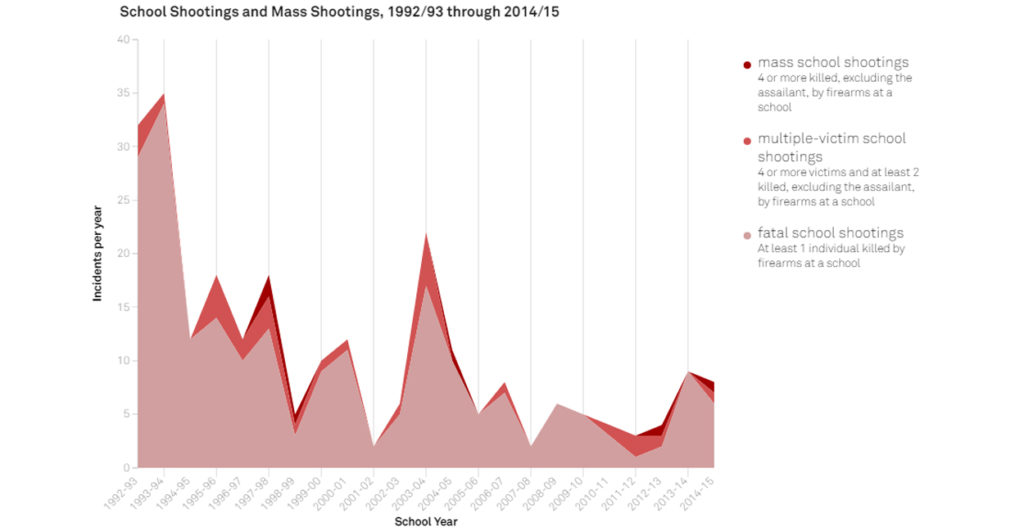
According to a new study, school shootings have declined since the early 1990s. “There is not an epidemic of school shootings,” said James Alan Fox, a professor of criminology, law, and public policy at Northeastern University.
     “The thing to remember is that these are extremely rare events, and no matter what you can come up with to prevent it, the shooter will have a workaround,” Fox also said.

“The Three R’s of School Shootings: Risk, Readiness, and Response” is a new study that dives into the numbers of mass shootings at schools in the United States. According to the Northeastern News write-up of study, four times the number of children were killed in schools in the early 1990s than [are] today, Fox said.”
     The study defines a “multiple victim” shooting as having at least four victims and at least two deaths, not including the assailant. Since 1996, there have been 16 multiple victim shootings. Of those, eight were mass shootings—which involve four or more deaths, excluding the assailant.
(Photo: Wiley/Blackwell Publishers)

Authors of the study suggested that school intruder drills, requiring ID cards for entry, and metal detectors have been largely ineffective.
     “[School intruder drills] just serve to alarm students and make them think it’s something that’s common,” said Emma Fridel, a doctoral student who helped write the study with Fox.
     As for metal detectors, a school shooter in Minnesota killed the guard at the entryway of the metal detector in 2005 and another shooter killed and injured children on a playground rather than entering the school in 1989. In 1998, two students pulled the fire alarm and shot students as they exited the school.

Increasing mental health resources could possibly help deter mass shooting, Fridel suggested, pointing out the high student-to-student counselor ratio.
     “You might have students in a very large school who are troubled but who are basically flying under the radar because you have one guidance counselor for 400 students,” she said.

“Notwithstanding the occasional multiple-fatality shooting that takes place at one of the 100,000 public schools across America, the nation’s schools are safe. Over the past quarter-century, on average about 10 students are slain in school shootings annually,” wrote Fox for USA Today earlier this month. “Compare the school fatality rate with the more than 100 school-age children accidentally killed each year riding their bikes or walking to school.

The data Fox and Fridel utilized came from the FBI, Gun Violence Archive, Congressional Research Service, and others.

[italics, and colored emphasis mine]