Sunday, May 24, 2015

# 1238 (5/24) SUNDAY SPECIAL: "Is the Atheist Population Skyrocketing?"

"IS THE ATHEIST POPULATION SKYROCKETING?" - Jerry Newcombe | May 20, 2015;http://townhall.com/columnists/jerrynewcombe/2015/05/20/is-the-atheist-population-skyrocketing-n2001747/page/full [AS I SEE IT: It was easy as a Christian to be discourged byar the results of a recent Pew Research study on religion in America. But in this article (and the ones listed afterwards) we are reminded that the mainstream media tends to interpret things in a way that fits their worldview and not necessarily tells the whole story. Also, I appreciate the perspective of Dr. Moore in the second article that follows. Be encouraged! - Stan]

Will the last true Christian in America please turn out the lights on the way out? A recent study on religion and America that has received much attention has been interpreted by some to indicate that Christianity is on its virtual deathbed. But as the saying goes, “The good news is the bad news is wrong.”

     The study comes from the respected Pew Research Center: “America’s Changing Religious Landscape” (5/12/15). The subtitle is: “Christians Decline Sharply as Share of Population; Unaffiliated and Other Faiths Continue to Grow.” They note that as recently as 2007, nearly eight in 10 Americans identify themselves as Christians; whereas today, that number is down to about seven in 10. Liberal mainline Protestants are losing the largest numbers; the number of self-identifying Catholics has also shrunk somewhat. Evangelicals are basically holding their own. Certainly, the church in all its branches has its work cut out for it.

    But the biggest shocker is what we could call the rise of the “nones”: “Over the same period, the percentage of Americans who are religiously unaffiliated---describing themselves as atheist, agnostic or ‘nothing in particular’---has jumped more than six points, from 16.1% to 22.8%.” This includes many young people who are part of the “nones.”

     Dr. Byron Johnson, a great researcher who often works with Gallup on the subject of religion in America, cautions us on the interpretation of the data. The author of the book, "More God, Less Crime," Johnson teaches at Baylor and has taught at the University of Pennsylvania and Princeton.
I asked Dr. Johnson about the new study, especially about the rise of the “nones.” He said, “Don’t be fooled, Jerry. We have some of the world’s top religion scholars doing social science research. We publish books and scientific articles in peer-reviewed journals---the other side doesn’t do either.”

      In a recent radio interview I did with him, Dr. Johnson made some fascinating remarks on the perceived decline of Christianity in America and the rise of the “nones.” He said, “There are these ongoing reports by the media that indicates religion is declining. Most of the secular media is looking for something that shows that religion is declining…so that’s why you hear all these reports about the growth of atheism.”

     For example, says Johnson: “In one of their recent studies, Pew found that 44 percent of Americans are not affiliated with the religious tradition/denomination in which they were raised. That finding was interpreted to mean that 44 percent of Americans had abandoned the faith. But this simply acknowledges that Americans shop around in a highly competitive religious economy---looking for the best product. It’s a sign of religion’s vitality not a sign of leaving faith behind. “

    He added, “Much to the chagrin of most of the media, atheism has remained flat for over seven decades. Four percent of Americans fall into that category. It hasn’t changed. If atheism were on the rise, it would be such a phenomenal story. But instead, since it isn’t, they have to do what they can to make us believe that it is.” But he cautioned, “You’d be blind not to know we have a secular society. But the reality is we have a religious society as well. It’s very vibrant.

     I asked him about the “nones” and their significant growth in recent times. He answered: “There are a number of people who would mark ‘none,’ n-o-n-e, on a survey, and two or three questions later will give you the name and address of a place [house of worship] they regularly attend, and guess what? Almost all of these are non-denominational, evangelical churches. I’m not saying all of the ‘nones’ are evangelical.” But many of them are.

     Here’s the rub: Are all the “nones” (or even a majority of them) atheists? No, says Johnson: “The ‘nones’ have been equated with atheism. That’s what’s really going on here. The number of ‘nones’ is growing, and it is true. But what I’m saying to you is that when you unpackage it, it looks completely different.” In other words, the recently released report is being interpreted by some to indicate that America is becoming more atheistic because of the increase of those who list no religious identification. He said that’s where interpreters of the Pew study are in error.

     Meanwhile, how many evangelicals are in the country at present? Using a three-fold criterion to define an evangelical (i.e., one who has accepted Jesus as Savior, believes in the authority of the Bible, and shares the faith), Johnson says based on years of his surveying, there are about 100 million. “That’s a huge, huge category.”

All this reminds me of the Mark Twain line: "The rumors of my death have been greatly exaggerated."

Dr. Jerry Newcombe is a key archivist of the D. James Kennedy Legacy Library and a Christian TV producer.

"Is Christianity Really Dying in America?"CBNNews.com, May 15, 2015;
http://www.cbn.com/cbnnews/us/2015/May/Is-Christianity-Really-Dying-in-America/
     A recent survey by the Pew Research Center shows the number of people who call themselves Christians is at all-time low, while those who profess no religious affiliation is at an all-time high.
The mainstream media is reporting the story as if it's the end of Christianity. But Dr. Russell Moore, with the Southern Baptist Convention's Ethics and Religious Liberty Commission, has a different perspective.
     "We do not have more atheists in America today than in previous generations. We simply have more honest atheists in America," he wrote on his blog recently. Despite the rise in those who don't believe, Moore said the study actually reveals hope for the faith.

"Christianity isn't normal anymore. It never should have been. The increasing strangeness of Christianity might be bad news for America, but it's good news for the Church," he wrote. "The Bible Belt may fall. So be it. Christianity emerged from a Roman Empire hostile to the core to the idea of a crucified and resurrected Messiah," he said. "We've been on the wrong side of history since Rome, and it was enough to turn the world upside down."

[bold and italics emphasis mine]

"How to Share Christianity in an Age of No Faith" -  May 13, 2015;
http://www.cbn.com/cbnnews/us/2015/May/Changing-Landscape-Non-Religion-Taking-Hold-in-US/
"Post-Christian Era? The Future of Faith in America" - By Paul Strand, April 29, 2013;
http://www.cbn.com/cbnnews/us/2013/January/Post-Christian-Era-The-Future-of-Faith-in-America/

Saturday, May 23, 2015

#1237 (5/23) "American College of Pediatricians Confirms Abortion-Breast Cancer Link..."

"AMERICAN COLLEGE OF PEDIATRITICANS CONFIRMS ABORTION-BREAST CANCER LINK: 'Not Merely Correlational' ”- Brad Mattes / Apr. 24, 2015 | http://www.lifenews.com/2015/04/24/american-college-of-pediatricians-confirms-abortion-breast-cancer-link-not-merely-correlational/
breastcancer
Breast cancer. Two of the scariest words a woman can hear.

You’d think people who claim to advocate for women would do everything possible to educate them about their risks. You’d think they’d offer all the information and all the research.But the abortion industry has a vested interest in making sure women don’t hear about the link between abortion and breast cancer. In fact, they deny it exists, even in the face of another medical entity warning young girls of the risk.

Earlier this month, after considering research, the American College of Pediatricians firmly reiterated its stand on the abortion and breast cancer (ABC) link. The president of the College flatly stated, “When one considers the normal anatomy and physiology of the breast it becomes clear that this link is causal not merely correlational.”

Here’s the link in a nutshell: before pregnancy, lobules in the breast are immature and undifferentiated—not yet milk-producing cells. Days after conception, though, estrogen levels start rising, triggering changes. By the end of the first trimester, estrogen is up by 2,000 percent. By 20 weeks into pregnancy, lobules have increased so much that breast volume doubles. In the last 20 weeks, the lobules mature until they can produce milk. At 40 weeks, 85 percent of the lobules have differentiated and matured into Type 4 cells, known to be more cancer-resistant.

The exposure of immature lobules to estrogen is when they’re quickly growing and changing. It’s at this time they’re most vulnerable to breast cancer. If a woman has an abortion before 32 weeks, her lobules and ducts have increased and been exposed to an estrogen bombardment, but they never get the chance to mature into the protective Type 3s and 4s. She only has more Type 1s and Type 2s—more places for cancer to form.

Metastatic breast cancer is on the rise in the US among women ages 25 to 39. And it’s not just here: other countries where abortion has increased also show a rise in breast cancer. Studies also show that risk increases with every subsequent abortion, as the lobules are stimulated again and again with estrogen but never allowed to mature. Learn more about the ABC link on our website.[http://www.lifeissues.org/category/abortion/abortion-cancer/]

Both Planned Parenthood and—amazingly—Susan G. Komen for the Cure deny the link. Planned Parenthood calls it a myth. Planned Parenthood and Komen don’t have any trouble talking about other risk factors for breast cancer. But they won’t talk about abortion. Planned Parenthood starts its explanation by smearing those who do want women to have full information. Komen lumps abortion right up there with “left-handedness” as a non-factor.

Komen’s recent experience with Planned Parenthood’s mafia thuggery explains why they deny the ABC link. But Planned Parenthood’s zeal for all things abortion is understood by the millions of dollars they rake in by committing abortions.

Imagine the loss of income to Planned Parenthood should the truth about the ABC link be widely known. Killing babies is their cash cow and they’ll protect it at all costs, even when Komen gets in the way. It’s not about safeguarding the health of women. It’s all about the money.

Each year thousands more are diagnosed with those two frightening words, “breast cancer.” Imagine the number of women who could be spared this horrible and often deadly experience if the abortion industry would come clean and stop putting ideology over the lives of countless women. Sounds like a real war on women, if you ask me.

Begin helping women today. Get informed and then share your life-saving knowledge with others. We’re on the side of more information to empower women. You can read the College’s full statement here.[http://www.acpeds.org/the-college-speaks/position-statements/health-issues/abortion-and-the-risk-of-breast-cancer-information-for-the-adolescent-woman-and-her-parents]

[bold and italics emphasis mine]

LifeNews.com Note: Bradley Mattes is the executive director of Life Issues Institute.

Friday, May 22, 2015

#1166 (5/22) "Debunking Global Warming Claims..."

"DEBUNKING GLOBAL WARMING CLAIMS:National Security Concerns and Shrinking Glaciers" - February 18, 2015; http://www.ncpa.org/sub/dpd/index.php?Article_ID=25377&utm_source=newsletter&utm_medium=email&utm_campaign=DPD [AS I SEE IT: Recently, President Obama was at it again, declaring in a commencement speech that climate change (ie, the latest term for "global warming") is the greatest threat facing America. When the leader of the free world doesn't even recognize who or what is and what isn't a danger to America, it emphasizes just how much danger we all face from our true enemies. - Stan]

Many of the claims made by environmentalists about the catastrophic effects of global warming have failed to transpire.  James Taylor, senior fellow at the Heartland Institute, dispels some of the most outrageous in a recent Forbes article.  Two claims seem particularly egregious and worthy of refutation: first, that global warming threatens national security and second, that global warming is causing glaciers to shrink.

President Obama himself said climate change posed "immediate risks to our national security" in his January State of the Union speech, a claim echoed by many environmentalists who believe global warming will cause instability in already unstable regions by creating weather such as droughts and natural disasters that could endanger food supplies, ultimately leading to resource shortages, mass migrations and conflict. Taylor says the claim is faulty:

Is global warming really causing a reduction in food and water? No. In fact, warming has promoted rather than damaged crop production -- it has lengthened the growing season, and higher concentrations of carbon dioxide have increased crop yields.

Water, too, is safe: soil moisture has improved, and the earth has seen more precipitation due to warming temperatures.

As for concerns about shrinking glaciers, the claim is equally misleading. In fact, Taylor says the Antarctic Ice Sheet has grown steadily since the government first began measuring it in 1979, despite that icebergs have broken off of it. While environmentalists point to an iceberg ("larger than the city of Chicago") that broke away from the Pine Island Glacier (part of the West Antarctic Ice Sheet) in 2013, Taylor says the Antarctic Ice Sheet actually set a record that year for being more extensive than any time in recorded history, and it grew even larger in 2014.

Additionally, environmentalists will contend that Montana's Glacier National Park has seen a reduction in glaciers from 150 to 35 over the last 100 years. Again, Taylor says that's entirely misleading: those glaciers have been receding for over 300 years, well before the rise of SUVs or coal-fired power plants.

[To read the rest of Taylor's debunking of global warming myths, go to the website noted below.]

[bold and italics emphasis mine]

Source: James Taylor, "Top 10 Global Warming Lies That May Shock You," Forbes.com, February 9, 2015. http://www.forbes.com/sites/jamestaylor/2015/02/09/top-10-global-warming-lies-that-may-shock-you/
-------------------------------------------------------------------------------
"Fix, Don't Raise The Gas Tax" - by James Taylor, 1/09/2015; http://www.forbes.com/sites/jamestaylor/2015/01/09/fix-dont-hike-the-gasoline-tax/

"Wind Power Is Not Economically Feasible" - March 25, 2015; http://www.ncpa.org/sub/dpd/index.php?Article_ID=25492&utm_source=newsletter&utm_medium=email&utm_campaign=DPD

"The Cost of the Renewable Fuel Standard to Motorists" - March 16, 2015; http://www.ncpa.org/sub/dpd/index.php?Article_ID=25460&utm_source=newsletter&utm_medium=email&utm_campaign=DPD

Thursday, May 21, 2015

#1236 (5/21) "How Government Debt Disinherited the Next Generation…and How To Fix It"

"HOW GOVERNMENT DEBT DISINHERITED THE NEXT GENERATION...AND HOW TO FIX IT" - Diana Furchtgott-Roth, Jared Meyer| 05/12/2015 | http://www.economics21.org/commentary/government-debt-disinherited-millennials-aca-regulation-05-12-2015 (This article originally appeared in The Fiscal Times. It is adapted from "Disinherited: How Washington Is Betraying America’s Young.")[AS I SEE IT: It concerns me that thus far 2 "conservatives" who may be candidates for President next year have recently said that they will "not touch entitlements." In light of what is shared in this article - which I have to believe every conservative (yes, even every liberal) in our government knows is true - such statements are clearly self-serving and not realistic. If Americans have any hope of turning the tide of our growing national debt, we need leaders who are committed to be REAL with us. - Stan]

    Burdened with an obligation to pay government debt they did not incur, young Americans – those born between the early 1980s and the beginning of the 21stcentury, or millennials – begin life at least partially robbed of their birthright. This is the first generation of young Americans that our government systemically disfavors and the first generation whose prospects are lower than those of their parents.
    Their parents and grandparents, beneficiaries of the New Deal and Great Society programs that are bankrupting America, never intended this. They are deeply concerned that their children and grandchildren cannot find jobs and are facing a future of decreased opportunity. They never anticipated their comforts would come at the expense of their progeny.

What can be done to create a system that’s more fair and sustainable?
      Mary Parrilli, now in her twenties and living outside of Chicago, told us, “I am outraged. We have been scammed, end of story. I do not expect to get back any of the money I am paying into Social Security – to me, it’s just another tax. I think people should help the elderly, especially their own family, but it is immoral for the government to force this on us. This is a perfect example of punishing the young and the successful and rewarding the irresponsible.”
      Increasingly devastating fiscal conditions are being handed to our nation’s youth. Every Social Security and Medicare Trustees Report and every Budget Outlook from the nonpartisan Congressional Budget Office shows fiscal deficits far into the future. These deficits drive the national debt even higher and someday the bill will come due. Only substantial tax increases or spending cuts will solve the problem – and judging by the current political climate, these aren’t coming any time soon.
      Because of automatic entitlement spending, Congress is unable to balance the budget without taking direct action to rein in the growth of these programs. To make matters worse, spending in 2009 was $3.5 trillion and revenue was $2.1 trillion, leaving a deficit of $1.4 trillion. Seven years from now, the deficit is expected to surpass $1 trillion again and continue rising after that. This will leave debt held by the public at more than 79 percent of GDP in 2024, compared with about 73 percent now.
     The Affordable Care Act has also raised health insurance premiums for young Americans and lowered them for middle-aged and older people. Young, healthy Americans are, in effect, required to pay for the health care of older Americans. Yet Washington has added to it by raising the cost of insurance for millennials and lowering it for their parents.
    Young people also encounter an education system that bankrupts them and leaves them far behind their peers in other countries. When young people leave school, they face a hostile job market littered with government regulations. These problems are systematic – and only a radical shift in politics and the policies they produce can turn the tide.

Why do politicians refuse to respond to the mistreatment of so many young Americans? Why is it so difficult to alter the egregious policies that keep young people unemployed, uneducated, and liable for trillions of dollars in unfunded promises?
     In Washington, D.C., and in state capitals around the country, entrenched interests protect the old, who have had the time and resources to build up a powerful political apparatus. Washington dare not take on the American Association of Retired Persons, one of the largest interest groups in the country, and change the unsustainable trajectory of entitlement programs.
    Rather than modify Social Security to defend its solvency, AARP chose to protect generous benefits for today’s retirees and disregard the future. (AARP spent $25 million on lobbying in the 2012 presidential election cycle and more than $16 million in the 2014 midterm election cycle. Based on money spent, AARP consistently ranks in the top 1 percent of organizations tracked by the Center for Responsive Politics.)
    Medicare, which will become insolvent sooner than Social Security, is defended by its own interest groups, such as the National Committee to Preserve Social Security and Medicare. The committee is rated has a “heavy hitter” in terms of political spending and one of the largest donors to federal elections since 1990.
    At the state level, public sector unions keep in place defined benefit pension plans that promise generous payouts to today’s retirees at everyone else’s expense. While union bosses are free to negotiate favorable contract terms with the politicians they bankroll, critical parties are left out – taxpayers and those who will be responsible for paying unfunded liabilities in the future.
    Many other interest groups lobby for policies that harm people, such as minimum wage hikes and other labor-market regulators that prevent the unskilled from entering the job market. Occupational licensing laws stay in play thanks to the efforts of those who already hold those licenses and want to defend their favored positions. Teachers’ unions protect the jobs of poor educators and stand in the way of meaningful education reforms that would greatly benefit students and younger, more effective teachers.
    Proportionately, the young do not vote. “Our generation has grown up with full acceptance of crushing national debt,” one frustrated 25-year-old told us. “We might not care as much as we should because we have never known life without it.” Two thirds of millennials perceive government to be inefficient and wasteful.

How can we change Washington’s direction to paint a brighter future for America’s next generation? Certain programs must be reformed; certain laws must be changed or repealed. The steps we must take are not politically easy – but each is necessary. Here are some of the most vital:
    --Congress must examine its spending every year and cut out waste, such as redundant, ineffective job-training programs, government-guaranteed loans to politically connected companies, and costly subsidies to favored industries.
    --Cutting back on government regulations that do little more than increase the size of bureaucracies and protect politically connected interests should be a bipartisan priority.
    --Enacting long-term reforms to entitlement programs to make them sustainable is necessary. Congress should vote on every dollar spent, every year. While it would make the budgeting process larger and more complicated, it would restore accountability and force Washington to make tough choices.
    --Gradually raising the retirement age for collecting Social Security benefits makes sense as people live longer. It’s unwise to provide full retirement at age 67 for those born after 1990. Raising the retirement age will also take away federal disincentives that discourage people from working longer. More work benefits the economy – leading to economic growth. Additionally, Social Security benefit increases should be pegged to the price level in the economy rather than wage level. What a person needs to live, not what other people make, should determine payouts.
    --Reforming the Affordable Care Act, starting with modified community ratings that prevent insurance companies from charging older people more than three times as much as younger ones, and the employer mandate penalty. The effort to extend coverage to the uninsured is admirable, but requiring employers to provide the insurance or pay a fine is not an integral component of ACA. American health care policy should harness the power of competition by repealing burdensome laws such as the ban on buying insurance across state lines and the preferential tax treatment given to employer-sponsored health plans.

America’s problems have solutions. We need a joint effort from the young and old to force politicians to discuss the issues and begin implementing solutions. Older Americans do not want to pass a future of higher taxes on to their grandchildren and great-grandchildren. They want solutions as much as anyone else.

[bold, italics, and colored emphasis mine]

Diana Furchtgott-Roth is director of Economics21 at the Manhattan Institute and Jared Meyer is a fellow at the Manhattan Institute. They are the coauthors of “Disinherited: How Washington Is Betraying America’s Young.” Follow Diana on Twitter @FurchtgottRoth and Jared @JaredMeyer10.

Wednesday, May 20, 2015

# 1235 (5/20) "You Gotta Have a Purpose..."

"YOU GOTTA HAVE A PURPOSE - START BY ASKING THE RIGHT QUESTIONS"
By: John Stonestreet| Breakpoint.org: May 19, 2015;
http://www.breakpoint.org/bpcommentaries/entry/13/27384?spMailingID=11417245&spUserID=MTMyMjM2ODE5OQS2&spJobID=541210406&spReportId=NTQxMjEwNDA2S0
daily_commentary_05_19_15
Want to start an argument? Bring up religion or politics. Want to start a thoughtful discussion? Mention purpose!

New York Times columnist David Brooks, who was one of Chuck Colson’s favorites, has a new column that I think Chuck would have loved. Brooks, who is on a tour promoting his new book, “The Road to Character,” says that people he meets are searching for purpose. “They feel a hunger to live meaningfully,” he writes, “but they don’t know the right questions to ask, the right vocabulary to use, the right place to look or even if there are ultimate answers at all. I find there is an amazing hunger to shift the conversation. People are ready to talk a little less about how to do things and to talk a little more about why ultimately they are doing them.

A generation or two ago, Brooks says, there were lots of public authority figures talking about why—some of them good, others not so much. Theologian Reinhold Niebuhr and Rabbi Abraham Joshua Heschel were household names. Author Harry Emerson Fosdick and philosophers Hannah Arendt and Jean-Paul Sartre led very public discussions on the meaning of existence or the nature of evil. And Brooks forgot to mention Billy Graham! Back then there was an appetite for street-level philosophy—and maybe there still is.

Also, schools back then were more than job training programs. There was a coherence to the educational process that, as Neil Postman wrote about a few decades ago, has been replaced by the acquisition of skills. So education no longer pursues a purposeful vision, it pursues a career alone.

This is largely the result of knowledge becoming ever more specialized. “Intellectual prestige,” Brooks writes, “has drifted away from theologians, poets and philosophers, and toward neuroscientists, economists, evolutionary biologists and big data analysts. These scholars have a lot of knowledge to bring, but they’re not in the business of offering wisdom on the ultimate questions.”

Chuck Colson used to ask four “ultimate” or “worldview” questions, critical tools that we can use in searching for purpose. Question one: Where did I come from?  Two: What’s wrong with the world? Three: Is there a solution? And Four: What is my purpose? As Vaclev Havel observed, it’s not that we aren’t finding answers to these questions. It’s that these questions are no longer being asked.

Of course, questions about purpose can only be answered in the One who purposed us. As Augustine said, “You have made us for yourself, O God, and our hearts are restless until they find their rest in you.”

Our hearts certainly won’t find rest in money. Gallup did a survey of 132 countries and found those with lower per capita economic output actually had higher rankings for meaning. And generally lower suicide rates, too. Why, when so many of us in the West equate wealth with happiness? Well, it turns out those countries are more religious, giving people a sense of purpose. Even among wealthier countries where religion plays a more prominent role in people’s lives, we report higher levels of meaning. 

Increasing numbers of Americans, of course, are going outside of organized religion, seeking to construct their own meaning. Yet those self-made answers rarely quiet our restless hearts. As Pascal said, “It is in vain, oh men, that you seek within yourselves the cure for all your miseries. All your insight has led to the knowledge that it is not in yourselves that you discover the true and the good.”

The Christian worldview, based on biblical revelation, answers all four of Chuck’s questions, explains both our human dignity and our depravity, and points us to a fixed reference point by which we can orient our lives: God Himself. “Man’s chief end,” the Westminster Shorter Catechism states, “is to glorify God and to enjoy Him forever.”

Come to BreakPoint.org and click on this commentary. We’ll link you to resources that will help you, your children, and your searching neighbors connect with God’s grand purpose for our lives—and His grand purpose for all of creation—which, by the way, is the subject of my new book with Warren Smith entitled, “Restoring All Things: God’s Audacious Plan for Changing the World through Everyday People.” Again, check it all out at BreakPoint.org.

[bold and italics emphasis mine]

RESOURCES
"What is Your Purpose?" - David Brooks | New York Times | May 5, 2015; http://www.nytimes.com/2015/05/05/opinion/david-brooks-what-is-your-purpose.html?_r=1
"The Issue Is Truth" - Chuck Colson | BreakPoint.org | July 25, 2003;http://www.breakpoint.org/bpcommentaries/breakpoint-commentaries-search/entry/13/12206
"Answering before They Ask" - Mark Earley | BreakPoint.org | August 20, 2003;http://www.breakpoint.org/bpcommentaries/breakpoint-commentaries-search/entry/13/12264
AVAILABLE AT THE ONLINE BOOKSTORE
Restoring All Things: God's Audacious Plan to Change the World Through Everyday People
John Stonestreet, Warren Smith | Baker Books | May 2015
How Now Shall We Live? -Chuck Colson, Nancy Pearcey | Tyndale House Publishers | August 1999
Making Sense of Worldviews with John Stonestreet, CD - John Stonestreet | Colson Center
Wide Angle: Framing Your Worldview DVD - Chuck Colson, Rick Warren | Colson Center
Wide Angle: Framing Your Worldview Small Group Study Guide
Chuck Colson, Rick Warren | Colson Center
Rewired: A Teen Worldview Curriculum, book and CD - Prison Fellowship & Teen Mania
Worldview and Why It Matters Leadership Training Course DVD -Chuck Colson, Glenn Sunshine, T.M. Moore | Colson Center

Tuesday, May 19, 2015

# 1234 (5/19) "Unraveling the Poverty Myths Obama Is Promoting"

"UNRAVELING THE POVERTY MYTHS OBAMA IS PROMOTING"Stephen Moore/ @StephenMoore / May 18, 2015 / http://dailysignal.com/2015/05/18/unraveling-the-poverty-myths-obama-is-promoting/

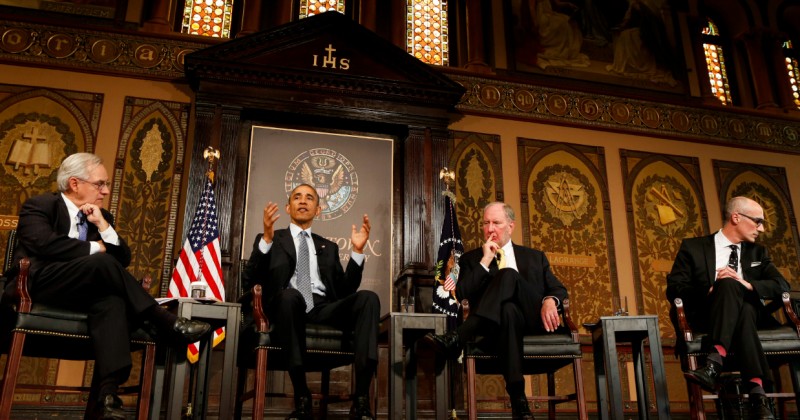
President Obama participates in a panel discussion during the Catholic-Evangelical Leadership Summit on overcoming poverty at Georgetown University. (Photo: Aude Guerrucci/CNP/AdMedia/Newscom)

Our class warrior in chief was at it again last week complaining about our “ideological divides that have prevented us from making progress” in solving problems like poverty. Just when you thought you’d heard it all.

Our most ideological president perhaps ever is arguing that there is too much ideology in Washington. Wow. Apparently an ideology is a firmly held belief that is held by other people—especially those on the right. In a discussion on poverty at Georgetown University, the president managed to blame the slow-growth economy and stagnant wages on everything from Ayn Rand (who promoted “cold hearted policies” and classified everyone as a “moocher”) to California’s Proposition 13 (which is responsible for the Golden State’s dreadful schools). Everything has contributed to our current malaise except for his own failed policies.

Here’s a brief truth squad examination of Obama’s mythologies and misstatements of fact.

[1] President Obama: “The stereotype is that you’ve got folks on the left who just want to pour more money into social programs, and don’t care anything about culture or parenting or family structures … ” After more than $22 trillion spent on the War on Poverty since 1964 (in inflation adjusted dollars)—how is it a stereotype to say the left only wants to pour money at programs? This official poverty rate has remained virtually stagnant since the War on Poverty began.

Just a few weeks ago the president blamed the Baltimore riots on Republicans for not spending and borrowing even more money on his social programs. He sounded like a parody of himself.
      If the left really wants to advance cultural values like work, why do they oppose reforms to a welfare system that requires able-bodied adult Americans to work in exchange for receiving welfare benefits like food stamps?

[2] Obama: “It is a mistake for us to suggest that somehow every effort we make has failed and we are powerless to address poverty. That’s just not true. First of all, just in absolute terms, the poverty rate when you take into account tax and transfer programs, has been reduced about 40 percent since 1967.” 
     There are two problems with this defense of the welfare state. First, the official poverty was falling before 1965 and at a faster rate than after the Great Society got rolling in the mid-1960s.This official poverty rate has remained virtually stagnant since the War on Poverty began.
     Second, the decline in poverty that Obama is boasting about is only after taking into account tax credits and government handouts and welfare benefits. When excluding these programs there has been little progress at all.
     Redistribution may have raised the material living standards of some of the poor. But it has not increased self-sufficiency. The original purpose of the welfare state was to lift people into self-sufficiency, not to create a permanent underclass dependent on taxpayers. Lyndon Johnson told us when he started these programs that “the days of the dole are numbered.” We have passed day 18,000.
    Obama also wants it both ways. He says over and over, even in this speech, that the biggest problem with the economy is income inequality because the rich are getting richer and the poor poorer. So if the poor are getting poorer, how have his social programs worked to reduce poverty?

[3] Obama: “In some ways, rather than soften the edges of the market, we’ve turbocharged it.” Wait, we’ve turbo-charged the free market? When? Where?

[4] Obama: “There are programs that work to provide ladders of opportunity … but we just haven’t figured out how to scale them up.”
     Hold on. One of the few programs that has proven to provide “a ladder of opportunity” is the Washington D.C. Opportunity Scholarship Program for roughly 1,500 kids each year to attend private schools. They are all poor and almost all black. The graduation rates for these kids have improved in some cases markedly. But guess who doesn’t want to “scale up” this successful program (which is, by the way, one of the few programs that would actually be appropriate for the federal government to scale up)? In every budget Obama has submitted, he has proposed eliminating the program.
      It’s more than a little hypocritical for a president who sends his own daughters to private schools that cost $30,000 a year to prevent poor children in Washington, D.C., from attending those same schools.

[5] Obama: “And so over time, families frayed. Men who could not get jobs left. Mothers who are single are not able to read as much to their kids.”
     The president acts as though “families frayed” by accident. No, there were major cultural shifts that contributed to the major decline in marriage and rise in unwed births, not to mention the introduction of a massive government welfare system that financially took the place of the father.
     In 1960, not even one in four black children were born without a father in the home. By 2013 that number had soared, tragically, to nearly three of every four black children being born outside of marriage. As economist Thomas Sowell has put it: “the black family survived centuries of slavery and generations of Jim Crow, but it disintegrated in the wake of the liberals’ expansion of the welfare state.”

[6] Obama: “You look at state budgets, you look at city budgets, and you look at federal budgets, and we don’t make those same common investments that we used to. … And there’s been a very specific ideological push not to make those investments.”
    In 1950 total state, local and federal government spending was just over $500 billion (in constant 2015 dollars) and 22.2 percent of our GDP. Today it is nearly $6 trillion and 33 percent of our GDP. Under Obama federal spending will reach $4 trillion next year and borrowing to finance these “common investments” will have risen by $8 trillion over his tenure.

The only thing that has been underfunded over the last decade is middle-class family incomes, which have stagnated.

[7] Obama: “We don’t dispute that the free market is the greatest producer of wealth in history—it has lifted billions of people out of poverty. We believe in property rights, rule of law, so forth.”
    No, you don’t. And that’s the whole problem.

[bold, italics, and colored emphasis mine]

Stephen Moore, who formerly wrote on the economy and public policy for The Wall Street Journal, is a distinguished visiting fellow for the Project for Economic Growth at The Heritage Foundation. Read his research.

"On Poverty, President Shows Poor Judgment" - Tony Perkins, Washington Update, May 13, 2015; http://www.frc.org/washingtonupdate/20150513/on-poverty
     "...Anyone involved in faith-based ministry must have needed a strap to pick their jaws up off the floor. This President is accusing the church -- the most effective social outreach program in the history of America -- of ignoring the poor to fight a war on social issues that, oh by the way, he started? That's not only ignorant of the church's activities -- it's insulting. The religious community hasn't ignored the poor. On the contrary, there's no more generous segment of society than Christian conservatives and the ministries that their giving makes possible..."

Monday, May 18, 2015

#1233 (5/18) "Regs to Riches?"/"Obama Administration’s Regulations Cost Americans $80 Billion a Year"

"REGS TO RICHES?" - Tony Perkins, Washington Update, May 12, 2015; 
http://www.frc.org/updatearticle/20150512/regs-riches

If you can't legislate -- regulate! That's the slogan of the Obama administration, which has apparently been stuffing the rulebooks at government agencies to get its way on everything on health care to greenhouse gases. In its new "Ten Thousand Commandments" report, the Competitive Enterprise Institute counted 3,554 new regulations in 2014 alone. "If U.S. federal regulation was a country, it would be the world's 10th largest!" CEI pointed out. [[http://m.washingtonexaminer.com/report-obama-regs-cost-1.88-trillion-14976-per-house-13rd-of-income/article/2564347]

And those guidelines aren't just oppressive -- they're pricey. Just implementing these changes costs about $1,880,000,000,000 each year. That's some expensive red tape! To put it in perspective, Congress passed 224 new laws in the same time frame -- which gives the Obama administration a 16-1 advantage over actual legislators in directing government activities. And these aren't insignificant changes either. They define things like "marriage" for federal benefits and, as we saw today, "gender" for health care.

Even "progressives" like Matt Schudtz think it's ridiculous that the administration has tried to slip these changes past Americans when nobody's looking. "It's become an unfortunate tradition of this administration," he said of the President trying to accomplish his agenda without following the constitutional process. "Congressional rather than agency approval of regulations and regulatory costs should be the goal of reform," the report's author insisted. "When Congress ensures transparency and disclosure and finally assumes responsibility for growth of the regulatory state, the resulting system will be the one that is fairer and more accountable to voters."

The American people were clear on Election Day that there was no appetite for the President's lawlessness. Seven months later, that hasn't changed! 

[bold and italics emphasis mine]

"OBAMA ADMINISTRATION'S REGULATIONS COST AMERICANS $80 BILLION A YEAR"James Gattuso/ @Jamesgattuso / Diane Katz/ @Dianeskatz / May 16, 2015 / http://dailysignal.com/2015/05/16/obama-administrations-regulations-cost-americans-80-billion-a-year/

(Photo: Miguel Vasconcellos/ZUMAPRESS/Newscom)
What do restaurant menus, refrigerators, community banks and escalators have in common? All were subjected to yet more federal regulation last year.

No fewer than 184 “major” new rules have been imposed since the start of the Obama administration, costing Americans about $80 billion per year in additional regulatory costs. And many more regulations are on the way. Another 126 such rules are on the administration’s agenda, such as directives to farmers for growing and harvesting fruits and vegetables; strict limits on credit access for service members; and another redesign of light bulbs.

A new Heritage Foundation study found that in 2014, red tape entangled virtually every aspect of American life. The largest single area was financial services, which has been inundated with hundreds of new regulations as a result of the 2010 Dodd-Frank law. The full effects of the act have yet to be felt, but its restrictions are already crippling community banks and increasing consumers’ banking costs, while doing little to reduce the threat of bailouts.

Energy use was also a favorite target for regulators last year. New “efficiency” rules imposed on everything from ice cream coolers and cellphone adapters to the electric motors that power escalators.

Regulators say these rules will help consumers and businesses by lowering energy bills. But this “benefit” will likely be offset by higher product costs. Whether energy savings are worth the higher cost of a more efficient item is a decision that consumers and business owners can and should make for themselves. Taking away their choice is not a benefit; it is, in fact, a steep cost.

The U.S. Food and Drug Administration also devised costly new rules intended to control Americans for their own good. For example, the agency issued rules mandating that restaurants and even vending machine operators provide calorie counts for all the food they sell. Alas, as much as the bureaucrats wish they could “nudge” citizens to behave in prescribed ways, such measures rarely turn out as planned. In the case of nutrition labeling, a mountain of research has documented that nutrition labeling does not change eating patterns.

Altogether, Obama administration regulators imposed 27 “major” new rules last year (defined as those that cost the economy at least $100 million annually). Against this were just two actions to decrease regulatory burdens—despite a widely touted “retrospective review” initiative that President Barack Obama claimed would take outdated rules off the books.

Minus these two lonely reductions, the cost of red tape rose by $7.6 billion last year, and a six-year increase of $80 billion. That’s more than twice the cost imposed by President George W. Bush at the same point in his presidency. There was also $1.8 billion in reported one-time implementation costs for the 2014 rules, bringing the administration’s six-year total for such costs to about $17 billion.

And that’s only the costs reported by the regulators themselves. Almost half the time, the rule makers failed to fully quantify the real impact of their dictates and prohibitions.

This represents a major dysfunction in the administrative process. Analyzing costs is necessary to identify the trade-offs inherent in rulemaking, and to determine the most efficient and effective course of action among various alternatives. It is also crucial information that allows the public to hold regulators accountable.

The Obama administration defends its regulatory record by touting the projected benefits of the rules. But benefit estimates—as calculated by the agencies—need to be considered with skepticism. While regulators have an incentive to minimize the costs of regulations, they also have an incentive to misconstrue the benefits.

Absent substantial reform, economic growth and individual freedom will continue to suffer. Immediate changes should include requiring every major regulation to obtain congressional approval before taking effect, and requiring legislation that would increase red tape to undergo an analysis of its likely impacts before being voted on. Sunset deadlines also should be set in law for all major rules, and independent agencies should be subject—as are executive branch agencies—to the White House regulatory review process.

The need for reform of the regulatory system has never been greater. To prevent further harm to the economy, and to the individual liberties of Americans, Congress should take immediate steps to control the flood of red tape.

[bold and italics emphasis mine] (Originally distributed through McClatchy Tribune.)

James Gattuso handles regulatory and telecommunications issues for The Heritage Foundation as a Senior Research Fellow in its Roe Institute for Economic Policy Studies. Read his research.
Diane Katz, who has analyzed and written on public policy issues for more than two decades, is a research fellow in regulatory policy at The Heritage Foundation. Read her research.