Sunday, August 14, 2016

#1680 (8/14) SUNDAY SPECIAL: "The Election and the Judgment of God - AND GOD GAVE THEM OVER'"

"The Election and the Judgment of God - AND GOD GAVE THEM OVER'" - By: John Stonestreet| Breakpoint.org: August 9, 2016;
http://www.breakpoint.org/bpcommentaries/entry/13/29668[AS I SEE IT: I can't but sympathize with this fellow believer in his disappointment and sense of despair regarding the upcoming elections, in particular the contest for the Presidency. And while I agree with his noting that the election of local leaders and the work of the Church may be more significant in the long run, I also believe God can bring us through even leadership that  fails us (just note how He has during these past many years). The consequences of that leadership and any future bad leadership may just be the leadership we deserve, but I believe God is faithful to bring us through such times, whether or not it is his judgement that causes us to be "handed over." He was faithful to Israel to bring her through times of the greatest judgement and He will not fail us no matter how we have failed to bless Him (in contrast to how greatly He has blessed America as a nation). And anyway, I'm not so sure we are necessarily destined to get bad leadership. Maybe we just have not prayed enough for God to change the heart of whoever is elected to lead us. What can happen has still not happened, right? - Stan]
daily_commentary_08_09_16
I suppose you’ve noticed all the gallows humor going on regarding the presidential election. And for good reason. So, have you heard this one? Donald Trump and Hillary Clinton are stranded at sea on a life boat. Who survives? Ha! America does!

Ok, now that I’ve offended everyone: What a bizarre election year this has been. As my BreakPoint this Week co-host Ed Stetzer has said quite a few times, “When political historians look back on the early 21st century, the phrase we’ll hear the most is, ‘except for 2016’.”

Now, despite the dire warnings from both candidates about the consequences of electing their opponent, the most important thing about this election is not who becomes president. The most important thing about this election is what it reveals about us as a society.

Nearly 40 years ago, in a famous speech at Harvard University, the great Aleksandr Solzhenitsyn said: “There are meaningful warnings which history gives a threatened or perishing society. Such are, for instance, the decadence of art, or a lack of great statesmen.”
Talk about prophetic!

Folks, I might as well just say it: I am convinced that this election is an indication that God is judging America. Now claiming to know God’s mind both for what and with what He is bringing judgment is theologically indefensible and only makes us look silly. (You may recall a few notable Christians who stuck their foot in their mouths after 9/11 and Hurricane Katrina). And yet, as Stephen Keillor argued in his book “God’s Judgments,” it is also theologically indefensible to not acknowledge God’s working in history, including through acts of judgment.

And in this case, I am ready to say, God is judging our country. Why? As my colleague Roberto Rivera often says, “The five scariest words in the Bible are, ‘…and God gave them over’.”

The most common way God judges is with the natural consequences of our choices and behavior. This is especially true in politics, which is mostly downstream from – and a reflection of – the broader culture. In other words, especially in our country, we tend to get the leaders we deserve. Which is why this November we should cast our vote with fear, trembling, weeping, praying for mercy, and maybe even while wearing sackcloth and ashes.

Whenever I think of stepping into the voting booth on November 8, I somewhat melodramatically think of Dietrich Bonhoeffer’s Christmas letter:  “One may ask,” he wrote, “whether there have ever before in human history been people  . . . to whom every available alternative seemed equally intolerable, repugnant, and futile…”

Look, I realize that many of my brothers and sisters in Christ have found a level of clarity about the upcoming presidential vote that I have not--perhaps out of resignation or from some political calculations. Perhaps I will too, but until then, I hope there are some things on which we Christians can agree.

First, our deepest problems aren’t political ones, and the state is not able to address them. Looking to the state for hope is always misguided, but every four years we seem to fall for it.

Second, although the presidential race is the only one being talked about, the most important political decisions we will make this year, I'm convinced, will be the local ones. The only thing to mitigate the chaos created by an ever-encroaching federal government convinced of its own indispensability is a stronger local, civil society.

Third, ... the Church must be the Church. Look, the Church is not reliant one bit on the state to do the life-giving, Gospel-proclaiming, brokenness-restoring work God has called it to do. The Church is the most effective institution of social change, period.

And finally, but most important, we pray for God’s mercy. He judges the wicked by leaving them to their own devices. The sooner we abandon those devices and turn back to God, the better.  And, I am not speaking here about “them,” those outside the Church. No way. As Peter wrote in his first epistle, “it’s time for judgment to begin in the house of God.” May God have mercy, but if He brings judgment, so be it.

[bold, italics, and colored emphasis mine]
FURTHER READING AND INFORMATION - As you consider your vote, do pray for the country and for the Church. And remember, we are people of hope, because our hope is in the One who will never leave or forsake us.
Onward: Engaging the Culture Without Losing the Gospel- Russell Moore | B&H Publishing Group| August 2015
Fool’s Talk: Recovering the Art of Christian Persuasion- Os Guinness | IVP Books | July 2015

Saturday, August 13, 2016

#1679 (8/13) PRO-LIFE SAT: "Incredible Photo of Ezekiel, Miscarried at 11 Weeks, Shows Unborn Baby’s Humanity"

"INCREDIBLE PHOTO OF EZEKIEL, MISCARRRIED AT 11 WEEKS,SHOWS UNBORN BABY'S HUMANITY" - Micaiah Bilger, Aug 9, 2016 | http://www.lifenews.com/2016/08/09/incredible-photo-of-ezekiel-miscarried-at-11-weeks-shows-unborn-babys-humanity/
ezekiel
The photo shows a tiny baby in the palm of his mother’s hand, with his facial features already forming. The baby’s tiny arms and legs are folded across his body, showing his tiny fingers and toes.

A Texas baby who was miscarried after just 11 weeks in his mother’s womb is making an impact on people’s lives all across the world.

Tiffany Burns and her husband, James, lost their unborn child to a miscarriage in January. The family was able to see their unborn child’s body after he died; and they named him Ezekiel. A few weeks ago, they decided to share a photo of their baby Ezekiel on Facebook.

Burns said she wanted to share her son’s story to help people realize that his life was valuable. She wrote online: This is my hand. Holding my sweet baby, Ezekiel. I delivered him on January 20, 2016. His heart stopped at 11 weeks 2 days. He had a heartbeat. Such a sweet sound. He had life! He was not a blob. He was not just a clump of cells. He was formed. Perfect. Look at the details. His sweet fingers. Toes. I am blessed to be his mother. He lived to show others life! Please feel free to share his LIFE with others. He’s my sweet little missionary!

Baby Ezekiel’s detailed photo and his story quickly went viral. Thousands of people began sharing it, and an Italian blog even ran a story about him. His mom’s original post now has almost 6,000 shares and 11,000 likes on Facebook. The family received some nasty comments, but most people have encouraged the family.

Ezekiel’s photo and story are making an impact by demonstrating how unborn babies are so much more than blobs of tissue. By 11 weeks, Ezekiel’s age, an unborn baby has already developed to an amazing extent. According to the Endowment for Human Development, the unborn baby’s brain waves can be measured before 11 weeks. Their kidneys begin to produce urine, and their sexual organs are forming. Doctors have observed babies hiccuping at this stage and starting to show a preference for their right or left hand.

Yet, every year, hundreds of thousands of unborn babies die in abortions at this stage of development in the United States. According to the Centers for Disease Control, at least 119,994 unborn babies were aborted between 9 and 13 weeks gestation in 2012.

Stories like the Burns family’s are raising awareness about the value of these unborn children. On Monday, Burns posted a follow-up message about the impact that her son’s story is having across the world:

Friends! Keep praying! Praying for those who have lost, praying for those who are trying to make tough decisions, praying for those who have ended life and are living with a terrible pain, praying for those who do not know Jesus Christ, praying for James Burns and me as we share Ezekiel. …

God is using our sweet Ezekiel in ways I never imagined. I’m receiving comments and personal messages from people all over the world about how his picture is changing hearts and healing. Praise God!! Please keep praying with and for us!! We feel them and He has given us strength to look past the ugly comments. I believe those ppl are hurting. I’m in awe of what God is doing.

[bold, italics, and colored emphasis mine]

Friday, August 12, 2016

#1678 (8/12) "How Other Nations Stop US From Deporting Criminal Illegal Immigrants"

"HOW OTHER NATIONS STOP US FROM DEPORTING CRIMINAL ILLEGAL IMMIGRANTS" - Josh Siegel / July 27, 2016; http://dailysignal.com/2016/07/27/how-other-nations-stop-us-from-deporting-criminal-illegal-immigrants/?

Thousands of illegal immigrants with criminal convictions have been released from custody because they can’t be repatriated to their home countries. (Photo: Peggy Peattie/ZUMA Press/Newscom)

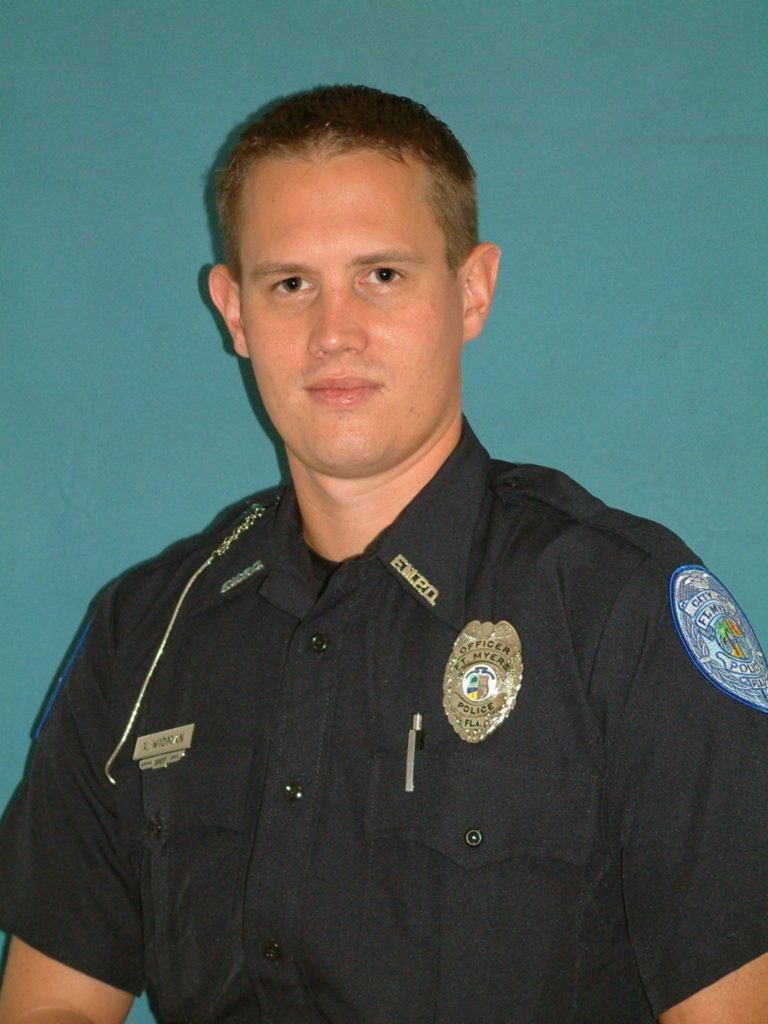
Susanna Ruth Makinson can blame a lot of things for why her then-husband was shot dead eight years ago while patrolling the streets of Fort Myers, Florida, the first time since 1930 a police officer had been gunned down in the city. That’s because, in a distant way out of her—and his—control, Andrew Widman’s death felt preventable; his killer, Abel Arango, was an illegal immigrant and convicted felon who was released from detention because his native Cuba wouldn’t take him back.

But though Makinson wishes the government would do more to fix this little-known problem in the immigration system, to do more to pressure uncooperative countries to accept their citizens who are here illegally and commit crimes, she also has gained a lifetime of perspective raising three kids without their father. “It’s a huge problem that criminals take advantage of; most people don’t know it’s possible for the originating country to decline the person being deported,” Makinson told The Daily Signal in an interview. 
Andrew Widman of the Fort Myers Police Department was killed in the line of duty in July 2008. (Photo: Courtesy of Susanna Ruth Makinson)

Pressure to Do More
     Yet in 2016, the inability to deport criminals continues to frustrate lawmakers, advocates of tougher immigration laws, and families who’ve been victimized by violent offenders. According to Immigration and Customs Enforcement (ICE), an agency of the Department of Homeland Security, thousands of illegal immigrants with criminal convictions have been released from custody—some who’ve committed crimes like assault and murder—because they can’t be repatriated.

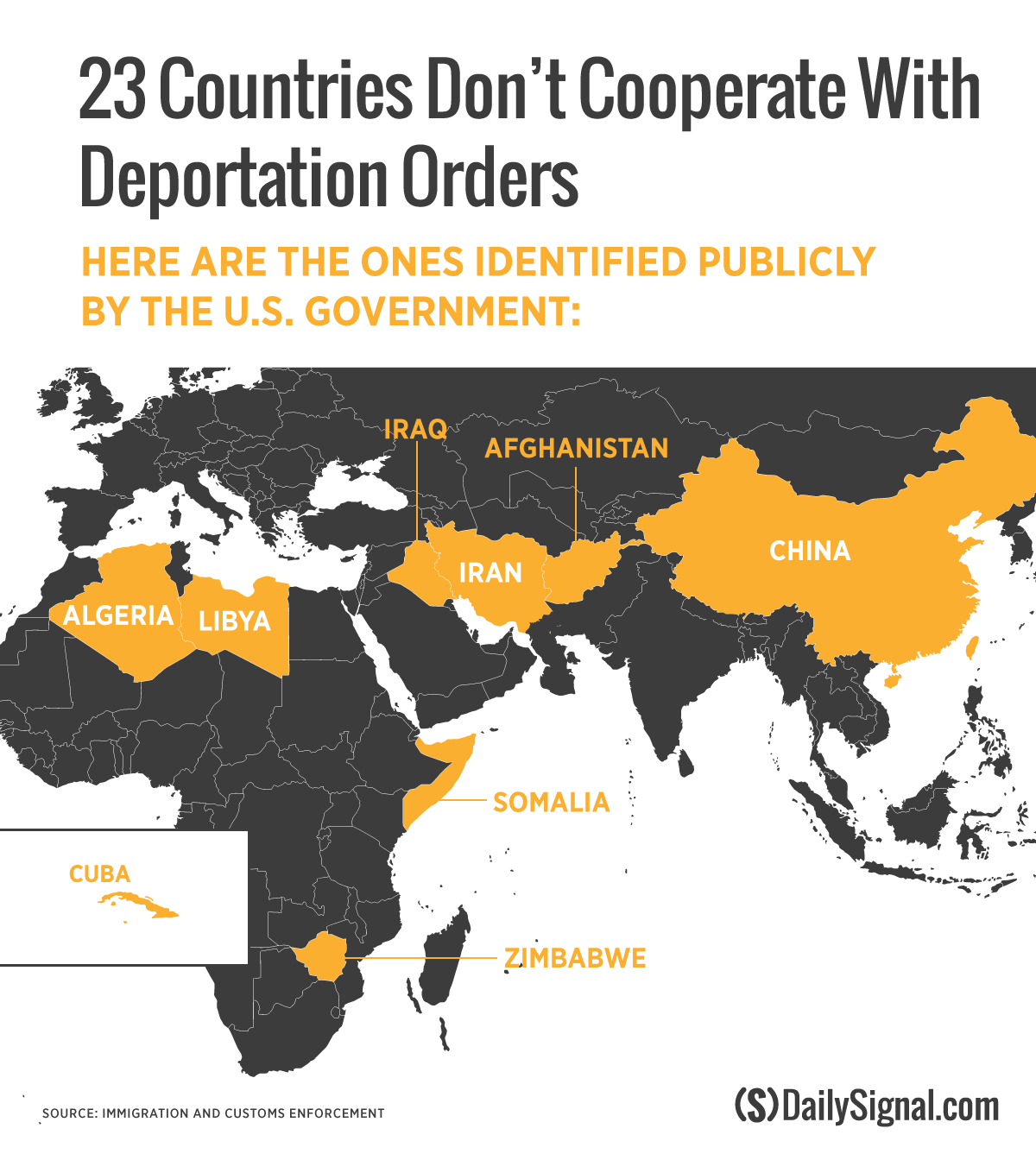
As of May, ICE classified 23 countries, including China, Afghanistan, Iraq, Iran, and Libya, as being “recalcitrant,” or uncooperative. That lists also still includes Cuba, a country with which the Obama administration restored diplomatic relations with last year after five decades of hostility. “We shouldn’t allow other countries to dictate who will be deported from the United States,” said Jessica Vaughan of the Center for Immigration Studies. “The Obama administration has been passive on this and not used the tools Congress has given them to address this problem.”
160728_deportation-map_v3
Deporting illegal immigrants is more complex than simply sending them on a plane home. Like anyone traveling abroad, those destined for deportation need documentation, like a passport. If the native country refuses to issue those papers, the U.S. cannot deport people there.

But critics say the government can be more aggressive in using diplomatic leverage to pressure countries to comply. Under immigration law, the State Department can deny visas to citizens of countries that refuse to repatriate their nationals. The government is reluctant to use this authority, however. A State Department official told The Daily Signal that the government has refused to issue visas to only one nation, in 2001 against the South American nation of Guyana.

“Visa restrictions are not imposed lightly,” the State Department official said. “For many years, we have worked with DHS [Department of Homeland Security] to review the status of each recalcitrant country on a case-by-case basis. We engage at the highest levels to resolve these issues diplomatically when possible, while remaining ready to invoke visa restrictions, as warranted, in consultation with DHS.”

Sen. Chuck Grassley, R-Iowa, who chairs the Judiciary Committee, wrote a letter last month to Homeland Security Secretary Jeh Johnson urging him to work with the State Department to more liberally administer visa sanctions to noncompliant countries. “The Department of Homeland Security and the State Department together have an effective tool to discourage this behavior, and it’s high time they use it,” Grassley told The Daily Signal in an emailed statement. “No other American family should have to endure a tragedy because criminal immigrants are allowed to stay in this country, even if foreign countries won’t take responsibility.” 

In addition, Sen. Richard Blumenthal, D-Conn., plans to introduce legislation to sanction countries that won’t take back their citizens. One of the most egregious crimes occurred in Blumenthal’s state. Last month, Jean Jacques, an illegal immigrant from Haiti, was sentenced to 60 years in prison for murdering Casey Chadwick, a 25-year-old woman from Norwich, Connecticut. Jacques, 41, had a previous attempted murder conviction and should have been deported, but Haiti would not take him back because they said he could not prove he was a citizen.

Challenges to Deportation
     The government faces a number of challenges in deporting illegal immigrants who commit crimes here. A 2001 Supreme Court decision, Zadvydas v. Davis, said that the government cannot indefinitely detain an immigrant just because that person’s country of origin declines to accept his repatriation. If the immigrant cannot be deported after six months, they must be released from custody. However, according to ICE, immigration authorities can hold immigrants longer in a “very narrow category of cases involving special circumstances, including certain terrorist [activities] and dangerous individuals with violent criminal histories.” But immigration officials argue the legal standard for keeping an immigrant in detention for that reason is tough to meet.

“The Supreme Court’s Zadvydas decision has required ICE to release thousands of dangerous individuals,” said ICE Deputy Director Daniel Ragsdale in testimony before Congress this month. “Sadly, ICE records indicate a number of these aliens have gone on to commit additional crimes while in the United States.”

Despite the hurdles, ICE and the State Department claim to be making progress. In fiscal year 2015, Ragsdale told Congress, ICE was able to remove convicted criminals to 10 countries, including Uganda and Sudan, which did not previously accept its citizens back.

The State Department and ICE are pursuing other avenues to push countries to cooperate. An ICE official told The Daily Signal that the agency has sent 125 letters this fiscal year to nation’s embassies in the U.S. seeking cooperation in the deportation process. The official said ICE has issued more of these letters this year than in any other year. Also, before resorting to visa sanctions, the government can recall a recalcitrant country’s ambassador to the U.S. for a meeting.

    Despite these efforts at improvement, uncooperative nations continue to contribute to a glaring weakness in the U.S. immigration system, leading to tragic consequences...
 
[bold, italics, and colored emphasis mine]

Josh Siegel is the news editor for The Daily Signal. 

"In 2015, 19,000 Criminal Illegal Immigrants Were Released From Custody" - Josh Siegel / April 28, 2016; http://dailysignal.com/2016/04/28/in-2015-19000-criminal-illegal-immigrants-were-released-from-custody/  

Thursday, August 11, 2016

#1677 (8/11) "Russian Olympics Cheating Is Emblematic of the Nature of Putin’s Regime"

"RUSSIAN OLYMPICS CHEATING IS EMBLEMATIC OF  THE NATURE OF PUTIIN'S REGIME" - Daniel Kochis / August 05, 2016 / http://dailysignal.com/2016/08/05/russian-olympics-cheating-is-emblematic-of-the-nature-of-putins-regime/?
160805_OlympicsRussia_Ramirez
The World Anti-Doping Agency found that Russia operated a state-sponsored doping operation for athletes in past Olympic games. (Photo: Murad Sezer/Reuters/Newscom)


The Games of the XXXI Olympiad open[ed Sunday night] in Rio de Janeiro, Brazil. As you watch[ed] the parade of nations, you may [have noticed] Russia’s contingent of Olympians [was] noticeably smaller. That’s because well over 100 Russian athletes have been banned from competing in the Olympics for their use of performance-enhancing drugs.

In December 2014, the World Anti-Doping Agency began looking into allegations that Russia was running a state sanctioned doping operation for its Olympic athletes. The anti-doping agency’s investigations found that Russia had indeed operated a state-sponsored doping operation for athletes competing at the 2012 Summer Olympics in London and the 2014 Winter Olympics that Russia hosted in Sochi. One of the investigative reports, released on July 18, stated that Russia’s “Ministry of Sport directed, controlled, and oversaw the manipulation of athlete’s analytical results or sample swapping … ” The report also cites the active engagement of the Centre of Sports Preparation in Russia and the Russian Federal Security Service.

The head of the International Olympic Committee described Russia’s actions as a “shocking and unprecedented attack” on the integrity of the sport and on the Olympic games. Nothing about Russia’s doping program should be shocking; rather, it is yet another example of the brutal nature of the Russian regime. As The Heritage Foundation has described, the regime is “an autocracy that justifies and sustains its hold on political power by force, fraud, and a thorough and strongly ideological assault on the West in general, and the U.S. in particular.”

Russian President Vladimir Putin’s regime defines itself against the United States. Putin sees Russia as a great power and undoubtedly sees Olympic medal counts as another means to solidify his country’s great power status. At the 2010 Vancouver Winter Olympics, Russia came in 11th in the overall medal count, winning only three gold, five silver, and seven bronze medals. In Sochi, however, at the apex of the state-sponsored doping operation, Russia won 13 gold medals, 11 silver, and nine bronze, coming in first in the overall medal count.

Russia also seeks to make a mockery of international norms, values, and standards of conduct. The doping scandal shows a complete lack of respect for the integrity of sport as well as for the international organizations that organize the Olympic Games and the countries and athletes that participate from across the globe.

In July, the International Olympic Committee decided against issuing a blanket ban for Russian athletes at the Olympics, instead largely leaving the decision to the international federations of each sport to decide whether Russian athletes would be individually banned from participating. The World Anti-Doping Agency criticized the International Olympic Committee’s decision not to issue a blanket ban, saying that the investigations “exposed, beyond a reasonable doubt, a state-run doping program in Russia that seriously undermines the principles of clean sport embodied within the World Anti-Doping Code.”

While some Russian athletes will be able to compete at the Olympics in Rio, the doping scandal has once again highlighted the criminal nature of the Russian regime, a nature that is at the very heart of the country’s actions at home and abroad.

The next president must come into office approaching Russia as it actually is, not as the U.S. wishes it might be. Russia is not a fit international partner, the size and scope of the doping operation, as well as the government’s involvement in directing it, once again drive this point home.

[bold, italics, and colored emphasis mine]

Daniel Kochis is a research associate at The Heritage Foundation's Margaret Thatcher Center for Freedom. Read his research.

Wednesday, August 10, 2016

# 1676 (8/10) "Ominous Signs for Turkish Christians - POST-COUP TARGETS"

"Ominous Signs for Turkish Christians - POST-COUP TARGETS" - By: John Stonestreet|Breakpoint.org: August 8, 2016; http://www.breakpoint.org/bpcommentaries/entry/13/29665
daily_commentary_08_08_16
In once-secular Turkey, Christians have become targets of Muslim persecution. Here’s what you need to know.

For nearly the last hundred years, Turkey, straddling Europe and Asia, has walked a precipitous path. Turning its back on the brutal Ottoman Empire of its past, the nation of 80 million people had attempted to combine its dominant Muslim culture with a more Western-oriented secularism—allowing a measure of political and religious freedom not common in most other Muslim-majority states.

Well, it seems as if Turkey is now on its way to falling into an intolerant form of Islam—if it hasn’t already. How do I know this? By listening to the country’s beleaguered Christian minority, which has dwindled from 22 percent of the population to a microscopic 0.2 percent just over the last century.

You probably know that Turkey, a key NATO ally that is 98 percent Muslim today, has deep Christian roots. The Book of Acts tells us that the followers of Jesus in Antioch, Antakya today, were the first to be called Christians. Revelation’s Seven Churches of Asia were in what is now Turkey. The first seven Ecumenical Councils in church history were held there. The magnificent Hagia Sophia in Constantinople—today, Istanbul—was one of the crown jewels of Christendom, until the city fell to the Ottomans in 1453. For the past 85 years, the Hagia Sophia, under secular rule, has been a museum, a cultural artifact of a proud Christian past. However, Muslim prayers are again being heard from within its walls.

There are other sounds in Turkey, too—the sounds of glass shattering, of fires burning, of shots fired, of people screaming. You likely heard of the failed coup by the military against the Islamist-leaning government of President Recep Erdogan. The government has rounded up or jailed more than 15,000 people suspected of participating in the coup. Scores are definitely being settled.

All of that is bad enough, but we are seeing something else in Turkey common in Muslim-dominant cultures when chaos breaks out: Christians become convenient targets. London’s Express newspaper reports that hardline Sunni Muslims, whipped into a frenzy by imams calling on them to take to the streets, targeted a small, Protestant church in a shopfront in Matalya. Shouting “Allahu Akbar,” the mob smashed the church’s windows, although no one was hurt. “The attack on the church was light,” the pastor told the Express. “But it’s significant that it was the only shopfront attack in those three days. We were the only targets.” In one Black Sea city another group smashed the windows of the Santa Maria Church, breaking down its door with hammers. And the Turkish government has confiscated churches in the city of Diyarbakir.

Nine out of ten Turks believe that to be a Turk is to be a Muslim, so non-Muslims are automatically suspect. Such suspicion has led to violence against Christians even before the latest attacks. The Express notes, “In 2007, three Christian employees of a publishing house for Bibles in Malatya were attacked. After being tortured, their hands and feet were tied and their throats cut by five Muslim assailants.”

Today, imams subsidized by the government are reading sermons warning that Turks should not befriend Jews or Christians. “There’s no doubt that the government uses the mosques to get its message across to its grassroots supporters,” a pastor in Istanbul says. “There’s an atmosphere in Turkey right now that anyone who isn’t Sunni is a threat to the stability of the nation.”

So how do we Christians in the West support our brothers and sisters in Turkey? First, get informed. Come to BreakPoint.org for resources to get up to speed. Second, the U.S. has considerable influence with its NATO ally. Write your Senators and congress member, contact the White House and urge them to hold the Turkish regime accountable for protecting its Christian minority. And three, pray for the persecuted Church in Turkey and throughout the Middle East. In the end, Christ is their true defense.

[bold, italics, and colored emphasis mine]

FURTHER READING AND INFORMATION
"Turkey's Backlash: Christians pay price as extreme Islam surges after attempted coup" -Marco Giannengeli | Express.co.uk | August 1, 2016; http://www.express.co.uk/news/world/695008/turkey-turns-to-islam-attempted-military-coup-christians-erdogan

"Islamist Turkey seizes ALL Christian churches in city and declares them 'state property'" - 
Nick Gutteridge | Express.co.uk | April 22, 2016; http://www.express.co.uk/news/world/663089/Islamist-Turkey-Erdogan-seize-Christian-churches-Diyarbakir-persecution-state-property

"Churches in Turkey on the Verge of Extinction" - Uzay Bulut | gatestoneinstitute.org | April 19, 2015; https://www.gatestoneinstitute.org/5584/turkey-churches

"Turkish Troops Surround US-NATO Base" - Saagar Enjeti | Stream.org | August 1, 2016; https://stream.org/turkish-troops-surround-us-nato-base/

"Turkey deals iron-fisted blow to coup plotters" - Onize Ohikere | World.wng.org | July 21, 2016; https://world.wng.org/2016/07/turkey_deals_iron_fisted_blow_to_coup_plotters_0

Missions in the Third Millennium: 21 Key Trends for the 21st Century- Stan Guthrie, Jonathan Bonk | Paternoster Publishing| January 2001; http://www.colsoncenterstore.org/product.asp?sku=1842270427

CONTACT INFORMATION
Contact the White House - https://www.whitehouse.gov/contact
Contact the U. S. Department of State - https://register.state.gov/contactus/
Contact the U. S. Congress - http://www.contactingthecongress.org/
Contact the U. S. Senate - http://www.senate.gov/senators/contact/
---------------------------------------------------------------------
"First Turkey, Then the World? Erdogan Sets off Western Alarms" - Chris Mitchell, CBN News, 08-08-2016; http://www1.cbn.com/cbnnews/israel/2016/august/first-turkey-then-the-world-erdogan-setting-off-western-alarms?cpid=EU_CBNNEWS

Tuesday, August 9, 2016

#1675 (8/9) DID YOU HEAR? - 'Purpose Driven Life' Saves Michael Phelps / Satan Clubs In Schools

" 'PURPOSE DRIVEN LIFE' SAVES OLYMPIAN MICHAEL PHELPS FROM SUICIDE" - CBN News, 08-08-2016; http://www1.cbn.com/cbnnews/us/2016/august/purpose-driven-life-saves-olympian-michael-phelps-from-suicide?cpid=EU_CBNNEWS [AS I SEE IT: As great news as this story is, I'm not sure we are to assume that Michael Phelps has a personal relationship with Jesus or just promotes the principles of the book. Of course, I'll be praying he does have that relationship. - Stan]
Michael Phelps ap
U.S. Olympic swimmer Michael Phelps is celebrating after earning his 19th gold medal in the men's four by 100 freestyle relay at the Olympics in Rio de Janeiro Sunday night. But just two years ago the gold winning medalist was in a much darker place. Phelps recently revealed that he suffered an identity crisis and wanted to end his life.

"I thought the world would just be better off without me," Phelps told ESPN. "I figured that was the best thing to do — just end my life." After a second DUI arrest in 2014 and an image surfacing of Phelps smoking from a bong, he said he felt his reputation was ruined and there was no way he could bounce back from those mistakes. "This is the end of my life... How many times will I mess up? Maybe the world would be better without me," Phelps remembered thinking.

But then Christian friend and NFL star Ray Lewis stepped with words of encouragement. Lewis, who made a comeback after a series legal troubles himself, told Phelps he could get his life on track. "This is when we fight," he told Phelps at the time. "This is when real character shows up. Don't shut down. If you shut down we all lose."

The 22-time medal winner entered a psychological trauma and addiction treatment center in October in 2015. While he was there, Lewis sent Phelps a copy of Rick Warren's Purpose Driven Life. Phelps credits Warren's book for uplifting him and giving him hope again. "It's turned me into believing there is a power greater than myself and there is a purpose for me on this planet … It helped me when I was in a place where I needed the most help," he said. It affected him so deeply that Phelps would read the book to fellow patients, which earned him the nickname "Preacher Mike."   

Warren responded to Phelps comments about the book in a Facebook post this week: "I'm proud of @MichaelPhelps for his victories even before the Olympics begin. Excited he'll be carrying the flag for the U.S.," it read. Phelps told NBC's "Today" that he can finally give 100 percent of himself at the Rio games and is excited about what the future holds. "I'm happy to turn the page to the next chapter. I'm happy to move on from my swimming career and go out how I wanted to," he said.

 [bold and italics emphasis mine]

"Michael Phelps Is Driven - AN OLYMPIAN FINDS HIS PURPOSE" - By: Eric Metaxas|
Breakpoint.org: August 11, 2016; http://www.breakpoint.org/bpcommentaries/entry/13/29694

"6 THINGS TO KNOW ABOUT 'SATAN CLUBS' IN PUBLIC SCHOOLS" - CBN News, 08-05-2016; http://www1.cbn.com/cbnnews/us/2016/august/6-things-to-know-about-satan-clubs-in-public-schools?cpid=EU_CBNNEWS
afterschoolsatanlogo
There's a new kind of after-school club showing up in public high schools. They're called "Satan Clubs," and some say they're designed to compete with Christian clubs.

In his most recent article, Jordan Lorence, with Alliance Defending Freedom, says the creators of the "Satan Clubs" are just plain "jerks." Lorence has provided legal counsel and litigated cases around the nation regarding religious freedom and conscience protection laws. "The people running new Satan Clubs to compete with Christian after-school clubs don't actually believe in Satan. They just want to be jerks to people who do," he said.

The Satanic Temple is behind the clubs but they aren't actually made up of people who worship Satan. Instead, they "reject all forms of supernaturalism and are committed to the view that scientific rationality provides the best measure of reality."

Lorence also outlines six facts about the Satanic Temple and the After School Satan Clubs.
*After-School Satan Clubs Don’t Worship Satan
*The Church of Satan Rejects Using Satanic Clubs in Public Schools
*Satan Clubs Could Jettison Girl Scouts and 4-H Clubs
*The Good News Club Decision Was Good for Everyone
*Satan Clubs Do Not Encourage Religious Tolerance
*Satan Clubs Raise Difficulties for Gay-Straight Alliances

First, leaders say that they have adopted the "Satan" moniker as a "metaphorical construct" intended to reject tyranny over the human mind. According to reports, the clubs' activities do not include anything theological or spiritual, but they do include a literature lesson, creative learning activities, and a science lesson. However, Lorence believes the main goal of the Satan clubs is to do whatever it takes to oppose Christian clubs.

While some people don't like the idea of these Satan clubs forming at their schools, Lorence says they have the same rights as other outside groups like the Girl Scouts and the 4-H Club. "The First Amendment does not allow the government to exclude groups from meeting because of their viewpoint," he said.

Lorence also believes that by using the inflammatory name "Satan," creators are trying to provoke some school officials to close schools to all outside clubs in an effort to eliminate evangelical Christian groups. He says these clubs don't seem to realize they have benefited from the court cases brought on behalf of Christian clubs, like the 2001 Supreme Court Good News Club decision. It basically said if you let one religion into the public schools, you have to let others in as well.

That, Lorence says, promotes, rather than stifles, diversity. "The leader of the Satanic Temple acts as if the Christian Good News Clubs are the only religious entities meeting in public schools, and that the court victories they have won for freedom only benefit Christians," Lorence explained. "By obsessively focusing only on Good News Clubs and the Establishment Clause, the Satanic Temple misses the big picture that many student groups, religious and non-religious, meet in public schools, so students need to learn how to tolerate their fellow classmates who do not share their beliefs," he said. 

"So, After-School Satan Clubs have the right to meet in public schools," Lorence added, "But only on the same terms and conditions as everyone else. Also, its leaders should abandon their condescending attitudes towards fellow citizens with religious beliefs, and join with us to protect the dignity of all people to exercise their freedom of speech." 

[bold, italics, and colored emphasis mine]

Monday, August 8, 2016

#1674 (8/8) "Philippines Wisely Rejects Western Imperialism on Climate Policy"

"PHILIPPINES WISELY REJECTS WESTERN  IMPERIALISM ON CLIMATE POLICY" - Todd Gaziano / August 02, 2016 / http://dailysignal.com/2016/08/02/philippines-wisely-rejects-western-imperialism-on-climate-policy/?

Philippine President Rodrigo Duterte's repudiation last month of the Paris climate treaty is particularly inconvenient for those pushing an activist policy agenda. (Photo: Rouelle Umali/Xinhua News Agency/Newscom)

My family members in northern Virginia, who disdain cold weather, have an aphorism that captures our thoughts about climate change: “Global warming, every little bit helps!”

The new Philippine president, Rodrigo Duterte, may not be rooting for warming like we are, but his repudiation last month of the Paris climate treaty is particularly inconvenient for those pushing an activist policy agenda.

The fundamental truth is that every nation should reject economically unsound policy initiatives that harm their citizens and are devoid of any meaningful climate benefit, regardless of mainstream climate change projections.

Geologic climate change is undeniable; that modern man can have an impact on the climate is certainly plausible and merits careful study. The seemingly large, scientific agreement that man has had a material impact on the climate in the past 150 years and is likely to have a greater impact in the future, though not a true consensus, becomes less unified when the focus turns to how significant and how likely each of those effects may be over the next century.

It is the nature of science that some predictions and models will be revised over time. But overall, our scientific understanding of the climate and man’s impact on it will continue to improve in the next few decades. I’m eager for those developments for several reasons, including that the scientific studies genuinely interest me.

But even assuming the current projections of those who claim to speak for the climate change consensus prove to be accurate, the temperature increase in the next 20 years will be exceedingly tiny by the standard of world history.

According to the Intergovernmental Panel on Climate Change, the temperature increase for 2016-2035 relative to 1986-2005 without significant global climate initiatives may be 0.3 to 0.7 degree Celsius. Over the longer term, the panel’s mid-range scenarios predict average temperatures to increase by about 1.5 to 3 degrees by the end of the 21st century. Given my wife’s and my disdain for winter, a 0.3 to 0.7 degree increase over the next 20 years is not remotely enough to suit our tastes. And if we are lucky enough to live 40 more years, we think an additional half-degree warming in our last two decades will be equally inadequate.

Putting our personal preferences aside, there would be more important net winners and losers with increasing concentrations of carbon dioxide and other greenhouse gases in the atmosphere. For example, there could be improved crop yields in some regions while other areas may be harmed by various impacts. Climate change activists argue that the global net harms easily swamp any benefits. Yet even assuming that is the case doesn’t end the policy debate.

The critical policy debate is what costs are reasonable or necessary to impose now, especially since the possible scenarios (outlined by the Intergovernmental Panel on Climate Change and other scientists) still include a fair degree of uncertainty as to their relative likelihood and range of impacts.

The supposedly debate-ending claim that is often made is that even a modest sea level rise will devastate poor people who live near the coast, especially those who live in the tropics, where warming and other impacts may be greater. The climate change panel’s mid-range projection is that sea levels may rise by a little less than a foot in the next 50 years. That doesn’t end the policy debate for many reasons, including the following considerations:

Will a given policy initiative, such as the misnamed “Clean Power Plan” in the United States, actually help in negotiating world-wide reductions in carbon emissions or will such unilateral Environmental Protection Agency dictates actually decrease American negotiating leverage to secure enforceable reductions from China, India, and other rapidly industrializing nations? Relatedly, will reductions in Western nations’ industrial output caused by mandated carbon reductions, carbon taxes, and other regulatory measures shift more industrial production to countries with dirtier plants—but still decrease employment and growth in the West?

Will people be harmed more by the enormous costs (economic and noneconomic) of a given policy initiative than by the negligible impact on warming the initiative is supposed to effect? For example, unemployment and increased poverty from reduced economic growth increase certain serious diseases, infant mortality, and other measurable harms.

Will further scientific study and technological advances in the next two decades produce significantly more cost-effective solutions to reduce carbon emissions and climate change?

Returning to Duterte’s repudiation of the Paris treaty, what makes it particularly inconvenient for the climate policy activists is that the Philippines fits the profile of a nation most at risk from climate change. The nation is composed of over 7,500 tropical islands, with a rapidly growing population, currently over 100 million. Many of those millions live near the coast, which is regularly battered by typhoons. Yet Duterte did not even pay lip service to the Paris treaty his predecessor signed. Instead, he said he wanted to kick an unnamed ambassador from an industrialized nation who was pressuring him to follow it.

The Philippines is still industrializing, and Duterte made it perfectly clear it is not going to curb its economic development in the near term out of concern for climate change. Indeed, he said it would be “stupid” and “absurd” to try to meet the targets urged on the Philippines since that would stymie its growth—for little to no meaningful impact on global temperatures.

The Paris treaty, assuming it goes into force when the requisite number of nations causing 55 percent of global emissions join it, would still be largely symbolic because the signatories set their own targets for reducing greenhouse gases and there is no effective enforcement mechanism.

Thus, it would have been easy for Duterte to pretend to stay onboard with the agreement and even demand payments that are planned for developing nations to meet their targets. (The U.S. has already contributed $500 million to the Green Climate Fund.) Other nations will surely play that game.

Producers in emerging nations may benefit when the others become less competitive, even ignoring the potential bribes. But in contrast to merely signing up for an international kabuki dance, it would be the height of folly for developing nations to actually implement most of the policies Western climate imperialists urge.

Duterte has seemingly concluded that no conceivable climate change goal is worth even the tiniest compromise on his country’s future growth curve. Given that growth in any period is compounded many times over in the next century, who can blame him? (Although there’s no need to threaten to attack foreign ambassadors, except rhetorically, which is probably what he was clumsily attempting.) Duterte deserves praise for his honesty—as well as his wisdom in focusing on economic growth that will be much more important to the Philippine people in the long run.

Unless America also changes course, only “stupid” nations like ours and others in Europe will attempt “absurd” initiatives like the Clean Power Plan that will put a drag on our already sluggish economies and cause additional industrial production and jobs to move elsewhere.

At least my family will know that such costly and counterproductive policies won’t materially affect climate change one way or the other. And we’ll keep hoping that the Intergovernmental Panel on Climate Change projections of mild warming will prove accurate in our lifetimes. To us, every little bit helps.

[bold, italics, and colored emphasis mine]

Todd Gaziano is executive director of Pacific Legal Foundation’s D.C. Center and senior fellow in Constitutional Law. For many years previous, he was the founding director of the Legal Center at The Heritage Foundation.

"US Should Be Wary of New Philippines President" - Walter Lohman / July 07, 2016; http://dailysignal.com/2016/07/07/us-should-be-wary-of-new-philippines-president/