Thursday, December 28, 2017

#2180 (12/28) "A Frosty Reception To Trump's [Call for] Prayer"

"A FROSTY RECEPTION TO TRUMP'S [CALL FOR] PRAYER" - Tony Perkins, Washington Update, Dec. 21, 2017; http://www.frc.org/updatearticle/20171221/frosty-reception [NOTE: Go to http://www.cbn.com/tv/5688418423001?mobile=false - to see video of prayer.]
If you thought tax reform terrified liberals, try praying about it! During [last Wednesday's]  historic votes, Donald Trump sent the Left into a full-on panic by pausing a moment in his cabinet meeting to thank God for their pending success. Before he turned the floor over to Secretary Ben Carson, the president looked at the media in the room and told them they could stay if they wanted to. After all, he joked, "[Y]ou need the prayer more than I do. I think you may be the only ones. Maybe a good solid prayer, and they'll be honest then. Is that possible?"

Well, the media was honest all right -- but only about their distress. Most liberal reporters were -- if not alarmed, then completely baffled -- by Carson's appeal. MSNBC led the parade of the perplexed, calling the display "unusual" and "striking." ThinkProgress's overreaction was almost comical. The group's Aaron Rupar described what has always been a normal expression of faith in the White House (until recently) as "creepy" and "cult-like." In some pockets of the press, the prayer overshadowed the real news itself: that Congress had passed the most meaningful tax overhaul in 30 years.

Meanwhile, Dr. Carson's appeal was hardly the stuff of controversy. He thanked God for our freedom and the opportunities we, as Americans, have been given, and continued:
     "We thank you for the president and for cabinet members who are courageous, who are willing to face the winds of controversy in order to provide a better future for those who come after."
    "We're thankful for the unity in Congress that has presented an opportunity for our economy to expand so that we can fight the corrosive debt that has been destroying our future. And we hope that that unity will spread even beyond party lines so that people will recognize that we have a nation worth saving. And recognize that nations divided against themselves cannot stand."
    "In this time of discord, distrust and dishonesty, we ask that you will give us a spirit of gratitude, compassion and common sense. And give us the wisdom to be able to guide this great nation in the future we ask in the name of the Father, the Son and the Holy Spirit."

Since the birth of our nation, we've have had presidents who prayed and called the nation to prayer -- including Democrats! Franklin Roosevelt's 1944 prayer was so significant that he put it on the White House's official Christmas card. "Not only did we have prayer in meetings like this," David Barton told me on Wednesday's "Washington Watch," "but by the time you get to 1815, there had been 1,400 government-issued calls to prayer for the nation, so that's not just prayer in Cabinet meetings. That's calling the whole nation to prayer..."
    And this isn't just a colonial times phenomenon. In case MSNBC has forgotten, David pointed out, "Just on the other end of Pennsylvania Avenue, we don't do anything in the House and Senate without having someone who is paid to pray open things up with prayer. So why they would think that's unusual in a Cabinet meeting is pretty much indicative of their lack of polish on everything else." Although, he went on, "I guess if your framework is based on the last eight years [under Barack Obama], then yes, it would be unusual and striking."

For almost a decade, Obama treated faith like a toxin that needed neutralizing. Christianity was his favorite target, and he spent eight years training Americans to treat religious expression like public enemy number one. Now, David points out, Donald Trump is "making it mainstream again. And this is really bothering [the media], because they're no longer the sole outlet for where people get their information. And so because of what happened today, it allows us to [hear] things that they'd just assume people not know..."

In all honesty, the Left's reaction only shows their own hostility to faith. Liberals preach inclusion, but when it comes right down to it, they don't believe in any of it. Instead, they mock the White House, knowing deep down that the real battle isn't over Christmas or Cabinet prayers. The real war is over Christianity -- and for the first time in a long time, they're losing.

 [bold, italics, and colored emphasis mine]
Wednesday, December 27, 2017

#2179 (12/27) "Time to Defund the United Nations"

"TIME TO DEFUND THE UNITED NATIONS" - Ben Shapiro: Dec 27, 2017; https://townhall.com/columnists/benshapiro/2017/12/27/time-to-defund-the-united-nations-n2427203 [AS I SEE IT: The obvious question seems to be: In what way - at least recently if not ever - has the United Nations acted in a way that prevented war and established peace? When has this "united" body accomplish a clear good in the world? I'm waiting but I'm not holding my breath. - Stan]
Last week, Democrats and many in the mainstream media became highly perturbed by the Trump administration's suggestion that the United States might tie continued foreign aid to support for its agenda abroad. Foreign dictators agreed. Turkish President Recep Tayyip Erdogan, who spent the last year arresting dissidents, announced, "Mr. Trump, you cannot buy Turkey's democratic free will with your dollars, our decision is clear."

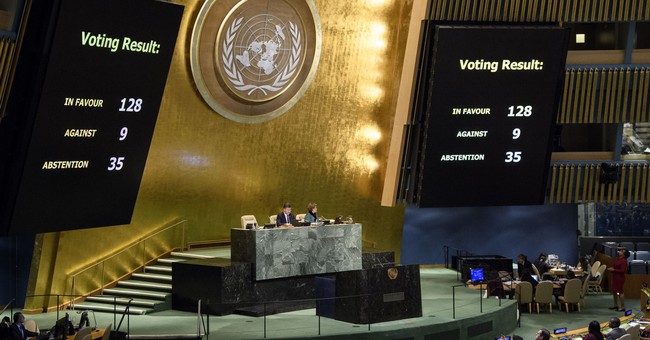
Herein lies the great irony of the United Nations: While it's the Mos Eisley of international politics -- a hive of scum and villainy -- and it votes repeatedly to condemn the United States and Israel, the tyrannies that constitute the body continue to oppress their own peoples. Among those who voted last week to condemn the U.S. for recognizing Jerusalem as Israel's capital and moving its embassy to Jerusalem were North Korea, Iran, Yemen and Venezuela. Why exactly should the United States ever take advice from those nations seriously?
    We shouldn't. And we should stop sending cash to an organization that operates as a front for immoral agenda items.

The United Nations spends the vast majority of its time condemning Israel: According to UN Watch, the U.N. Human Rights Council issued 135 resolutions from June 2006 to June 2016, 68 of which were against Israel; the U.N. Educational, Scientific and Cultural Organization only passes resolutions against Israel; and the U.N. General Assembly issued 97 resolutions from 2012 through 2015, 83 of which targeted Israel.

Meanwhile, the U.N. has done nearly nothing with regard to Syria. It has instead suggested that Israel turn over the Golan Heights to the Syrian regime. The U.N. can't even successfully prevent the slaughter of the Rohingya in Myanmar. But they certainly have something say about whether the United States ought to recognize Jerusalem as Israel's capital.

One of the great lies of the Obama administration was that diplomacy is a foreign policy. We often heard from it that the only two alternatives were diplomacy and war. That was the stated reason for pursuing a one-sided nuclear deal with Iran that left Iran with burgeoning regional power and legitimacy. "What? Do you want a war or something?" it asked. 

But the moment that the Trump administration uses tools of diplomacy, including financial pressure, to achieve American ends, the left complains. Would it prefer war? Diplomacy is a tool, not a foreign policy, and the use of diplomacy to pressure other nations to follow our lead is not only smart but also necessary. That is why the Trump administration was exactly right to negotiate a $285 million cut to the U.N.'s budget. Now we ought to slash our contributions to the counterproductive organization, since we pay one-fifth of the total bill.

The U.N. has always been a foolish fantasy, a League of Nations knockoff that's been about as productive and twice as irritating. It's an outmoded organization that's outlived whatever small usefulness it once had. There's no reason for us to continue cutting checks to prop up regimes that condemn us publicly for exercising the most basic standards of morality.

[bold, italics, and colored emphasis mine]

Tuesday, December 26, 2017

#2178 (12/26) "Nikki Haley's Finest Hour"

"NIKKI HALEY'S FINEST HOUR" - Guy Benson: Dec 22, 2017; https://townhall.com/tipsheet/guybenson/2017/12/22/video-netanyahu-thanks-america-praises-nikki-haleys-un-votes-and-powerful-speech-n2425903 [AS I SEE IT: 1) I SO agree that Nikki Haley as UN ambassador is the best appointment that President Trump has made next to Supreme Court justice Gorsuch. She has such "spunk" and a no-nonsense approach to diplomacy that is very refreshing. I cheer every time I hear about something  she has spoken on. 2) Just last night (12/25),  ambassador Haley - ie, the U.S. - announced that it is cutting the money it gives to the United Nations (note the link at the end of this article). It's a great START! - Stan]
     Aside from the nomination of Neil Gorsuch to replace Justice Scalia on the US Supreme Court, I'm not sure I've ever been any prouder of the Trump administration than I was during Nikki Haley's scathing and righteous speech before the UN General Assembly [last] Thursday.  (Katie wrote up Haley's remarks [https://townhall.com/tipsheet/katiepavlich/2017/12/21/haley-at-un-n2425682] and the subsequent vote
[https://townhall.com/tipsheet/katiepavlich/2017/12/21/here-is-the-list-of-countries-that-just-voted-against-the-united-states-at-the-un-n2425807]) in which the large majority of the UN's "community of nations" purported to declare the United States' decision to recognize Jerusalem as the capital city of Israel (which it is) 'null and void.'  "Your empty, symbolic votes to single out America for our unwavering support for a country you loathe mean nothing," Haley warned delegates. "We've made our decision as a sovereign nation, and there's nothing you can do about it -- but we will remember your actions the next time you come, hat in hand, begging us for more money." Here's the video, in case you missed Amb. Haley's tour de force: [https://usun.state.gov/remarks/8232]

   "... To its shame, the United Nations has long been a hostile place for the state of Israel. Both the current and the previous Secretary-Generals have objected to the UN’s disproportionate focus on Israel. It’s a wrong that undermines the credibility of this institution, and that in turn is harmful for the entire world...When we make generous contributions to the UN, we also have a legitimate expectation that our good will is recognized and respected. When a nation is singled out for attack in this organization, that nation is disrespected. What’s more, that nation is asked to pay for the “privilege” of being disrespected. In the case of the United States, we are asked to pay more than anyone else for that dubious privilege. Unlike in some UN member countries, the United States government is answerable to its people. As such, we have an obligation to acknowledge when our political and financial capital is being poorly spent. We have an obligation to demand more for our investment. And if our investment fails, we have an obligation to spend our resources in more productive ways."
     "Those are the thoughts that come to mind when we consider the resolution before us today...The United States will remember this day in which it was singled out for attack in the General Assembly for the very act of exercising our right as a sovereign nation. We will remember it when we are called upon to once again make the world’s largest contribution to the United Nations. And we will remember it when so many countries come calling on us, as they so often do, to pay even more and to use our influence for their benefit. America will put our embassy in Jerusalem. That is what the American people want us to do. And it is the right thing to do. No vote in the United Nations will make any difference on that. But this vote will make a difference on how Americans look at the UN and on how we look at countries who disrespect us in the UN. And this vote will be remembered."

     Contrast that moral clarity with the shameful and craven actions of the previous administration, and the gratuitous and disloyal votes of normal US allies.  Good for her.  Israel was one of just eight nations who joined the United States on this vote, with a few dozen more abstaining.  Haley is hosting a 'friendship reception' for the nations that chose not to vote against the US on this issue  Israel's Prime Minister tweeted a short video thanking America and Amb. Haley for their leadership:
     Benjamin Netanyahu✔ @netanyahu
Thank you, Ambassador Haley. On Hanukkah, you spoke like a Maccabi. You lit a candle of truth. You dispel the darkness. One defeated the many. Truth defeated lies. Thank you, President Trump. Thank you, Nikki Haley.

     Jerusalem is the capital of Israel.  That's a fact.  It will remain a fact. It has been US policy to recognize that fact since 1995, reaffirmed overwhelmingly by Congress this past summer.  After campaigning to relocate America's embassy accordingly, other presidents eventually chose to seek waivers to the law; President Trump chose to follow through on his pledge and not evade compliance any longer.  A sovereign nation made a decision to uphold its own policy -- established by the elected representatives of a free people -- and to acknowledge empirical reality.  For that transgression, the pitiful and feckless United Nations voted to condemn that sovereign nation.  Americans should not forget Amb. Haley's leadership on this issue, nor should we forget the countries who sided with "the jackals" over the Middle East's only liberal democracy and United States of America.  Between her General Assembly address and her defiant Security Council veto, this week has been Nikki Haley's finest hour:
    Nikki Haley✔@nikkihaley
The United States will not be told by any country where we can put our embassy.

     Thank you, Madame Ambassador.  As for the very first point she made at her speech, here is CNN's Jake Tapper calling out the mind-boggling hypocrisy and perverse priorities of the United Nations.  His upbraiding of certain member nations is excellent, but keep watching until the very end.  The statistic he shares about UN resolutions is really extraordinary.  Not all criticism of Israel policy is "anti-Semitic," obviously, but Tapper heavily hints that there's something dark behind the grossly disproportionate targeting of Israel by the UN.  He's right:
 
Noah Pollak @NoahPollak Watch this excellent @jaketapper comment on the UN General Assembly vote against the US and Israel today. The same General Assembly that systematically ignores virtually every genuine human rights atrocity in the world. https://www.
youtube.com/watch?

[bold, italics, and colored emphasis mine]

"Nikki Haley is Throwing a Party For Pro-America Countries After Jerusalem Vote" - Katie Pavlich: Dec 22, 20187; https://townhall.com/tipsheet/katiepavlich/2017/12/22/nikki-haley-throws-a-party-for-proamerica-countries-after-jerusalem-vote-n2426202
"It’s Official: Nikki Haley Announces Cuts to the UN Budget" - Katie Pavlichlich: Dec 25, 2017; https://townhall.com/tipsheet/katiepavlich/2017/12/25/its-official-nikki-haley-announces-cuts-to-the-un-budget-n2426933

Monday, December 25, 2017

# 2177 (12/25) CHRISTMAS: "A Celebration of Life"

CHRISTMAS, 2017

"A CELEBRATION OF LIFE" - David Limbaugh : Dec 22, 2017; https://townhall.com/columnists/davidlimbaugh/2017/12/22/a-celebration-of-life-n2425912
People often lament that in our celebration of Christmas, we tend to lose sight of its true meaning. Not to be a contrarian, but I don't think the two are mutually exclusive.

    At Christmastime, we celebrate family, giving, tradition, friendship, community, love, goodwill and so much else that is great and good about human existence. These sublime experiences and institutions are wonderful precisely because our savior, in whom goodness inheres, created them.

With proper godly perspective, delighting in these glorious gifts actually enhances our focus on God; it doesn't diminish it. Of course, we must discipline ourselves, if it doesn't occur naturally, to give thanks to God and to consciously savor him and his gift of life to us.

This time of year, we celebrate Christ's incarnation -- his birth, his earthly example and his miracles and teachings. We humbly bow at the Crucifixion, marvel at the magisterial Resurrection and gratefully acknowledge our regeneration salvation in him. We cherish that he is truth, the judge and the very giver of life.
    Unlike the mythical god of deism, our God did not create us and then callously abandon us to a desperate state of sinfulness, misery and suffering. He is not only the Creator but also the sustainer of the universe. The writer of Hebrews assures us, "He upholds the universe by the word of His power." The Apostle Paul proclaims, "He is before all things, and in Him all things hold together."
    Though God gave us the freedom to sin and mankind subsequently fell, Christ became sin for us, thereby conquering sin and death. He offers us redemption and eternal life in his presence.

It is fitting that we celebrate Christ's birth, because his redeeming work on our behalf -- his death on the Cross and thus our salvation -- could not have been accomplished without his incarnation. It is all part of a piece. If he had merely been in form a human but in substance only God, his suffering, the Crucifixion and the Resurrection would have been illusory.
    Paul wrote to the Philippians: "Have this mind among yourselves, which is yours in Christ Jesus, who, though he was in the form of God, did not count equality with God a thing to be grasped, but emptied himself, by taking the form of a servant, being born in the likeness of men. And being found in human form, he humbled himself by becoming obedient to the point of death, even death on a cross."

Jesus wasn't just the greatest of all human prophets. He was fully God and fully man, a truth that Christians believed from the beginning and that the Council of Chalcedon formally affirmed in A.D. 451. "Therefore, following the holy fathers, we all with one accord teach men to acknowledge one and the same Son, our Lord Jesus Christ, at once complete in Godhead and complete in manhood, truly God and truly man, consisting also of a reasonable soul and body; of one substance with the Father as regards His Godhead, and at the same time of one substance with us as regards His manhood."

Christianity's critics sometimes question God's permitting human suffering, but the Cross, to paraphrase the late Pastor John Stott, smashes those concerns to smithereens. Christ understands our suffering and even our mundane problems because he became one of us and experienced what we experience. "For we do not have a high priest who is unable to sympathize with our weaknesses, but one who in every respect has been tempted as we are, yet without sin" (Hebrews 4:15).

Christ suffered -- so that we can live -- more pain than anyone who has ever existed. It was not only his physical beatings and passion but also his excruciating separation from the Father and his endurance of God's wrath for all of the past, present and future sins of mankind. Moreover, God created us knowing at the time that Christ's human birth and sacrificial death would be necessary. John tells us that Jesus is "the Lamb that was slain from the creation of the world." A greater act of love is inconceivable.   

Having become human and suffering as a human being, Christ is an empathetic, personal God, who is approachable to us and with whom we can have a personal relationship. "Let us then with confidence draw near to the throne of grace, that we may receive mercy and find grace to help in the time of need" (Hebrews 4:16). 

This Christmas, let's celebrate the wonders of our existence as human beings created in God's image and with the capacity for his love, which we must abundantly share with one another. Let's draw near to his throne of grace, profusely thanking him for the undeserved mercy he gave us and meditating on "whatever is true, whatever is honorable, whatever is just, whatever is pure, whatever is lovely, whatever is commendable" (Philippians 4:8).

[bold, italics, and colored emphasis mine]
David Limbaugh is the author of the New York Times best-selling book: "Jesus on Trial: A Lawyer Affirms the Truth of the Gospel;"is brother of radio talk-show host Rush Limbaugh, is an expert in law and politics who writes engaging columns from a fresh, conservative point of view.

Sunday, December 24, 2017

#2176 (12/24) "Minimalism Isn’t the Key to Christmas"

CHRISTMAS EVE, 2017

"MINIMALISM ISN'T THE KEY TO CHRISTMAS - We need more than anti-consumerism for a healthy Christian holiday." - Jen Pollock Michel;
http://www.christianitytoday.com/women/2017/december/this-christmas-minimalism-isnt-solution.html
  Minimalism Isn’t the Key to Christmas Image: Bernard Bodo / iStock

Three years ago, my husband and I decided that we would no longer travel for Christmas. Our parents, all of them living in the Midwest, were devastated. When we’d moved to Toronto from Chicago, the terms were clear: If we were moving the grandchildren across an international border, we were responsible to bring them home for the holidays. But where was home? Even if our passports declared us strangers, our house in Toronto had begun to feel more like home than the one we had left behind—the one we actually owned.

I’ll be home for Christmas, we sing. And it’s for good reason that Christmas lures us home. As I can attest, waking up in a hotel on Christmas morning and shuffling to the lobby for your first cup of hot coffee does a number on the holiday spirit.

What makes a home a home, then?
    For the past several years, IKEA representatives have traveled across the globe to ask people about their domestic experiences and expectations. In 2016, they visited 12 cities and interviewed 12,000 people; in 2017, they traveled to 22 countries, surveying more than 22,000 people. In the first survey, respondents concluded that a home was composed of four intangibles: comfort, safety, belonging, and love.
    Even if IKEA’s findings (detailed in their annual Life at Home reports) primarily aim to sell us more furniture, lamps, and posters of Paris, they tell us something about the fundamental human longing for home. For Christians, they also illuminate this surprising truth: Neither consumerism nor anti-consumerism defines a true home.
    Roy Langmaid, a psychologist cited in the 2017 IKEA Life at Home Report, talks about home as moderns have come to think of it—as the expression of personal identity. Identity is a narrative, Langmaid says, and home tells part of the story. If we change the objects, we change the story, which is why some of us find it so difficult to get rid of things—so difficult, in fact, that 1 in 10 Americans is paying for off-site storage. (In the UK, that number is 1 in 100; in Japan, 1 in 300.)
    Despite these emotional attachments, respondents to IKEA’s survey admitted that half of their domestic arguments involved the problem of having too much stuff. On the one hand, we feel more and more tied to the objects in our home; on the other, we feel more and more anxious about the physical clutter. In other words, we want to clear our space but can’t bear the burden of negotiating what stays and what goes. (Inevitably, Christmas will add to our pile of things wanted and unwanted.)

    In Scripture, Jesus didn’t warn against excessive accumulation because it was a mental health hazard. In fact, every time Jesus and the New Testament writers warn against material greed, they don’t mention the anxiety of physical clutter and the reward of minimalism. Rather, they point forward to a more permanent home—and investment in a more lasting kingdom.
    In Luke 12:13–21, Jesus tells the story of a rich fool who presumes longevity of life. I’ll build bigger barns for all my stuff, he reasons. But his life is demanded of him far earlier than expected, and to his regret, he discovers that he has not been rich toward God.
    In Luke 16:19–31, we find a similar story. The rich man, “clothed in purple and fine linen and who feasted sumptuously every day,” finds his fortune dramatically reversed with the fortune of a beggar, who had lain hungry at his gate every day. In the afterlife, the rich man is humiliated, the poor man exalted. Both men discover the fleeting shadow of this life and conversely, the never-setting sun of eternity.
    Paul, too, instructs the rich not to “put their hope in wealth, which is so uncertain,” but rather to be generous. “In this way they will lay up treasure for themselves as a firm foundation for the coming age, so that they may take hold of the life that is truly life” (1 Tim. 6).

    In other words, the point is not necessarily that we’re forbidden from owning and accumulating. Rather, it’s that if our apartments, houses, condos, and rented rooms tell any story, it should be this: We’re waiting on a better world.

The gospel tells an old, old story. God wriggled his way through a womb to make his home among us. Taking up flesh, Jesus pitched his tent in our neighborhood. He came as a poor man and owned so little that he didn’t have a place to lay his head. On the eve of his betrayal, arrest, and crucifixion, he told the disciples about his true home: his Father’s house with its many rooms. “If that were not so,” he said, “would I have told you that I am going there to prepare a place for you?” (John 14:2).

Maybe, then, the best homes we make tell realistic, honest stories about the human condition on this side of heaven. They’re impermanent and imperfect, no matter how much we seek (or avoid) accumulation. Earthly homes are fleeting stars. Like the Wise Men, we follow them as a way to long “for a better country—a heavenly one” (Heb. 11:16). If only for a glimpse of the Christ!

“I’ll be home for Christmas,” we sing. And then again, maybe not.

Jen Pollock Michel is the award-winning author of Teach Us to Want and Keeping Place. She lives with her husband and five children in Toronto.


December 24 | BANGLADESH - Pray for Tania. Her husband suffered a massive heart attack. Pray that God may raise His healing hand over her husband. 

*Names changed for security reasons.

Saturday, December 23, 2017

#2175 (12/23) PRO-LIFE SAT: "Real Feminists Care About Women and Children. Real Feminists are Pro-Life"

CHRISTMAS, 2017
Mary and Joseph never considered aborting their "inconvenient" child over 2000 years ago and as a result the world has been blessed as it has not by any other child born. Tragically, today and EVERY day in America, an estimated excess of 4,000 girls and women have their "inconvenient" unborn child aborted, most times thinking they are just ridding their bodies of tissue. Oh, that each one would have the eyes to see the CHILD they carry and ponder the untold blessings that child has been destined by God to bring into the world. Let us pray that more and more will CHOOSE LIFE rather than death for their CHILD, this Christmas and every day.

"REAL FEMINISTS CARE ABOUT WOMEN AND CHILDREN. REAL FEMINISTS ARE PRO-LIFE" - Kristan Hawkins. Dec. 21, 2017|
http://www.lifenews.com/2017/12/21/real-feminists-care-about-women-and-children-real-feminists-are-pro-life/
     As we approach a holiday in which an almost single mother and a step-father welcome a special baby born during a forced journey to comply with a government order, it’s interesting to ponder how women’s interests have been evolved from empowering women in the context of their lives and families to focusing on things that ensure they don’t have families at all.

Today’s mainstream feminists work to enforce an agenda for women that has been reduced to a single issue and one group of people (not necessarily female): abortion and any who pledge allegiance to that cause. First wave feminists like Susan B. Anthony and Elizabeth Cady Stanton have been replaced by Planned Parenthood apologists who ignore the kinds of issues that once united disenfranchised women. On my on-going speaking tour of Ivy League colleges, discussing the misinformation campaigns that pollute too much of modern day feminism, I’ve realized the one of the best ways to illustrate how self-appointed mainstream feminists have lost there way is to recommend that students take a literature class.

If you want to see just how far gone many modern day feminists are consider the world of Jane Austen, Emily and Charlotte Bronte, in stark contrast to the whining tour of Hillary Clinton and her current apologists. Her reasons for a failed campaign never include her leadership or political agenda, but rather things like the misogyny that’s “endemic” to America or that the men dropped the ball (like Barack Obama or Bernie Saunders) by not doing enough to help, or that old canard about women being too whipped to think for themselves.
    During her campaign, Clinton and her allies were direct that a vote for her was a vote for abortion and all that Planned Parenthood wanted to sell. They were dismissive of women who didn’t share their views … and they were dismissed in the election.

While I, like the overwhelming majority of Americans, believe in the goal of our feminist foremothers, equality for all human beings including the right of women to vote, to own property, to speak publicly, to chose and to fulfill their educational, career, and family goals, I’m sure the self-proclaimed leaders of today’s feminist movement and those lingering second-wave feminists of the 1960s and 1970s would tell you that I don’t belong, that in fact I’m not welcome. I’m not a “feminist” because I don’t support abortion.

But feminism used to be about empowering women who faced legal and social situations that crippled their futures. One afternoon in a library would illustrate what I mean.
    In the world of the Bronte sisters and Jane Austen, women were treated like second-class citizens, whose diminished economic opportunity stemmed from patriarchal inheritance laws, blocked access to education, and crushing societal expectations. With potent pens, the authors illustrated that their heroines faced dire circumstances BECAUSE they were women.
    Consider that in Pride and Prejudice, Elizabeth Bennet and her four sisters are forbidden to inherit their father’s estate and will be penniless and homeless should he die, leading to their mother’s rather painful match making, and eventually to Mr. Darcy. 
    In Sense and Sensibility, three girls and their mother are tossed from their home when a loving father dies, and his son by a first marriage abandons them at the urging of a greedy wife. Marianne and Elinor find love, though not a simple path, and for Marianne in particular one wonders if her feelings for Colonel Brandon were partially flamed by his resources after she is jilted by a fortune hunter.
    In Mansfield Park, Fanny Price is a poor relative, living with extended family, navigating a dynamic in which her lack of options keep her right where she is, in a dark story of social pressures. In Emma, the rich heiresses plays match maker for a bastard girl who is considered lucky when a farmer makes her an offer. Her friend’s prospects are compared again and again against Emma’s, and the lack of options is clear.
    Women’s crushing pressures portrayed with Austen’s light touch become darker as the Bronte sisters, who suffered at the hands of their father, explore doom, loss and lack of choice. In Jane Eyre, Charlotte Bronte writes a painful story of a girl who wants to make her own way, keeping her conscience clear, even as she loves the troubled, married Mr. Rochester. And who can forget Emily Bronte’s Wuthering Heights, a tragic love story in which poverty and family crush the lives of Heathcliff and Catherine and the children that endure them.

Still, you don’t have to look back to the Victorian age to see women in our world today whose futures are limited because economic advancement is controlled by a patriarchy. Modern day feminists who talk endlessly about abortion remain too often silent about women in other cultures whose lives are controlled only because of their sex.

On my speaking tour, some feminists have taken offense of my criticism of a movement that once sought to empower women in whatever role they chose. But I didn’t leave feminism behind; it left me. In working with Generation Z and Millennial voters nationwide on all kinds of campuses, I know firsthand that today’s women want more than abortion, that for the majority of students pre-born life is valued and that success means more than just a career.

Jane Austen once said, “Give a girl an education and introduce her properly into the world, and ten to one but she has the means of settling well, without further expense to anybody.” That drive for self-empowerment is what I find on college campuses among women today, who don’t rely on a feminist label and whose futures are brighter than ever.

[bold, italics, and colored emphasis mine]

Friday, December 22, 2017

#2174 (12/22) "4 Big Signs of a Trump Economic Recovery"

ATTENTION:  SCROLL DOWN  to get TODAY'S article entitled in ALL CAPITAL LETTERS. And PLEASE be sure to note the various PRAYER REQUESTS listed BEFORE and AFTER the posted article. (NOTE the list of DAILY prayer requests for the persecuted church.)  They ALL deserve  your intercession. 
THANK YOU.
"4 BIG SIGNS OF A TRUMP ECONOMIC RECOVERY"-  Fred Lucas / December 15, 2017 / http://dailysignal.com/2017/12/15/4-big-signs-of-a-trump-economic-recovery [AS I SEE IT: I can almost guarantee you will not read the things this article points out in the mainstream press unless it is stated in a negative context. It's way past time the American people noted what great things - though not perfect as nothing ever is - has been accomplished in just the past year. - Stan]
President Donald Trump has some fun cutting symbolic red tape Thursday at the White House to demonstrate the huge growth in government regulations since 1960. The White House says the administration has killed 22 regulations for every new one. (Photo: Mike Theiler/UPI/Newscom)

The economic numbers clearly have improved on President Donald Trump’s watch, with unemployment down and consumer confidence stronger. “We are just getting started,” @POTUS says.
    “Economic growth has topped 3 percent,” Trump said ... at a White House event while addressing his administration’s reduction in regulations. “Two quarters in a row, except for the hurricanes, we would have almost hit 4 percent, and you remember how we were doing when I first took office.”
    Trump also noted a difference between President Barack Obama’s eight years in office and the current outlook. “This country was going economically down,” he said. “Small business optimism is at its highest point in 34 years, and we are just getting started.”
    Trump ... noted that his administration so far has killed 22 regulations for every one added. The president’s original executive order called for elimination of two regulations for every new one.

The debate with any president comes with how much credit or blame his policies deserve for the economy’s performance, and how big a factor his immediate predecessor’s policies are. Some experts are more cautious than others in giving Trump credit.

The National Association of Manufacturers’ survey of members found that 94.6 percent of respondents had a positive outlook for their companies for 2018. That is the best result in the survey’s 20-year history, and up significantly from the survey done in late 2016, when positive outlook hit 63 percent. This rosy attitude can be in part attributed to Trump’s policies, said Jay Timmons, president of the manufacturers association.
    “Most of our respondents were talking about pro-growth tax policies and getting around the regulatory morass, and those are the two big priorities for manufacturers,” Timmons told The Daily Signal in an in-person interview. “The third priority [for manufacturers] is infrastructure. Those are three big priorities for the administration. This will encourage hiring and investment.”

Consumers are spending more money, but expanding companies’ physical investments—buying a major tool, a truck, a facility—will be the real measurement, said Salim Furth, a research fellow in macroeconomics at The Heritage Foundation’s Center for Data Analysis.
    “The good direction of the economy in 2017 is largely a continuation of the strong economy that started in 2014, when we’ve had a huge decrease in energy prices because of fracking and low inflation,” Furth told The Daily Signal in a phone interview. Attributing economic growth to one president is difficult, but the benefits of fracking—the extraction of fossil fuels from rocks—are clear and provable, Furth said. “Anticipation of tax policies and regulatory policies can drive the economic outlook, but an administration that lives by the economic numbers dies by the economic numbers,” he said. “Politicians will always put their spin on numbers.”

But Trump should be credited as the “fountainhead of the current economic boom,” said Alfredo Ortiz, president of Job Creators Network, a pro-business advocacy group.
    “His long and deeply held commitment to tax cuts and deregulation, among other policies, has given small businesses—and for that matter, all businesses—the confidence and ability to invest, hire, and expand, generating the current economic boom,” Ortiz told The Daily Signal in a written statement. “Now President Trump must continue to leverage his leadership skills to get his policies across the goal line and consolidate these gains.”

Here are four key categories of economic indicators and improvements since Trump took office.

1. Growth Gets Closer to 4 Percent
    The gross domestic product grew by 3.3 percent for the third quarter of 2017, as the Trump administration touted the goal of achieving 4 percent growth. The White House Council of Economic Advisers estimates that without the major hurricanes, growth would have reached 3.9 percent. During Obama’s administration, annual growth never reached 3 percent.
    Labor productivity increased by 3 percent in the third quarter, up from 1.5 percent in the third quarter of 2016.
      Household wealth jumped by $1.7 trillion to a record $96.2 trillion, according to the White House, and almost 1.4 million Americans dropped off the food stamp rolls since January, when Trump took office.
    The unemployment rate fell to 4.1 percent for November, the lowest since President Bill Clinton 17 years ago. Unemployment claims fell to their lowest level in 44 years, according to the White House, and 12 states—Hawaii, California, Idaho, Texas, Alabama, Maine, Mississippi, Tennessee, Washington, Colorado, North Dakota, and Oregon—reached record low unemployment rates.

2. Stock Market Hits Record Highs
    The stock market performed well during the Obama administration, but hit new records under Trump. The Dow Jones Industrial Average is up over 32 percent since Election Day 2016. On Nov. 30, the Dow closed at over 24,000 points for the first time.
    “Because of our regulatory and other reforms, the stock market is soaring to new record levels, 85 [times], not including today. Hopefully, we’ll set another one today, 85 times since Election Day, creating $5 trillion of new wealth,” Trump said during the White House event. “And the $5 trillion was as of about three weeks ago, so I assume we probably hit $6 trillion almost.”

3. Companies Are ‘Coming Back Fast’
    Trump delights in touting examples of companies that are making major new investments in the United States. “They’re all moving back,” Trump told reporters Thursday. “They’re moving back into our country. Those companies are coming back, and they are coming back fast.”
    Some examples during the year include:
* Foxconn Technology Group announced it was investing $10 billion in Wisconsin to build a factory that will employ 3,000 workers. The company predicted it will benefit another 22,000 workers indirectly.
*Corning Inc. announced during a White House ceremony with Trump that it was investing $500 million in new U.S. production, creating 1,000 jobs.
*Broadcom Limited announced at another White House ceremony its plan to move headquarters back to the United States, bringing $20 billion in annual revenue.

4. Healthy Consumer and Employer Confidence
    To the degree that the economy is a self-fulfilling prophecy, business leaders, economists, and ordinary Americans seem to be feeling better about the days ahead. 
* The Conference Board’s Consumer Confidence Index rose for the fifth month in a row in November, to a 17-year high of 129.5.
* The Bloomberg Consumer Comfort Index reached a 16-year high.
* The Wells Fargo/Gallup Small Business Index found that optimism among small businesses held steady in the third quarter after the biggest increase in decades during the second quarter.

[bold, italics, and colored emphasis mine]