Wednesday, February 12, 2020

#2936 (2/12) "Millennials and the False Gospel of Politics"

"MILLENNIALS AND THE FALSE GOSPEL OF POLITICS" John Stonestreet and Shane Morris, Breakpoint.org, 2/11/20;
https://www.breakpoint.org/millennials-and-the-false-gospel-of-politics/ [AS I SEE IT: This article is very timely as the Democrat socialist candidate, Bernie Sanders - who enjoys great support from Millennials - is now leading other candidates of his party. His thinking reflects much of their thinking and this article  explains what may very well  lay behind much of that thinking. - Stan]


     Have you seen the image of that woman during President Trump’s 2017 inauguration who threw back her head and screamed “NOOO!” like Luke Skywalker did when he found out Darth Vader was his father? Well, the woman has since become a meme. And while it’s always unacceptable to ridicule or belittle anyone made in the image of God, I remember an insightful remark about this woman’s show of emotion. For her and for many others, the 2016 electoral results meant that hope itself was lost. For those who gnashed their teeth at the inauguration, politics had taken on the role of religion in their lives.

   January’s cover story of TIME magazine all but admits this, although the hope is noticeably revived. Charlotte Alter, the author of the forthcoming book “The Ones We’ve Been Waiting For,” makes no effort to hide the fact that for many millennials, political reform has become a kind of gospel—and they its evangelists.

   In a few years, writes Alter, millennials will be a majority of the electorate, and with historically favorable views of socialism, low views of organized religion, and liberal views on sex and gender, the up-and-coming generation looks ready to reverse what older voters have tried to accomplish by electing conservatives. Alter is not only okay with this, she’s more than okay. Her tone throughout the TIME article is triumphant. She can’t wait for millennial leaders and voters to transform America, nor does she expect their zeal to lessen, even as they age.
  The odd thing throughout the article is that Alter never bothers to argue that these ultra-liberal views are true. For her, young voters’ passion to “change to world,” together with the fact that they’re young, are all the evidence she needs to know that they’re right.

  If millennials’ and Gen Z’s political views are near-religious, then the devotion to that religion that Alter describes and reflects can be called a cult of adolescence. I used that term last year on BreakPoint after 16-year-old climate activist Greta Thunberg was applauded for shouting, “How dare you?” at a room of adults at the United Nations. It’s also the same cult we saw after the Parkland high school students slammed adults as ignorant and lazy for not passing the gun control laws they wanted.

   Writing at First Things last month, Theodore Dalrymple compares the activism of millennial progressives with an account by a young Marxist who traveled to Syria to fight for ISIS. Like this recruit to totalitarian ideology, Dalrymple thinks the rising generation of American voters is seeking more from politics than just good laws. They’re seeking salvation—they’re seeking a cure for the world’s evils, and an escape from what feels like a meaningless existence. Having abandoned any hope that these things will come from God, they’re left hitching their hopes to the next election, to the next Supreme Court ruling, or the next session of Congress.
   “There is an evangelical tone to their declarations,” Dalyrmple writes, “a sorting of the wheat from the chaff, the sheep from the goats, the saved from the damned. They do not merely want formal changes…[t]hey demand a reform of the human heart and intend to bring it about.”

   But of course, politics can never deliver those things. For those who look to activism and policy to fill what Dalrymple calls their “existential void,” the only thing worse than losing elections might be winning them.
   I don’t know whether Alter is right about the way millennials will vote in the long-term. If there’s one thing we’ve learned in the last few years, political pundits struggle to predict the future. Whenever they tell us an outcome is inevitable that’s almost reason alone to doubt it.

    But what is inevitable, I’m much more certain, is disappointment for anyone who makes politics their religion. As Christians who have answers that actually can satisfy and a gospel that actually can change hearts and the world, we should see in that disappointment a chance for truth and love, not for gloating.

 [italics and colored emphasis mine]

RESOURCES:
"How Millennial Leaders Will Change America" - Charlotte Alter | TIME | January 23, 2020; https://time.com/5770140/millennials-change-american-politics/
"Identity As Ideology " - Theodore Dalrymple | First Things | February 2020; https://www.firstthings.com/article/2020/02/identity-as-ideology
"Greta Thunberg and the Cult of Adolescence" - John Stonestreet | BreakPoint | December 26, 2019; https://www.breakpoint.org/greta-thunberg-and-the-cult-of-adolescence-2/


--------------------------------------


PRAYER MATTERS:

"To clasp the hands in prayer is the beginning of an uprising against 
the disorder of the world Karl Barth
"Prayer is inviting God into a seemingly impossible situation and trusting/resting in His love and grace to accomplish His perfect will in His perfect time and for His greatest glory. Intercession is  one of the great privileges AND responsibilities for EVERY believer."- Stan

World-Wide Prayer Requests:
------------------------------------------------------------
Praying Through the Open Doors World Watch List for persecuted believers:https://www.opendoorsusa.org/take-action/pray/monthly-prayer-calendar/
 Secret believers in North Korea Winters can be very difficult in North Korea. Food is often scarce— especially this winter following the recent drought. However, even in the midst of this difficulty, Christians often share a portion of their rice with their neighbors—a practice called “holy rice.” One underground leader says, “It’s a great way to build trust and, after trust has been built, to talk about the gospel.” Right now, Open Doors is helping 60,000 Christians with food relief to strengthen the church and empower believers. 
February 12 -[Trauma care in Nigeria The Shalom Center, a long-awaited trauma center in Nigeria from Open Doors, started operations in March 2019 after it was delayed by a year due to challenges with security in the area. The center is intended as a place where people who have suffered various kinds of trauma can come for extended care to find peace. Since opening on March 1, the center has trained trainers and provided weekly in-depth care to survivors of violent attacks.] “I was able to make sense of how trauma has affected my life,” says Pastor Peter.* Pray with him as he works through his pain.
*Representative name or photo used to protect identity
Tuesday, February 11, 2020

#2935 (2/11) "Trump’s Unorthodox Policy Wins Are Gaining Steady Support"

"TRUMP'S UNORTHODOX POLICY WINS ARE GAINING STEADY SUPPORT"Victor Davis Hanson / @VDHanson / February 07, 2020 / https://www.dailysignal.com/2020/02/07/trumps-unorthodox-policy-wins-are-gaining-steady-support/
-------------------------------------------------------------
--------------------------------------------------------------------------------------
    For all President Trump's tough talk, his ace in the hole is American soft power—based on a globally dominant economy, its global lead in the production of gas and oil, and an omnipresent cultural juggernaut.

     When candidate Donald Trump campaigned on calling China to account for its trade piracy, observers thought he was either crazy or dangerous. Conventional Washington wisdom had assumed that an ascendant Beijing was almost preordained to world hegemony. Trump’s tariffs and polarization of China were considered about the worst thing an American president could do.
   The accepted bipartisan strategy was to accommodate, not oppose, China’s growing power. The hope was that its newfound wealth and global influence would liberalize the ruling communist government. Four years later, only a naif believes that. Instead, there is an emerging consensus that China’s cutthroat violations of international norms were long ago overdue for an accounting.
   China’s reeducation camps, its Orwellian internal surveillance, its crackdown on Hong Kong democracy activists, and its secrecy about the deadly coronavirus outbreak have all convinced the world that China has now become a dangerous international outlier.

   Trump courted moderate Arab nations in forming an anti-Iranian coalition opposed to Iran’s terrorist and nuclear agendas. His policies utterly reversed the Obama administration’s estrangement from Israel and outreach to Tehran.Last week, Trump nonchalantly offered the Palestinians a take-it-or-leave-it independent state on the West Bank, but without believing that a West Bank settlement was the key to peace in the entire Middle East.

   Trump’s cancellation of the Iran deal, in particular, was met with international outrage. More global anger followed after the targeted killing of Iranian terrorist leader Gen. Qassim Suleimani. In short, Trump’s Middle East recalibrations won few supporters among the bipartisan establishment. But recently, Europeans have privately started to agree that more sanctions are needed on Iran, that the world is better off with Suleimani gone, and that the West Bank is not central to regional peace.
   Iran has now become a pariah. U.S.-sponsored sanctions have reduced the theocracy to near-bankruptcy. Most nations understand that if Iran kills Americans or openly starts up its nuclear program, the U.S. will inflict disproportional damage on its infrastructure—a warning that at first baffled, then angered, and now has humiliated Iran.

   In other words, there is now an entirely new Middle East orthodoxy that was unimaginable just three years ago. Suddenly the pro-Iranian, anti-Western Palestinians have few supporters. Israel and a number of prominent Arab nations are unspoken allies of convenience against Iran. And Iran itself is seemingly weaker than at any other time in the theocracy’s history.
Stranger still, instead of demanding that the U.S. leave the region, many Middle Eastern nations privately seem eager for more of a now-reluctant U.S. presence.

  For the last 20 years, much of the American orthodoxy had agreed with Europe that the increasingly anti-democratic, pan-continental, and borderless European Union was the remedy to all of Europe’s past 20th-century catastrophes. As a result, American presidents did not do much when EU nations typically racked up large trade surpluses with the U.S., often a result of asymmetrical fees, tariffs, and fines. The U.S. largely ignored the increasingly anti-democratic and anti-American tone of the EU. Nor did Americans object much when lackadaisical European NATO nations habitually welched on their defense spending commitments. 
Apparently, past U.S. administrations supposed that a paternalistic America would always be more eager to defend Europe than Europe would be to defend itself. 

   But then Trump again blew up more old assumptions. NATO will now only survive if its members keep their word and meet their spending promises. An economically stagnant, oil-hungry, and top-heavy EU will have to make radical changes, or it will sink into irrelevance and eventually break apart.

   Trump got little credit for these revolutionary changes because he is, after all, Trump—a wheeler-dealer, an ostentatious outsider, unpredictable in action, and not shy about rude talk.
But his paradoxical and successful policies—the product of conservative, antiwar, and pro-worker agendas—are gradually winning supporters and uniting disparate groups.After all, the U.S. is beefing up its military but using it only sparingly. It hits back hard at enemies but does not hit first.

   For Trump, being conventional is dangerous; being unpredictable is far safer.For all Trump’s tough talk, his ace in the hole is American soft power—based on a globally dominant economy, its global lead in the production of gas and oil, and an omnipresent cultural juggernaut. For Trump, the ex-television star, wars translate into bad ratings and worse optics. As a businessman, he believes needless conflicts get in the way of money-making and win-win deals.

  The result of the new orthodoxy is that the U.S. has become no better friend to an increasing number of allies and neutrals, and no worse an adversary to a shrinking group of enemies. And yet Trump’s paradox is that America’s successful new foreign policy is as praised privately as it is caricatured publicly—at least for now.

[italics and colored emphasis mine]

Victor Davis Hanson is a classicist and historian at the Hoover Institution at Stanford University, and author of the book "The Second World Wars: How the First Global Conflict Was Fought and Won." You can reach him by e-mailing authorvdh@gmail.com.

(C) 2020 TRIBUNE CONTENT AGENCY, LLC.


--------------------------------------


PRAYER MATTERS:

"To clasp the hands in prayer is the beginning of an uprising against 
the disorder of the world Karl Barth
"Prayer is inviting God into a seemingly impossible situation and trusting/resting in His love and grace to accomplish His perfect will in His perfect time and for His greatest glory. Intercession is  one of the great privileges AND responsibilities for EVERY believer."- Stan

World-Wide Prayer Requests:
------------------------------------------------------------
Praying Through the Open Doors World Watch List for persecuted believers:https://www.opendoorsusa.org/take-action/pray/monthly-prayer-calendar/
 Secret believers in North Korea Winters can be very difficult in North Korea. Food is often scarce— especially this winter following the recent drought. However, even in the midst of this difficulty, Christians often share a portion of their rice with their neighbors—a practice called “holy rice.” One underground leader says, “It’s a great way to build trust and, after trust has been built, to talk about the gospel.” Right now, Open Doors is helping 60,000 Christians with food relief to strengthen the church and empower believers. 
February 11 - [Trauma care in Nigeria The Shalom Center, a long-awaited trauma center in Nigeria from Open Doors, started operations in March 2019 after it was delayed by a year due to challenges with security in the area. The center is intended as a place where people who have suffered various kinds of trauma can come for extended care to find peace. Since opening on March 1, the center has trained trainers and provided weekly in-depth care to survivors of violent attacks.] Pray for discernment as the team works through all the preparations to grow the center and expand counseling and care initiatives.
*Representative name or photo used to protect identity

Monday, February 10, 2020

#2934 (2/10) "How the House’s Handling of Impeachment Hurts the American People"

"HOW THE HOUSE'S HANDLING OF IMPEACHMENT HURT THE AMERICAN PEOPLE"Kay C. James / @KayColesJames / January 29, 2020 / https://www.dailysignal.com/2020/01/29/how-the-houses-handling-of-impeachment-hurts-the-american-people
-----------------------------------------------------------------
------------------------------------------------------------------
     Whether the American people yet realize it or not, the House’s handling of the impeachment of President Donald Trump has inflicted serious damage on America’s constitutional system of government and threatened the very safety of our nation.

     The partisan nature of this particular impeachment will end up weakening not just Trump, but the office of the presidency. Every future president—Democrat and Republican—will be second-guessing his or her decisions to avoid crossing members of Congress and being threatened with impeachment based on the flimsiest of evidence. The latest alleged revelations from former national security adviser John Bolton don’t change the fact that last week, both lead House impeachment manager Rep. Adam Schiff and Senate Minority Leader Chuck Schumer admitted that the House voted to impeach the president without the evidence to prove he was guilty, demanding that the Senate call witnesses so they could do more evidence gathering.

   When Congress uses impeachment as a political weapon, it has the potential of stripping an enormous amount of constitutional authority from the presidency and shifting it to Congress. The House has created a precedent where future executives will feel compelled to run major decisions by Congress before carrying them out—even decisions that are solely in the president’s purview.
   The delay created while a president attempts to seek consent from Congress could cost American lives when quick, decisive actions are needed. Just think of the kind of havoc that could be wrought when such permission-seeking ends up delaying military action necessary to stop an attack on an American embassy, when it prevents counterterrorism measures required to thwart an imminent terrorist threat at home, or when it delays federal help to respond to a natural disaster threatening the lives of thousands of citizens.
   The office of the president has suffered additional long-term harm when one considers that when Trump chose to invoke executive privilege to prevent his staff from testifying in the impeachment hearings, the House charged him with “obstruction of Congress.” The long-held legal tradition of executive privilege allows a president to receive the best and frankest advice with which to make critical governing decisions, giving him and his staff the freedom to fully explore all sides of an issue.

   Throughout my career, I was blessed to work in senior positions in both state and federal government, and I will say that those deliberations can be very messy—but also very effective.
To function effectively, a president needs the ability to consult confidentially with his closest advisers. Taking that privilege away severely limits a president’s ability to serve citizens, as his advisers will be deterred from providing frank advice for fear their communications will be shared with millions—including foreign powers and political adversaries—on the evening news.

   If executive privilege is abused, Congress has the ability to take the president to court to challenge his claims. Yet the House failed to do that, perhaps surmising that, based on past precedent, the courts might disagree with it. Instead, the House decided to charge the president with obstruction of Congress, despite the fact that executive privilege is a tool that many presidents have used and that the Supreme Court repeatedly has affirmed. Impeaching a president for invoking executive privilege essentially guts this important tool.

   The Constitution’s Framers were very concerned that impeachment would be used as a political weapon, as is happening today. They never meant it to be the “no-confidence vote” of parliamentary systems that create turmoil by changing leadership anytime such a vote is called. Impeachment was meant for presidents who engaged in crimes so grievous that removing them from office couldn’t wait until the next election.

   With this impeachment, the House has threatened our very constitutional system, effectively turning presidents into mere puppets of Congress, rejecting the idea of a separate and co-equal branch of government. In doing so, the House has damaged the unique system of checks and balances the Framers crafted to prevent any one branch of government from becoming too powerful.

   The House also has made the American people the casualties in the process. The mere threat of impeachment may be all that is needed to stop future presidents from implementing policies that they know are popular with the people but unpopular with the opposition party in the House. In the worst-case scenarios, presidents who become paralyzed in their decision-making about national security and natural disasters could end up putting Americans in harm’s way.

   Only time will tell the extent of the damage that has been done.

     Kay C. James is president of The Heritage Foundation. James formerly served as director of the U.S. Office of Personnel Management and as Virginia's secretary of health and human resources. She is also the founder and president of The Gloucester Institute.
---------------------------------------------------------------
"How History Will Judge the Trump Impeachment"Hans von Spakovsky / @HvonSpakovsky / February 07, 2020 / https://www.dailysignal.com/2020/02/07/how-history-will-judge-the-trump-impeachment/
"Why Impeachment Failed" - David Harsanyi / @davidharsanyi / February 07, 2020;https://www.dailysignal.com/2020/02/07/why-impeachment-failed/


--------------------------------------


PRAYER MATTERS:

"To clasp the hands in prayer is the beginning of an uprising against 
the disorder of the world Karl Barth
"Prayer is inviting God into a seemingly impossible situation and trusting/resting in His love and grace to accomplish His perfect will in His perfect time and for His greatest glory. Intercession is  one of the great privileges AND responsibilities for EVERY believer."- Stan

World-Wide Prayer Requests:
-----------------------------------------------------------
Praying Through the Open Doors World Watch List for persecuted believers:https://www.opendoorsusa.org/take-action/pray/monthly-prayer-calendar/
 Secret believers in North Korea Winters can be very difficult in North Korea. Food is often scarce— especially this winter following the recent drought. However, even in the midst of this difficulty, Christians often share a portion of their rice with their neighbors—a practice called “holy rice.” One underground leader says, “It’s a great way to build trust and, after trust has been built, to talk about the gospel.” Right now, Open Doors is helping 60,000 Christians with food relief to strengthen the church and empower believers. 
February 7–8 - Pray for the country’s food crisis to be resolved and for peace and religious freedom in North Korea. Trauma care in Nigeria The Shalom Center, a long-awaited trauma center in Nigeria from Open Doors, started operations in March 2019 after it was delayed by a year due to challenges with security in the area. The center is intended as a place where people who have suffered various kinds of trauma can come for extended care to find peace. Since opening on March 1, the center has trained trainers and provided weekly in-depth care to survivors of violent attacks.
 February 9 - Thank the Lord for His provision to open the trauma center—so many participants have found healing and hope already. 
February 10 - Pray for grace, wisdom and perseverance for Rauta, the center’s hired staff counselor. 
*Representative name or photo used to protect identity
Sunday, February 9, 2020

#2933 (2/9) SUNDAY SPECIAL: "Saint Kobe and Our Sin"

"SAINT KOBE AND OUR SIN" - Stan Guthrie, Breakpoint.org, 02/6/20; https://www.breakpoint.org/the-canonization-of-saint-kobe/
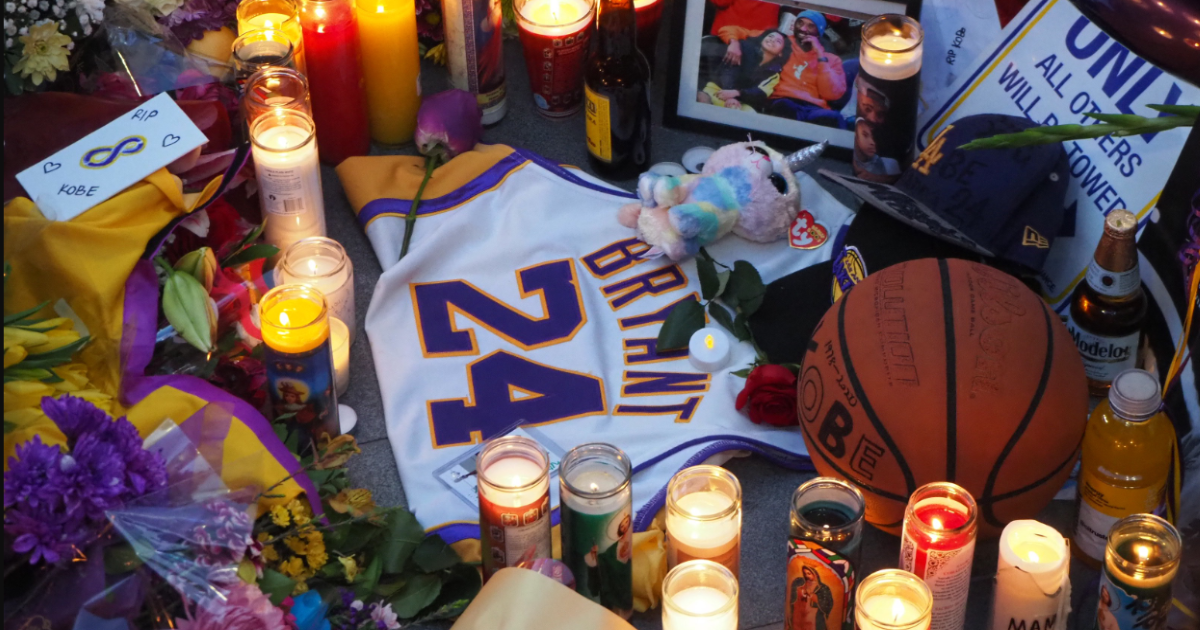
     Anyone who says that 21st-century America is incurably irreligious needs only to consider the national reaction to the tragic death of retired basketball superstar Kobe Bryant, 41, his 13-year-old daughter, Gianna, and seven other people near Calabasas, CA. Amid the scattered wreckage of the January 26 helicopter crash, the 20-year Los Angeles Laker has been not only lionized, but canonized.

   Last Friday’s game—the first for the Lakers since Bryant’s death—took on the trappings of a religious ceremony. Like followers of Jesus who are called “Christians” (little Christs, clothed in His righteousness), each member of the starting five was introduced as “Kobe Bryant” while wearing either Bryant’s No. 8 or No. 24 jersey. LeBron James, who some years ago took the torch from Bryant as the game’s best active player, retold the story of his hero as if he were preaching about a resurrected savior.
   “I look at this as a celebration tonight,” James told the assembly at Staples Center. “This is a celebration of the 20 years of the blood, the sweat, the tears, the broken-down body, the getting up, the sitting down, the everything. The countless hours, the determination to be as great as he could be. Tonight, we celebrate the kid that came here at 18 years of age, retired at 38 and became probably the best dad we’ve seen over the past three years, man.”

   Much of Bryant’s turn to faith and spirituality came in the wake of a 2003 incident in a Colorado hotel room that a 19-year-old woman called rape. Bryant claimed that he thought what happened between them was consensual, the charges were dropped, and he settled with the woman, who had filed a civil suit.

   Bryant’s religious stature after his death was raised by approving references to the fact that he and his daughter had attended Mass at the Cathedral of Our Lady Queen of the Angels just before boarding the ill-fated Sikorsky S-76B at John Wayne Airport in Santa Ana at 9:06 a.m. Another time Bryant had mentioned how much a talk with a priest had meant to him. Bryant once said, “God is great…until you got to pick up that cross that you can’t carry [alone], and He picks it up for you and carries you and the cross. Then you know…it don’t get no simpler than that, bro’.”

   Indeed not. Much of Bryant’s turn to faith and spirituality came in the wake of a 2003 incident in a Colorado hotel room that a 19-year-old woman called rape. Bryant claimed that he thought what happened between them was consensual, the charges were dropped, and he settled with the woman, who had filed a civil suit.

   Not surprisingly, there are iconoclasts among us who have expressed doubts about Kobe’s sanctity. One of them is Felicia Sonmez, a Washington Post reporter who—within hours of the helicopter crash—tweeted a story about the alleged sexual assault. Sonmez, who said she had suffered a sexual assault, faced a severe backlash over the atrociously timed tweet and was suspended by the Post, before quickly being reinstated.
  Then, a week after the tragedy, Disney heiress Abigail Disney engaged in a Twitter “tirade” against Bryant. Disney, who also said she had been assaulted, stated, “Do not deify him, he was not a god,” and “he was a rapist. Deal with it.”
   If Kobe Bryant could speak with us today, I suspect he would acknowledge the frightening depth of his sin, in both his best days and in his worst. Let us pray that he can also point to the even greater depth of God’s grace for him, and for us.

   The life of Kobe Bryant forces us to “deal with it”—and to look anew at our ideas of sin and redemption. While fewer and fewer Americans embrace any formal kind of faith, we just cannot seem to re-form the intrinsically religious shape of our souls. Some of us see Bryant as an unyielding apostle of hard work and uber-competitiveness—quintessentially American ideals. Others see him as a pampered, privileged athlete who took from another human being to satisfy his own selfish urges.
  Those in the first camp tend to skim past the sin, pointing to evidence that he became a changed man “after Colorado,” repairing his marriage to Vanessa and becoming a more engaged, loving father to his four daughters. Those in the second, however, seem to subscribe to the theory that “without the shedding of blood there is no forgiveness”—Bryant’s blood.

   Yet is there a middle ground for Kobe Bryant? By all accounts over the years he did change, even becoming a prominent supporter of women’s sports. Is it fair to brand the Kobe of 2020 with an ugly charge that was dismissed and (at least somewhat) paid for in 2003? What would the woman in that hotel room say today about the new, improved Bryant—and about his canonization?

   Are people always to be defined by their worst days, or can we acknowledge growth, repentance, and even a measure of redemption on the human plane? I think we must at least hold out this possibility, even while we remember the sins. Otherwise, in today’s relentlessly woke cancel culture, none of us is safe.

   But there are clear limits to redemption on the theological plane, which the Bible says is God’s work, not ours. No man can expiate his own sins, because the primary offended party is not a man—or a woman. It is God Himself. Ultimately, the two extremes of sin and redemption come together only under the atoning cross of Christ, which allows God to “be just and the justifier of the one who has faith in Jesus.”
   If Kobe Bryant could speak with us today, I suspect he would acknowledge the frightening depth of his sin, in both his best days and in his worst. Let us pray that he can also point to the even greater depth of God’s grace for him, and for us.


[italics and colored emphasis mine]

Stan Guthrie’s latest book is Victorious: Corrie ten Boom and The Hiding Place.

--------------------------------------


PRAYER MATTERS:

"To clasp the hands in prayer is the beginning of an uprising against 
the disorder of the world Karl Barth
"Prayer is inviting God into a seemingly impossible situation and trusting/resting in His love and grace to accomplish His perfect will in His perfect time and for His greatest glory. Intercession is  one of the great privileges AND responsibilities for EVERY believer."- Stan

World-Wide Prayer Requests:
------------------------------------------------------------
Praying Through the Open Doors World Watch List for persecuted believers:https://www.opendoorsusa.org/take-action/pray/monthly-prayer-calendar/
 Secret believers in North Korea Winters can be very difficult in North Korea. Food is often scarce— especially this winter following the recent drought. However, even in the midst of this difficulty, Christians often share a portion of their rice with their neighbors—a practice called “holy rice.” One underground leader says, “It’s a great way to build trust and, after trust has been built, to talk about the gospel.” Right now, Open Doors is helping 60,000 Christians with food relief to strengthen the church and empower believers. 
February 7–8 - Pray for the country’s food crisis to be resolved and for peace and religious freedom in North Korea. Trauma care in Nigeria The Shalom Center, a long-awaited trauma center in Nigeria from Open Doors, started operations in March 2019 after it was delayed by a year due to challenges with security in the area. The center is intended as a place where people who have suffered various kinds of trauma can come for extended care to find peace. Since opening on March 1, the center has trained trainers and provided weekly in-depth care to survivors of violent attacks.
 February 9 - Thank the Lord for His provision to open the trauma center—so many participants have found healing and hope already. 
*Representative name or photo used to protect identity
Saturday, February 8, 2020

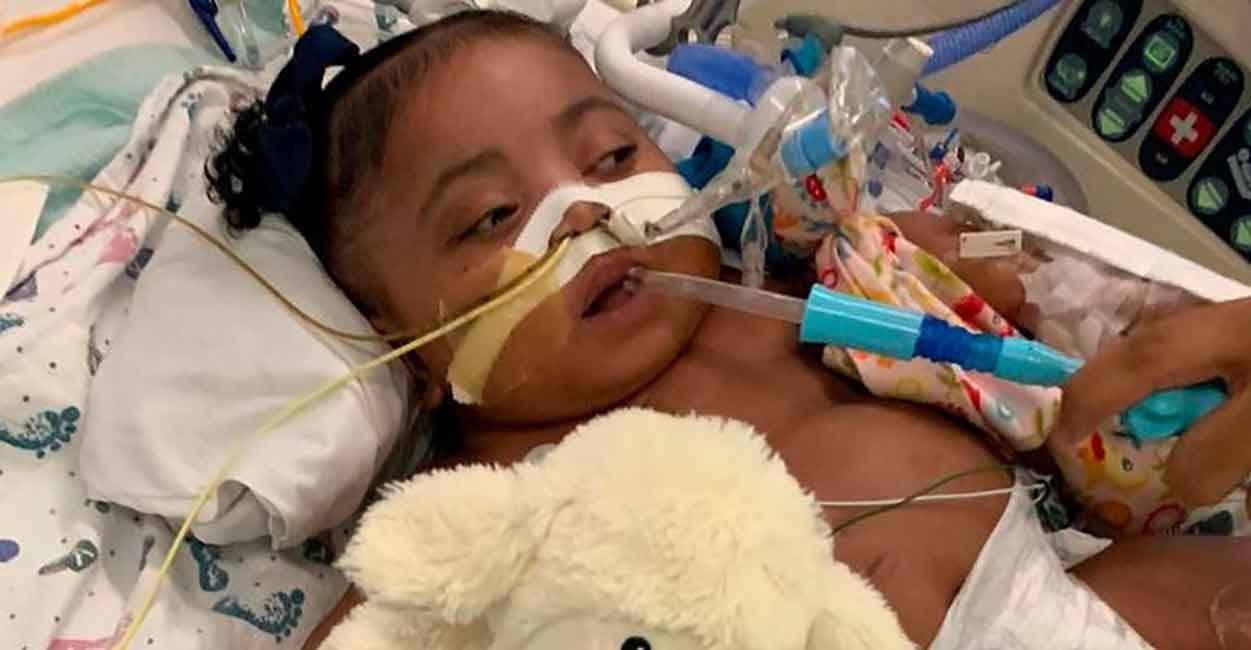
#2932 (2/8) PRO-LIFE SAT: "Baby Tinslee Lewis and the Difficult End-of-Life Care Debate"

"BABY TINSLEE LEWIS AND THE DIFFICULT END-OF-LIFE DEBATE"Robert Moffit / January 28, 2020 / https://www.dailysignal.com/2020/01/28/baby-tinslee-lewis-and-the-difficult-end-of-life-care-debate
     "I fully believe that Tinslee’s life is in God’s hands, and that she deserves a fair and fighting chance at life, however long God has for her," says Trinity Lewis, Tinslee's mother. (Photo: Texas Right to Life)

     Tinslee Lewis, a very sick year-old baby, is at the intersection of a bitter Texas debate over current law and ethical responsibilities in end-of-life care. Texas hospital officials want to withdraw Tinslee’s life-support—after having given her mother 10 days to find alternate care for the baby, which is what Texas law requires. Trinity Lewis, the girl’s mother, has not been able to find another hospital to take Tinslee and wants to keep the baby on life support. She has filed a lawsuit against the hospital.

   Little Tinslee was born prematurely and suffers from a rare heart defect, lung disease, and heart failure. Tinslee’s lungs are unable to deliver oxygen into her bloodstream. After multiple surgeries to correct her condition, she is sedated and on life support; specifically, a ventilator.
Authorities at the Cook Children’s Medical Center in Fort Worth, Texas, claim that she is in pain and concluded that her prognosis is terminal in their effort to withdraw her artificial life support.

   Texas hospitals, with the approval of their in-house ethics committees, can legally withdraw artificial life support, regardless of the patient’s objection or a family member authorized to act on the patient’s behalf. The patient or representative, as noted, must be given 10 days to find another hospital to take the patient before care is denied. Cook Children’s Medical Center has referred Tinslee’s case to 20 other hospitals or specialists, and thus far, all have declined to take responsibility for Tinslee’s care.

   Meanwhile, Lewis, objecting to the hospital’s decision to withdraw her baby’s life support, has taken legal action to stop the hospital from doing soThe New York Times reports that Lewis wants to give her child a “fighting chance” and wants to be the one who makes the final decision, not the hospital. Referring to the 10-day rule to find alternative care, Joseph Nixon, Lewis’ attorney, said, “The culprit in this case is the statute.”  

   In the initial phase of this legal battle, a Texas district court judge ruled in favor of allowing the hospital to discontinue life support, then a Texas court of appeals delayed that decision, ordering the hospital to maintain the little girl’s life support until it renders a final decision. Meanwhile, Texas Attorney General Ken Paxton filed an amicus brief in support of the mother’s case, arguing that current law allows the government to deny a person his or her right to life, and does so without “sufficient process of law.” 
   The reason: The statute doesn’t give the patient or her representative adequate notice of “why or how” the care is to be terminated, guarantee an opportunity for the patient or representative to be heard, or guarantee an impartial arbiter in the event of a disagreement. In short, the law gives the hospital virtually unilateral power to make the life-or-death decision.

   The case entangles two distinct—but inseparable—ethical and legal issuesMoral theologians and medical practitioners alike have long recognized the crucial distinction between ordinary medical care, which is focused on treating and curing disease, and extraordinary medical care, which often only prolongs pain and suffering without preventing eventual natural death.
   For example, the Christian Medical and Dental Associations declares, “Technology should not be used only to prolong the dying process when death is imminent.” Likewise, then-Pope John Paul II in his 1995 encyclical “Evangelium Vitae” (“The Gospel of Life”) reaffirmed the well-established distinction between ordinary and extraordinary (aggressive or “heroic”) medical treatment: “To forgo extraordinary or disproportionate means is not the equivalent of suicide or euthanasia; it rather expresses acceptance of the human condition in the face of death.”

   The physicians at Cook Children’s Medical Center may be perfectly correct in their clinical assessment that Tinslee’s prognosis is terminal, and they may be right that putting the child on artificial life support is in the category of “extraordinary” care that is not the best ethical alternative in her case. Nonetheless, given a hospital’s conflict of interest in a life-or-death question of provision of expensive care, it doesn’t logically follow that they should exercise the final judgment.

   Under the traditional Hippocratic Oath, the physician is the servant, not the master, of the patient. In the case of a child, it is the child’s parents—and not hospital or government officials—who have the primary right to determine the best interests of the child.
   In fact, two of the most notorious medical controversies in recent years—the cases of Alfie Evans and Charlie Gard, two British infants—centered on the British officials’ assertion that they, not the parents, had the ultimate right to determine the “best interest” of the children.   

   The Tinslee Lewis case is both hard and heartbreaking. Thus far, faced with a rejection of at least 20 alternative facilities or specialists, Lewis said she wants to get palliative care, to relieve her little girl’s pain, if she is in pain, and further treatment to possibly improve her condition:  
   "I fully believe that Tinslee’s life is in God’s hands, and that she deserves a fair and fighting chance at life, however long God has for her. My biggest priority is getting Tinslee appropriate care so that I can make the best decision for my baby.This situation takes away from my job as a mother and lets other people who don’t even know her decide whether her life is worth living."

   Parental authority is the primary issue in this case. Charles Krauthammer, then a columnist for The Washington Post and a physician, addressed precisely this issue in the case of Charlie Gard:"The sovereignty of loved ones must be the overriding principle that guides all such decisions. We have no other way. The irreducible truth is that these conundrums have no definitive answer. We thus necessarily fall back on family, or, to put it more sentimentally, on love." 

   The right and duty of doctors to act in accordance with traditional medical ethics is, however, also a crucial issue."  As the Christian Medical and Dental Associations has emphasized, “We do not oppose withdrawal or withholding of artificial means of life support in patients who are clearly and irreversibly deteriorating, in whom death appears imminent, and who are beyond reasonable hope of recovery.”

   It may be the right decision to withdraw life support. But as a matter of public policy, Paxton, Texas’ attorney general, is correct: We must have scrupulous due process and protections for the patient. Texas lawmakers are right to address the 10-day rule governing hospital decisions to end a patient’s life support. The law is flawed, and Texas legislators must do their best to uphold both parental rights and physicians’ rights of conscience.  

   Balancing the rights of patients and parents, and the rights of conscientious medical professionals, is a difficult, prudential exercise. A new Texas law, hopefully the product of careful consultation and deliberation, should reflect both a respect for the primacy of the patient’s wishes and the ethical responsibilities of physicians. It should repair the law’s due process deficiencies, guarantee a reasonable time frame for patients (or families) to exhaust medical alternatives, and protect the conscience and clinical judgment of medical professionals dedicated to traditional medical ethics, especially the sanctity of life.  

   Beyond Texas, state officials around the nation should re-examine their end-of-life laws, and encourage doctors and patients and their families to work together to facilitate sound end-of-life care arrangements.

[italics and colored emphasis mine]

     Robert E. Moffit, Ph.D., a seasoned veteran of more than three decades in Washington policymaking, is a senior fellow in domestic policy studies at The Heritage Foundation.


--------------------------------------


PRAYER MATTERS:

"To clasp the hands in prayer is the beginning of an uprising against 
the disorder of the world Karl Barth
"Prayer is inviting God into a seemingly impossible situation and trusting/resting in His love and grace to accomplish His perfect will in His perfect time and for His greatest glory. Intercession is  one of the great privileges AND responsibilities for EVERY believer."- Stan

World-Wide Prayer Requests:
------------------------------------------------------------
Praying Through the Open Doors World Watch List for persecuted believers:https://www.opendoorsusa.org/take-action/pray/monthly-prayer-calendar/
 Secret believers in North Korea Winters can be very difficult in North Korea. Food is often scarce— especially this winter following the recent drought. However, even in the midst of this difficulty, Christians often share a portion of their rice with their neighbors—a practice called “holy rice.” One underground leader says, “It’s a great way to build trust and, after trust has been built, to talk about the gospel.” Right now, Open Doors is helping 60,000 Christians with food relief to strengthen the church and empower believers. 
February 7–8 - Pray for the country’s food crisis to be resolved and for peace and religious freedom in North Korea. Trauma care in Nigeria The Shalom Center, a long-awaited trauma center in Nigeria from Open Doors, started operations in March 2019 after it was delayed by a year due to challenges with security in the area. The center is intended as a place where people who have suffered various kinds of trauma can come for extended care to find peace. Since opening on March 1, the center has trained trainers and provided weekly in-depth care to survivors of violent attacks.
*Representative name or photo used to protect identity

Friday, February 7, 2020

#2931 (2/7) "Breakfast with a Side of Prayer"

"BREAKFAST WITH A SIDE OF PRAYER" - Tony Perkins, Washington Update, February 06, 2020; https://www.frc.org/updatearticle/20200206/breakfast-prayer [AS I SEE IT: Not surprsingly, the mainstream  media chose to exclude the statements made by the president at Thursday's National Prayer Breakfast noted below that express humility and his struggle with forgiveness. Not having experienced what he has these many months - as well as what his family has endured behind the scene - it's easy to judge him. But his statements noted here illustrates how he struggles like the rest of us with the hard things of the Christian walk. His remarks later in the day at his celebratory meeting with friends on Captiol Hill unfortunately reverted back to that struggle and should be seen as such. It should lead us to continue to pray for President Trump and for each of us as well as we also struggle with the hard things of seeking to be Christ-like. - Stan
     If there were ever a time the nation needed prayer, it's now. The morning after America's long impeachment nightmare finally came to an end, Minority Leader Kevin McCarthy (R-Calif.) spoke for everyone when he said at this morning's National Prayer Breakfast, "The Lord works in mysterious ways. I do not think he could have picked a better day to bring us all together."

   It was a poignant reminder for everyone, including the two most prominent people on the dais. Hours after the Senate voted to acquit him, Donald Trump sat five seats away from the woman who not only ripped up his State of the Union speech on live television, but plunged the nation into these months of turmoil to begin with. Still, Harvard's Arthur Brooks said, "[The same Jesus] who taught us to love God taught us to love each other." Hoping to use the moment to call for healing, he insisted the biggest crisis facing our nation is the "crisis of contempt and polarization." It's tearing our society apart, he urged. But in this crisis, Brooks encouraged, "resides the greatest opportunity we have ever had as people of faith to lift our nations up and to bring our people together."

   As the president admitted later, that wasn't the easiest message to swallow. Behind the bravado, most Americans probably don't realize what a difficult time this has been for him. "As everybody knows, my family, our great country, and your president have been put through a terrible ordeal..." he said when he took to the podium. "They have done everything possible to destroy us and by so doing, very badly hurt our nation. They know what they are doing is wrong, but they put themselves far ahead of our great country. So many people have been hurt," he admitted, "and we can't let that go on."

   Looking at Brooks, he acknowledged how hard the message of forgiveness can be. "I'm sorry," the president said with humility. "I apologize. I am trying to learn... It's not easy. When they impeach you for nothing, and you're supposed to like them, it's not easy, folks. I do my best," he said. "I'm working very hard for you, I will tell you," he had started. Then, to laughter, "And sometimes you don't make it easy, and I certainly don't make it easy on you."

   But then, the president launched into the reasons that he hasn't just made it easy on Americans -- he's made it possible for Americans to live openly and authentically. "All of us here today reaffirm these timeless truths: Faith keeps us free. Prayer makes us strong. And God alone is the author of life and the giver of grace... In everything we do, we are creating a culture that protects freedom, and that includes religious freedom... So much of the greatness we have achieved, the mysteries we've unlocked, and the wonders we've built, the challenges we've met, and the incredible heights that we've reached has come from the faith of our families and the prayers of our people."

   We can talk about the Johnson amendment, he said. "We can talk about Mexico City Policy... But I also recently took executive action to stop taxpayer dollars from going to colleges and universities that spread the poison of anti-Semitism and bad things about Christianity. We are upholding the sanctity of life. And we are doing that like nobody has ever done it before from this position." But, the president insisted, there is "something which wasn't done nearly enough -- I could almost say wasn't done at all" before his administration: "We are standing up for persecuted Christians and religious minorities all around the world."

   "Religion in this country and religion all over the world -- certain religions in particular -- are under siege. We won't let that happen. We are going to protect our religions. We are going to protect Christianity. We are going to protect our great ministers and pastors and rabbis and all of the people that we so cherish and that we so respect... Let us ask Father in Heaven to guide our steps."

[italics and colored emphasis mine]


--------------------------------------


PRAYER MATTERS:

"To clasp the hands in prayer is the beginning of an uprising against 
the disorder of the world Karl Barth
"Prayer is inviting God into a seemingly impossible situation and trusting/resting in His love and grace to accomplish His perfect will in His perfect time and for His greatest glory. Intercession is  one of the great privileges AND responsibilities for EVERY believer."- Stan

World-Wide Prayer Requests:
-----------------------------------------------------------
Praying Through the Open Doors World Watch List for persecuted believers:https://www.opendoorsusa.org/take-action/pray/monthly-prayer-calendar/
 Secret believers in North Korea Winters can be very difficult in North Korea. Food is often scarce— especially this winter following the recent drought. However, even in the midst of this difficulty, Christians often share a portion of their rice with their neighbors—a practice called “holy rice.” One underground leader says, “It’s a great way to build trust and, after trust has been built, to talk about the gospel.” Right now, Open Doors is helping 60,000 Christians with food relief to strengthen the church and empower believers. 
February 6 - Pray for more children (in North Korea) to come to know Christ either through their parents or a secret believer
*Representative name or photo used to protect identity