Tuesday, January 13, 2015

# 1113 (1/13) "Why Free Community College Is Anything But Free"

"Why Free Community College Is Anything But Free" - Lindsey Burke / @lindseymburke / January 09, 2015 / http://dailysignal.com/2015/01/09/free-community-college-anything-free/?utm_source=heritagefoundation&utm_medium=email&utm_campaign=dailydigest&mkt_tok=3RkMMJWWfF9wsRoluKrJZKXonjHpfsX56eguXa%2B3lMI%2F0ER3fOvrPUfGjI4FRMFmI%2BSLDwEYGJlv6SgFQrLBMa1ozrgOWxU%3D [AS I SEE IT: While this article does mention what can be called the unintended consequences of this proposal, it says nothing about what is possibly an intended consequence - to gain the political support of another special interest group when elections come  around. No, that's not being cynical. It's being realistic about how too many use our tax money for political advantage. - Stan]
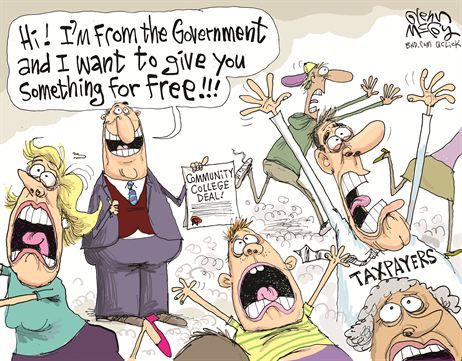
The Obama administration announced Thursday that it will propose two years of “free” community college, paid for by taxpayers, for students maintaining a “C” or better average. The federal government would finance three-quarters of the costs, and the administration says it hopes the remainder would be financed by states.

The White House claims the proposal will save students $3,800 per year in tuition costs. When asked about the cost of the proposal to taxpayers, the administration said it did not yet have a price tag, but that the cost would be “significant,” according to Politico. President Obama is expected to share more details of the plan in his Jan. 20 State of the Union address.

The administration’s proposal begs certain questions. Low-income students already have access to federal Pell Grants, which can be used to finance their tuition obligations at a community college. Indeed, the number of Pell recipients has doubled since 2008. So the proposal will serve as little more than a federal handout to the community college system.

And it’s a system that hasn’t exactly produced stellar outcomes. Just 20 percent of students who begin community college each year complete their program within 150 percent of the standard time, according to the U.S. Department of Education. And, as the Cato Institute’s Neal McCluskey found: "According to the National Student Clearinghouse Research Center, only 20 percent of community college students transfer to four-year schools, and only 72 percent of those will have finished or remained enrolled four years later. So, from what we can tell, we are looking at completion for just around 34 percent of community college students.

And what is to prevent community colleges from escalating tuition and fees once the federal government – via taxpayers – begins paying the tab? The White House says the federal government will pay three-quarters of the costs of “average” tuition at community colleges, but we’ll most certainly see that “average” increase in the years to come thanks to this new federal largesse.

Then there is the impact on the K-12 system. More than one-third of students have to take remedial courses when they enter college, as they leave high school unprepared for university-level work. Free community college would put even less pressure on high schools to produce graduates who are prepared for college-level work, as they could expect the new free community colleges to fill in what the high schools are failing to do. The proposal is more likely to produce a six-year high school system than a two-year gratis workforce preparation experience.

The administration’s proposal is another step toward the White House’s goal of a “cradle-to-career” education system, starting with free preschool and now free community college. And then, even if a student does accrue debt in this new federally funded free-for-all, the administration has capped loan repayments at 10 percent of discretionary income, and any remaining balance is forgiven by the taxpayers after 20 years. And those benefits are even more generous for individuals who work in “public service,” largely defined as government jobs.

Once again, the administration is pursuing initiatives to subsidize rising costs, instead of working with Congress on policies that actually would address the driver of college cost increases: the open spigot of federal student aid. Over the past several decades, college costs have risen at more than twice the rate of inflation, thanks in large part to federal subsidies.

Allow markets in higher education to work by limiting federal subsidies instead of increasing them, and costs will fall for students attending colleges of all types.

[bold, italics, and colored emphasis mine]

Lindsey M. Burke researches and writes on federal and state education issues as the Will Skillman fellow in education policy at The Heritage Foundation. Read her research.

Monday, January 12, 2015

# 1112 [posted later]

"Paris Shooting Another Example Of Why Republicans Must Lead" - Matt Towery | Jan 08, 2015; http://townhall.com/columnists/matttowery/2015/01/08/paris-shooting-another-example-of-why-republicans-must-lead-n1940003/page/full

The shocking act of murder by terrorists in Paris this week provides chilling new evidence that Republican majorities in Congress must act. The tepid response from the White House -- a hallmark of Obama, except on issues like race and law enforcement -- must come to an end. It will take action by Republicans on Capitol Hill to force a change. 

[Last] Monday, the political press was abuzz over a challenge to House Speaker John Boehner from several of his fellow representatives. But Boehner won another term as speaker. Now it's time for Boehner and Senate Majority Leader Mitch McConnell to demand that this nation set its priorities right. Rather than bashing law enforcement officials or promoting class warfare, Washington needs to come to grips with real issues that threaten America's security and well-being.

From cyber attacks to what we might call "practice runs" of terrorism against the West, such as the Paris massacre, the United States is being challenged to engage in a war. No one wants such a war, but we must at least admit that we are under attack.

While the Obama administration has been quick to point out a cyber attack they believe came from North Korea, the White House continues to not fully acknowledge acts of brutal terrorism by militant Islamists, who have made it clear that the destruction of the West is their ultimate goal.

For the last few months, our news has been dominated by issues of race and alleged abuse by law enforcement officials. No one denies that race remains an issue in America. But the Obama White House has treated it as if it were the central issue of our time. And thanks to people like New York City Mayor Bill de Blasio, honest and hard-working police officers have been lumped in with a handful of alleged renegades in being unfairly stereotyped.

And while passage of legislation such as the Keystone Pipeline is important, messaging on broader issues can also be critical, as the Obama administration has shown time and again with its inability to speak clearly and forcefully. So now the Republicans should use the bully pulpits in both the House and the Senate. They should stop quibbling over issues of comparatively small importance and start challenging Obama and his shrinking party on matters of life and death.

For example, no one has any concept of what our nation's defense system is against cyber attacks or other terrorist threats. What is clear is that this administration would rather focus on the alleged failures of the CIA than on formulating a clear plan to combat our terrorist foes.

Republicans must understand that while issues such as Obamacare and immigration are important to many Americans, the security of our citizens and the preservation of our major means of communications, such as the Internet, are our paramount interests. Rather than simply throwing rocks at what is clearly a lame duck president who is hell-bent on implementing tangential liberal policies, Republicans must offer well-thought-out and substantive proposals to secure this nation.

America has seen warnings and terrorist "practice runs" before. There was the World Trade Center bombing, for example, not many years prior to 9/11. That was during a time when the stock market seemed strong and people felt secure. Now, once again, we are witnessing practice runs of terrorism just as Americans are starting to feel good about lower gasoline prices and an improving economy. But neither interest in the economy and other traditional issues, nor happenings like unrest in Ferguson, Missouri, will seem important if America is the victim of another 9/11, or worse.

Both John Boehner and Mitch McConnell now enjoy unified Republican majorities in their respective chambers. Now it's time for them to dictate to the president some real solutions to deadly problems. Quickly.

[bold and italics emphasis mine]

Matt Towery is a former National Republican legislator of the year and author of Powerchicks: How Women Will Dominate America.

Sunday, January 11, 2015

# 1111 (1/11) "Two Words for Christians in 2015 - CLARITY AND HOPE"

Sunday Special -"Two Words for Christians in 2015 - CLARITY AND HOPE" - By: John Stonestreet| Breakpoint.org: January 6, 2015/ http://www.breakpoint.org/bpcommentaries/entry/12/26622?spMailingID=10309984&spUserID=MTMyMjM2ODE5OQS2&spJobID=460397634&spReportId=NDYwMzk3NjM0S0
daily_commentary_01_06_15
On a personal level, 2014 was a fun and challenging year. Fun with new experiences, trips with my family (including down under to Australia in July with my oldest daughter), and moving to a new house that we just love. God was very kind to us.I also learned a lot about things like habits and virtues, trust and leadership, and finding peace in confusion. As I said, God was very kind to us.

Now on a cultural level, it was a loaded year too. We saw how fragile our society is, and how old wounds can quickly be reopened and cause havoc. One of the key stories of 2014 is that racial divisions remain deep, and were exposed by the events in Ferguson and Staten Island.

We also saw how quickly cultural tides can change. Officially last year, same-sex marriage (for example) completed the shift from unthinkable to unquestionable. And in its wake, as my colleague Eric Metaxas mentioned yesterday, has come new threats to religious freedom—one that essentially enshrines a secular worldview. [We are told] Religious and moral convictions must be kept private and out of the public square in both politics and commerce.

Now each of these issues, and the many others we faced in 2014, demand two things of Christ-followers. First, we’re called to clarity. I am convinced, especially after the chaos of Ferguson and the response to the CIA Torture Report , that Christians need to be more careful than ever to avoid what Chuck Colson so often called the political illusion.

Our cultural divisions are falling today along almost completely political lines, and Christians very often find themselves using their faith to justify their political divisions rather than seeing each and every issue through the lens, first and foremost, of Scripture and historical Christian teaching.

And when those who are clearly our brothers and sisters in Christ and who share our worldview land on the other side of an issue, we must first pause and listen, and carefully consider whether we might have blind spots brought on in this politically charged environment in which we live. What’s most disturbing is when believers show an inability to listen, and to immediately castigate brothers and sisters in Christ as being “compromised.”

Now make no mistake—too many Christ-followers today are compromising on all-too-important issues like marriage and family, the image of God, the Bible’s truthfulness and other issues of central importance. Many are tempted to abandon the clarity of historic Christian teaching on these issues.

That’s why we need biblical clarity across the board. Not all disagreement is compromise, and it’s certainly not true that only those on the other side of the political aisle suffer from the Fall. We do too.

And so our categories cannot be first Republican or Democrat. And though those committed to historical Christian teaching will likely continue to find themselves most often on one side of the political aisle, let’s be clear: Our allegiance belongs to Christ, not the singular platform of a political party. And we can expect this temptation to only grow this year as presidential candidates launch their campaigns.

And as our culture continues to march toward unsustainable debt and family demise, we’ll also need to be clear as to what our true story really is. “Always be ready,” said St. Peter to a group of Christians facing persecution and dispersion, “to give an answer to anyone who asks you for the hope that is in you.” Our story is one of hope.

“Christians have not right to despair,” wrote Richard John Neuhaus, “because despair is a sin. And Christians have not reason to despair, quite simply because Christ has risen.” That’s the truth of our culture and all cultures. It is the truth whatever the level of cultural pressure we’ll face in 2015.

And as we stand committed and uncompromising, let’s stand hopeful. I think we’ll see how compelling it can be to others.

[bold, italics, and colored emphasis mine]

AVAILABLE AT THE ONLINE BOOKSTORE
Truth Matters: Confident Faith in a Confusing World - Andreas Kostenberger, Darrell Bock, Josh Chatraw | B&H Publishing Group | May 2014
Reasonable Faith: Christian Truth and Apologetics - William Lane Craig | Crossway Books | June 2008
The Case for Christ - Lee Strobel | Zondervan | September 1990
The Christian Mind: How Should a Christian Think? - Harry Blamires | Regent College Publishing | February 2005
Hope for Each Day: Words of Wisdom and Faith - Billy Graham | Thomas Nelson Publishers | April 2002

Saturday, January 10, 2015

# 1110 (1/10) "Sitting in the Abortion Clinic Waiting Room to Abort Her Baby, She Left When This Happened"

"Sitting in the Abortion Clinic Waiting Room to Abort Her Baby, She Left When This Happened" - by Nancy Flanders | Washington, DC | LifeNews.com | 12/24/14; http://www.lifenews.com/2014/12/24/sitting-in-the-abortion-clinic-waiting-room-prepared-to-abort-her-baby-she-left-when-this-happen [AS  I SEE IT: As I pray each morning for the estimated 3,000 girls and women who are planning to have their unborn babies aborted that day, I ask God to give each of them a dream or vision of their unborn child, that they would acquire a mother's special love for her child. (Those who will abort usually just regard their child as an "it," simply a mass of tissue.) I pray that -like the woman in this story - many might be moved to get up and leave even as they are in the killing center waiting for their appointment. - Stan] 

(LiveActionNews) — Married with no plan of having children, Inga Wismer was very much pro-choice when she found out she was pregnant. Her husband, who was adamant about not having children, told her to make an appointment for an abortion, and Inga did. But while she was sitting in the waiting room, looking around at the other women, Inga realized that what she was doing was wrong.“I realized I had no right to take another person’s life,” she recalls. “I got up and left.”

Because of her brave choice not to abort her son, Inga’s husband left her. Friends wondered why she would keep her baby if it meant losing her husband, but Inga was certain that her child’s life mattered and that he deserved a chance at life. Now, she and her second husband Michael have made another brave move in helping another child get his or her chance at life by adopting an embryo.
inga
After Michael adopted her son, the couple had another boy, but that pregnancy was followed by a second-trimester miscarriage that left them devastated. Her husband recognized how much Inga was hurting, and together they decided to adopt two siblings from Africa. Unfortunately, the two children had severe behavioral issues as a result of reactive attachment disorder (RAD).

According to the Mayo Clinic, RAD is a rare but serious condition in which an infant or young child doesn’t establish healthy attachments with parents or caregivers. A child may develop RAD if his basic needs for comfort, affection, and nurturing aren’t met.  Inga quit her job and began weekly counseling in order to help the children learn to bond with them.

Then, after an unexpected pregnancy and the birth of their daughter, problems with the adopted children escalated. One of the children even tried to suffocate the new baby. In addition, Inga’s 89-year-old father’s health was failing, and he moved from Russia to be closer to the family. Inga took care of him daily until his death seven months later. The family and each of its members was suffering greatly. It was then that the couple made a heartbreaking decision.

“We made an excruciating decision to disrupt our adoption (http://news.yahoo.com/giving-away--anatoly-a---200851799.html) and the children were immediately adopted by a couple who both happened to be special needs educators who were prepared for the behavioral issues,” explains Inga, “I was completely heart-broken, but it was what was best for the children.”

A year later, the couple still had the desire to adopt for a couple of reasons. They wanted to provide a home for a child, they wanted to continue to grow their family, and they had learned that they were both carriers of the genetic condition cystic fibrosis. This time, rather than adopt an older child, they visited a fertility clinic and were able to adopt an embryo donated to the clinic for adoption by a couple who had done in vitro fertilization.

“I am extremely pro-life now,” says Inga, “and I believe life begins at conception. These embryos deserve a chance at life too.”

Embryo adoption is a relatively new choice in adoption. According to the Embryo Adoption Awareness Center, embryo adoption began in 1997, and since then about 3,500 embryo adoptions have taken place. There are currently over 600,000 frozen embryos in the United States, an increase of 54% since 2002. Since 2011, the number of babies born through embryo adoption has increased by 25% thanks to its affordability compared to standard in vitro fertilization and the fact that the adoptive parents are able to experience pregnancy and childbirth. These two factors helped Inga and her husband make their decision to adopt an embryo.

Inga’s embryo transplant was successful, and she is currently about three months pregnant with their next child. “I wanted to share this story,” says Inga,” because I wanted to spread the word of hope, healing, and this miraculous way of family building. I wanted to tell about a new hope after a season of profound sadness, loss, death, and devastation. There is a new beginning, a new miracle. Life goes on.”

For more information about embryo adoption, visit the Embryo Adoption Awareness Center.

For more information about reactive attachment disorder and helping a child who has been diagnosed with RAD, visit RadKid.org.

For more information about cystic fibrosis and life with the condition, visit cff.org. For an account of giving life to a baby with cystic fibrosis, go here.(http://liveactionnews.org/mother-killed-daughter-just-like-mine/)

(bold and italics emphasis mine]

LifeNews Note: Nancy is a work at home mom who writes about parenting, special needs children, and the right to life. She is the lucky mother of two spirited little girls, one who has cystic fibrosis, and she spends any free moment she can find fundraising for a cure for CF. You can read her personal blog at www.ChronicAdmissions.com. Reprinted from Live Action News.

Friday, January 9, 2015

# 1109 (1/9) "New Year, Old Resolution - DEFEND RELIGIOUS LIBERTY"

"New Year, Old Resolution - DEFEND RELIGIOUS LIBERTY" - By: Eric Metaxas| Breakpoint.org: January 5, 2015 / http://www.breakpoint.org/bpcommentaries/entry/12/26604?spMailingID=10291941&spUserID=MTMyMjM2ODE5OQS2&spJobID=460126649&spReportId=NDYwMTI2NjQ5S0

If you’re like six in ten Americans, you make New Year’s resolutions at least some of the time. According to the website Statistic Brain, the top five resolutions are: losing weight, getting organized, spending less and saving more, enjoying life to the fullest, and staying fit and healthy.Now those are fine resolutions, although they’re all pretty self-directed. But if you’re making resolutions for 2015, let me urge you to consider an old one that hardly makes anyone’s list, but is certainly at the top of mine.

Will you resolve to support religious freedom in 2015? If we don’t do it in this New Year, it just might be too late.

Just think of all that has happened to undermine religious freedom, the first freedom, in 2014. Think about all the Christian bakers and florists who were told to support what are called “same-sex marriages” or face ruinous fines and the loss of their careers.

Or think of Gordon College, a well-regarded evangelical institution that faces the possible loss of accreditation for its biblical beliefs about human sexuality. Gordon President Michael Lindsey, a friend of mine, dared to sign a letter requesting that President Obama include a religious exemption in an executive order that would prohibit discrimination in hiring and employment on the basis of sexual orientation or “gender identity.”

Or, think of the owners of Hobby Lobby, a Christian-run company, or the Catholic Little Sisters of the Poor, being told by the Obama administration that they must provide their employees with drugs that can induce abortions.

Wheaton College in Illinois, which faces the same issue, is also fighting for its beliefs in court. Yet most of us go about our lives as if nothing is really happening, as if all is well. Well folks, it isn’t!

Now let me make it clear that I’m concerned about protecting this old, fundamental right for all Americans, not simply protecting our rights as Christians. God forbid. This is about freedom of conscience and giving everyone the opportunity to exercise a faith, or to exercise no faith at all.

I can never get Jonathan Swift’s classic satire “Gulliver’s Travels” out of my mind when I think of this. Remember the scene where a sleeping Gulliver is being tied down by the Lilliputians? Gulliver is like the American church, asleep. At any moment, if he wakes, he can crush the Lilliputians, which are the proliferating ways that our culture restricts our freedom of action and belief. But as Gulliver continues to sleep, the Lilliputians are putting one small rope across him followed by another. If Gulliver doesn’t wake up in time, eventually there’ll be too many ropes, and he will not be able to get up. Folks, that is happening.
As my friend Os Guinness said in his great book, “A Free People’s Suicide,” “America’s writing on the wall is evident to those who are watching.”

My question is whether this will be the year when the church finally realizes that although our situation may not be as dire as Bonhoeffer’s and the German church during the Third Reich, the principle is exactly the same. When the state tries to impose its values on a sleeping church, it will succeed and will eventually neutralize the voice of the church completely.

Now, I do see some hopeful signs. Remember earlier this year when the mayor of Houston subpoenaed the sermons of pastors? Many Christians, some of you, flooded her office with sermons, books, and Bibles, and she backed down. The incident was a tiny wake-up call for the church, enabling us to see that the battle for religious liberty is real, and we had better fight it.

But many more challenges are coming. Let’s make a resolution to stay awake for religious liberty in 2015. It is the most important resolution we can possibly make.

[bold and italics emphasis mine]

ORGANIZATIONS
The Alliance Defending Freedom - http://alliancedefendingfreedom.org/
The Becket Fund for Religious Liberty - http://www.becketfund.org/

RESOURCES
Manhattan Declaration website - http://www.manhattandeclaration.org/#0

FURTHER READING AND INFORMATION
New Years Resolution Statistics - University of Scranton. Journal of Clinical Psychology | January 1, 2014; http://www.statisticbrain.com/new-years-resolution-statistics/
AVAILABLE AT THE ONLINE BOOKSTORE
Bonhoeffer: Pastor, Martyr, Prophet, Spy - Eric Metaxas | Thomas Nelson | August 2011
A Free People’s Suicide: Sustainable Freedom and the American Future - Os Guinness | IVP | August 2012
The Global Public Square: Religious Freedom and the Making of a World Safe for Diversity
Os Guinness | IVP | September 2013

Thursday, January 8, 2015

# 1108 (1/8) "The Do-Something Congress"

"The Do-Something Congress" - Jackie Gingrich Cushman | Jan 08, 2015; http://townhall.com/columnists/jackiegingrichcushman/2015/01/08/the-dosomething-congress-n1939854/page/full [AS I SEE IT: I sense there are many who - rather than be hopeful - are already cynical about the new Congress being able to accomplish things despite the expected opposition from the President. As this article makes clear, the key is for the new Congress to wield its power wisely in the face of expected opposition. Can they? Of course. Will they? With our prayers, we can hope. As Scripture says, "With God, all things are possible." - Stan]

As members of the 114th Congress were sworn into office on Tuesday, their party affiliations described what happened last November: 246 of the 435 representatives and 54 of the 100 senators are Republican.
That might be enough for some fellow GOP'ers to claim victory and a "mandate," but they would be wise to recall a lesson from history.

The last time the House had so many Republicans was in 1947, when the 80th Congress was sworn in. At that time, Republicans also held 51 of the 96 Senate seats. Democrat Harry S. Truman, who had become president on April 12, 1945, upon Franklin Delano Roosevelt's death, was beginning the third year of his first term.In 1948, Truman ran against Republican nominee, Thomas Dewey, governor of New York. That year, Truman was also running against what he termed the "Do-Nothing Congress." Before the election, polls and pundits put Dewey in the lead and many believed there was no way he could lose. The Chicago Daily Tribune ran with the headline, " Dewey Defeats Truman," the morning after the election.But, in one of the biggest upsets in U.S. politics, Truman won. Not only did he win reelection but his party wrested control of Congress, where Republicans lost 73 seats in the House and nine in the Senate.

Sixty-eight years later, the 114th Congress has an opportunity to become the Do-Something Congress. To earn that distinction, Republicans should focus first on moving rapidly to pass bills -- on bipartisan issues that Obama will have to sign, and then move to more partisan issues that will allow for clear, clean lines to be drawn for the 2016 election.

Republicans should constantly and consistently promote what they have passed legislatively and what President Obama either sits on or vetoes. The reality and narrative should reflect a Congress whose members work hard and pass legislation and a president who "does nothing" or seeks to obstruct the will of the majority. The Republicans will have to be aggressive in their communications strategy, as the White House is very effective at shaping communications, if not governing.

Why is it important that they focus on execution? Last year, Americans told Gallup pollsters that government leadership was the country's most important problem. This included "President Barack Obama, the Republicans in Congress and general political conflict." It was the problem listed most often at 18 percent. (Conducted monthly, 1,000 adults, 95 percent confidence level, plus or minus 1 point.)

If, as the Gallup numbers show us, people are concerned with our government's lack of performance and they want our government to work -- who should take the lead? President Barack Obama, who is serving out the last two years of his second term, or Republicans, who recently gained seats in the House of Representatives and took control of the Senate? While some Republicans might claim they have the upper hand, given their pickup of many seats in the midterm election, the polling numbers provide a different perspective.

A Rasmussen poll released Tuesday found that "42 percent of Likely U.S. Voters think it would be better for the country if the president does more of what Congress wants. Just as many (43 percent) say it would be better if Congress does more of what the president wants." (Eight-hundred likely U.S. voters polled Jan. 2, 2015, 95 percent level of confidence, plus or minus 3 points.)

While the Republicans are busy being effective and making Washington work, they should also be focusing on the long term -- reaching out to women, minorities and anyone else who may be willing to work with them.

This time, winning a midterm election should be about more than a short-term gain of seats; it should instead be about setting the stage for a larger win down the road. This will require that the Republicans govern the entire country.

This is a chance for Republicans to reach out, to be inclusive and to ensure that all Americans can have a brighter future together.This is Republicans' opportunity to lead America and set the pace in a Do-Something Congress.

[bold and italics emphasis mine]

Jackie Gingrich Cushman is a speaker, syndicated columnist, socialpreneur, and author of "The Essential American: 25 Documents and Speeches Every American Should Own," and co-author of “The 5 Principles for a Successful Life: From Our Family to Yours”.


Wednesday, January 7, 2015

# 1107 (1/7) "The Private Sector, Not Obama, Created This Recovery"

"The Private Sector, Not Obama, Created This Recovery" - Stephen Moore / @StephenMoore / January 04, 2015 / http://dailysignal.com/2015/01/04/the-private-sector-not-obama-created-this-recovery/?utm_source=heritagefoundation&utm_medium=email&utm_campaign=morningbell&mkt_tok=3RkMMJWWfF9wsRoluavIZKXonjHpfsX56eguXa%2B3lMI%2F0ER3fOvrPUfGjI4FSsRjI%2BSLDwEYGJlv6SgFQrLBMa1ozrgOWxX0TD7slJfbfYRPf6Ba2Jw1qf0%3D

It only took six years, but we’re finally starting to see the U.S. economy kick into gear. This isn’t a story of government-directed growth, but the opposite—Washington’s role in the economy starting to shrink after years of Obama administration activism. The private sector is starting to take over.

Let’s start with the positive news. 
     Economic output soared in the third quarter at a rate of 5 percent. That comes on top of 4.6 percent growth in the second quarter. It appears that the U.S. economy has clawed out of its anemic 2 percent growth rut of the past five years and that we are now shifted into a higher gear with 3 percent-plus as the new normal.

The growth was propelled by a big rise in business investment, up nearly 9 percent, personal consumption up 3.2 percent and exports up 4.5 percent. Government spending, which is a negative for the economy, grew by 4.4 percent thanks to a big rise in military spending, but domestic spending is still restrained.

The news was so good that even the threat that the Federal Reserve will now have an excuse to raise interest rates couldn’t deter the bulls on Wall Street.

What’s generating the growth?
     A huge factor has been the fall in energy costs. As the oil price fell from $105 a barrel this summer to close to $70 by September, the cost of oil imports tumbled. Imports fell by nearly 2 percent, and this alone added almost 0.2 percentage points to gross domestic product growth.

Even that badly understates the economic windfall from cheap energy. Production costs fall when energy costs do, so the supply of American-produced non-oil and non-gas products, such as manufactured goods, rise when gas is cheap. With prices lower now in this quarter, the good news story rolls on. Thank you, fracking.

Businesses are clearly feeling less fearful about investing, and some of the negative, wet-blanket effect of Obama’s anti-business, anti-shareholder agenda has dissipated as the Republican Congress repels his worst ideas—cap and trade, minimum wage hikes, new taxes on the energy industry and massive new spending initiatives out of Washington.

Gridlock now looks to be built into the political system for the next two years, and in many ways that’s reassuring.

One troubling feature of the GDP report was that the largest contributor to personal consumption growth was health care spending. This is the Obamacare effect—and the big rise in spending is more concrete evidence that Obamacare is driving the cost curve up, not down. Rising health costs is nothing to celebrate. It’s further evidence that Obamacare is still a giant negative on the real economy, but the betting is Congress will at the least trim back some of its worst features.

Despite the boost in military spending in the last quarter, the biggest story of the U.S. economy over the past three years has been the retrenchment of government spending. Federal spending has fallen from above 23 percent of GDP in 2011 to just under 20 percent of GDP in the last quarter, according to an analysis by Dan Clifton of Strategas, an economic policy consulting firm. This is creating an anti-Keynesian boost to growth, because the government is taking fewer private-sector resources each month.

This recovery from recession is still nearly $2 trillion behind where it should be if we had a Reagan-paced boom. This is still one of the most anemic recoveries, though it is clearly picking up steam. Wages are still flat for most workers.

Republicans could keep growth in the 3 percent to 4 percent range by picking off the low-hanging fruit of economic policy proposals. These include the Keystone XL pipeline, corporate tax reform and slamming the brakes on the Obama regulatory assault. It also would be helpful for Congress to pass a law allowing the repatriation of foreign capital back to the United States at a 5 percent tax rate, to provide even more jobs.

Obama, despite his executive branch power grabs, is mostly a lame duck, and that’s what investors have been waiting for. Businesses and investors now believe that less is more when it comes to Washington. For the most part, they are probably right. This is a recovery that the private sector is creating. And, no, Mr. President, you didn’t build that.

[bold and italics emphasis mine]

(Originally appeared in the Washington Times)

Stephen Moore, who formerly wrote on the economy and public policy for The Wall Street Journal, is chief economist at The Heritage Foundation. Read his research.