Wednesday, December 16, 2015

#1439 (12/16) "...SALVATION BY TECHNOCRACY"

"The Paris Accord and Climate Change - SALVATION BY TECHNOCRACY" -  By: John Stonestreet| Breakpoint.org: Dec.15,2015;
http://www.breakpoint.org/bpcommentaries/entry/13/28602
daily_commentary_12_15_15
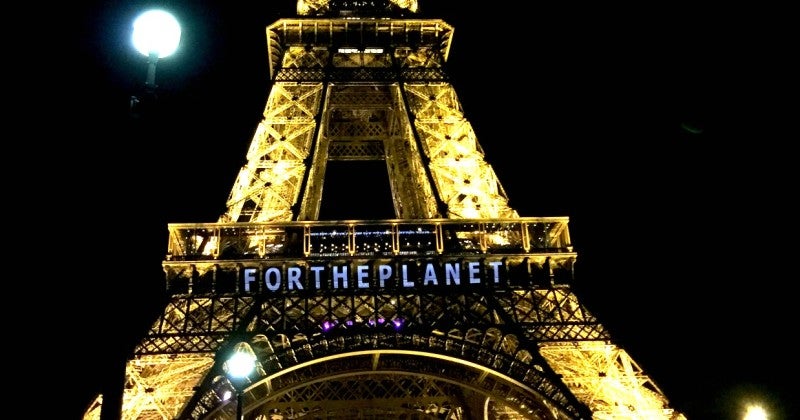
The Paris climate accord was announced with much pomp and self-congratulations… but let’s examine the worldview behind it.

This past weekend, representatives from 195 countries approved what the New York Times called a “landmark climate accord” in Paris. Not surprisingly, President Obama, who has made fighting global warming a cornerstone of his foreign and domestic policies, was delighted. He told reporters the accord “sends a powerful signal that the world is fully committed to a low-carbon future.” And then added that “We’ve shown that the world has both the will and the ability to take on this challenge.”

With all due respect to the president, the Paris agreement shows no such things about our collective global will, and even less about our abilities. What it shows is a commitment to a certain worldview. By way of evidence, let me quote Secretary of State John Kerry. In his December 9th address at the Paris summit, he told the audience, “The fact is that even if every American citizen biked to work, carpooled to school, used only solar panels to power their homes … if we somehow eliminated all of our domestic greenhouse gas emissions, guess what—that still wouldn’t be enough to offset the carbon pollution coming from the rest of the world. He continued: “If all the industrial nations went down to zero emissions . . .  it wouldn’t be enough, not when more than 65 percent of the world’s carbon pollution comes from the developing world.”

Well then why were we in Paris in the first place?
     American proponents of the accord, including the administration, argued the U.S. was trying to set an example for the developing world. But this is, to put it charitably, naïve. Nations like India and China have their own priorities, which include building more than 1,000 coal-fired power plants between them over the next decade. This would swamp any reduction in emissions from the industrialized west.

Another reason is money, at least for lesser-developed countries. The accord calls on industrialized countries to transfer an estimated $100 billion to them by 2020 and each year thereafter. And the UN would administer the funds. Nothing could go wrong with that plan, right?

But the most important reason isn’t a matter of science or even money. It’s a function of worldview. The key lies in the president’s claim that “the world has both the will and the ability to take on this challenge.” The Paris summit was nothing less than a chapter in a sort of secular, technocratic salvation history, complete with its own account of creation, fall, and redemption.

In the worldview that produced this salvation history, the world and everything in it—to borrow a phrase from our friends at World Magazine—is what we make of it. There is no problem beyond the reach of human ingenuity. What stands between us and the world we desire is just the right policies arrived at with the aid of science. In this version of salvation history, “nature” replaces creation, and, at least until the coming of homo sapiens, functioned just as it should. Then came the fall, what environmentalists have taken to calling the Anthropocene, in which human beings messed things up and threatened all of nature.

And what about redemption? Well in this story, it comes from enlightened humanity who take it upon themselves to “save the world” through a combination of science, in the form of computer models, public policies, and regulations. It doesn’t matter to them that the models have been proven inaccurate or that developing nations, the source of two-thirds of CO2 emissions, choose fighting poverty over curbing emissions every time.

Now there is of course a moral and prudential case to be made for not just spewing stuff into the atmosphere. That isn’t proper stewardship of creation. But neither is insisting that the steward—us—has salvation-like powers to restore the creation to its intended state. For that, only a real salvation history with a real savior will do.

[bold and italics emphasis mine]

FURTHER READING AND INFORMATION - As John has pointed out, the "landmark accord" of Paris fame is an example of a worldview that believes salvation will come at the hands of computer models and public policies. But to be proper stewards of this earth requires a worldview that recognizes the limits of policies and regulations, and a commitment to the Creator of all things.
RESOURCES:
"Again, why are we there? John Kerry admits at #COP21 that US emissions cuts accomplish nothing for climate" - Anthony Watts | wattsupwiththat.com | December 10, 2015;
http://wattsupwiththat.com/2015/12/10/again-why-are-we-there-john-kerry-admits-at-cop21-that-us-emissions-cuts-accomplish-nothing-for-climate/
"Nations Approve Landmark Climate Accord in Paris" - Coral Davenport | New York Times | December 12, 2015;http://www.nytimes.com/2015/12/13/world/europe/climate-change-accord-paris.html
Tuesday, December 15, 2015

#1438 (12/15) "‘Green’ Cronyism Is on Full Display In Paris"

"‘GREEN CROYNYISM IS ON FULL DISPLAY IN PARIS " - Nicolas Loris/ Dec.10, 2015/ http://dailysignal.com/2015/12/10/green-cronyism-is-on-full-display-in-paris/

PARIS–Cronyism is on display here at the United Nations climate conference (COP21), as developing countries aren’t the only ones trying to cash in on carbon regulations. The conference is full of exhibitors showcasing their carbon cutting technologies–each of which would benefit greatly from taxing carbon or forcing commitments to reduce greenhouse gas emissions.

The general conference arena contains rooms filled with vendors demonstrating how their business is reducing mankind’s carbon footprint. They include:

Reinsurance companies (warning against greater costs from extreme weather events).
Water systems companies.
Companies that make charging stations for electric vehicles.
Organizations dedicated to planting more trees.
Companies dedicated to capturing carbon from power plants and storing it underground.

The list is certainly exhaustive. The problem with all of them, however, is that they’re in Paris pushing for special privileges that will help their businesses at the expense of their competitors and at the expense of a competitive free market. It doesn’t matter what policies are advocated for – subsidies for carbon free energy technologies, a Green Climate Fund that finances green projects in developing countries, regulations that restrict the use of carbon-emitting natural resources or a carbon tax – those with special connections will benefit and the costs will be dispersed among the rest of us.

These are policies that will cost American households and businesses – at least those businesses not connected to politicians and bureaucrats – leading to lower levels of output, income and employment.

Because more than 80 percent of America and the world’s energy needs are met through carbon-emitting conventional fuels like natural gas and coal, reducing CO2 emissions will increase energy prices and force consumers to use less. In addition to the direct budget impact of higher costs for electricity, gasoline, heating oil, and natural gas, higher energy costs force cutbacks in both the production and consumption of all goods and services because energy is a staple input for the economy. The ultimate result is economic retraction and a reduction in living standards.

Crony policies that favor the well connected do more harm than the direct higher prices we pay. They harm competition and skew how markets should work. Businesses can and should take advantage of emerging markets and innovate to provide products people want.

That’s not what’s going on in Paris. Companies here are bent on crafting policies with the government and international bodies that would direct taxpayer money and private investment toward their projects. Private investment dollars will follow taxpayer-funded, subsidized projects because those government programs reduce the financial risk. Those are private investment dollars that can’t be spent on other potentially promising ideas. The result is a system that rewards what the government wants rather than what the market would produce, crippling innovation, competition and growth.

There also have been calls for energy policy reform and energy subsidy reform here in Paris, but even those calls are off base. They continue to get it wrong by calling for the end to subsidies for conventional resources like oil, coal and natural gas and pouring more money into intermittent, expensive renewable energy sources like wind and solar.

True policy and subsidy reform would eliminate preferential treatment for all energy sources and technologies and get the federal government and international bodies like the United Nations out of the energy businesses altogether.

The world has a diverse mix of energy producers and suppliers and the demand for affordable and reliable electricity and transportation fuel isn’t going anywhere any time soon. They don’t need help; they need bureaucrats to get out of the way. Only then will we eliminate cronyism in energy policy, encourage innovation, and have the resources to protect the environment.

Nicolas Loris, an economist, focuses on energy, environmental and regulatory issues as the Herbert and Joyce Morgan fellow at The Heritage Foundation. Read his research.

Monday, December 14, 2015

#1437 (12/14) "John Kerry’s Surprising Comments on International Regulations and Climate Change"

"JOHN KERRY'S SURPRISING COMMENTS ON INTERNATIONAL REGULATIONS AND CLIMATE CHANGE" - Nicolas Loris / Dec. 11, 2015 / http://dailysignal.com/2015/12/11/john-kerrys-surprising-comments-on-international-regulations-and-climate-change/

Although he probably didn’t mean to, Secretary of State John Kerry made a compelling case for why the U.S. and other countries should not go down the path of shutting down coal-fired plants, raising energy prices and stunting economic growth to combat global warming.

Speaking in Paris, Kerry said: 
     "The fact is that even if every American citizen biked to work, carpooled to school, used only solar panels to power their homes, if we each planted a dozen trees, if we somehow eliminated all of our domestic greenhouse gas emissions, guess what – that still wouldn’t be enough to offset the carbon pollution coming from the rest of the world. If all the industrial nations went down to zero emissions – remember what I just said, all the industrial emissions went down to zero emissions – it wouldn’t be enough, not when more than 65 percent of the world’s carbon pollution comes from the developing world.

He’s exactly right. Paul Knappenberger and Patrick Michaels estimate that the climate regulations the Obama administration are imposing on the energy sector – costs that will be passed down to households – will avert a meager 0.018 degree Celsius of warming by the year 2100.

In fact, the U.S. could cut 100 percent of its CO2 emissions and it would not make a difference in global warming. Using the same climate sensitivity modeling as the U.N.’s Intergovernmental Panel on Climate Change, the world would only be 0.137 degree C cooler by 2100. What’s worse is that if you included100 percent cuts from the entire industrialized world in their modeling, then you would only avert warming by 0.278 degree C by the turn of the century.

If Kerry got his wish, developing countries like India and China would play ball. But they’re not going to and quite frankly, neither is the rest of the developing world and some parts of the developed world. According to the Climate Action Tracker, there are plans to build more than 2,400 coal-fired power plants over the next 15 years. That includes plants that have been announced, in the pre-permit stage, permitted or under construction. These countries want access to cheap and abundant energy, in order to provide their citizens with a stable current of electricity and to keep their economy growing.

Kerry got one point very wrong, however. We’re talking about carbon dioxide emissions, not carbon pollution. The administration has evolved their message on this issue, from global warming, to climate change, to carbon pollution. Carbon dioxide is a colorless, non-toxic gas that does not have adverse impacts on human health. Calling CO2, carbon pollution, is deceiving the public. But at least Kerry spoke clearly about the futility of any unilateral or multilateral plans to address global warming.

[bold, italics, and colored emphasis mine]

Nicolas Loris, an economist, focuses on energy, environmental and regulatory issues as the Herbert and Joyce Morgan fellow at The Heritage Foundation. Read his research.

"Sen. Ted Cruz: ‘Global Warming Alarmists’ Ignore Scientific Data ‘Inconvenient’ to Climate Change Narrative" - Natalie Johnson/ Dec.9, 2015 / http://dailysignal.com/2015/12/09/sen-ted-cruz-global-warming-alarmists-ignore-scientific-data-inconvenient-to-climate-change-narrative/
     "...Judith Curry, former chair of Georgia Institute of Technology’s School of Earth and Atmospheric Sciences, testified that while climate scientists uniformly agree that surface temperatures have increased during the past century, there is 'considerable' disagreement about whether humans drive global warming and if warming is dangerous to the planet. Curry’s research led her to findings that natural causes could be playing a larger role in warming than human activity, challenging what many consider 'settled' conclusions in the climate debate.
     But instead of leading to reignited deliberation, Curry said the science community quickly branded her a “heretic” for challenging the status quo. 'In their efforts to promote their ‘cause,’ the scientific establishment behind the global warming issue has been drawn into the trap of seriously understating the uncertainties associated with the climate problem,' she said, adding: 'This behavior risks destroying science’s reputation for honesty and objectivity. Without this objectivity and honesty, scientists become regarded as merely another lobbyist group.' ”

Sunday, December 13, 2015

#1436 (12/13) SUNDAY SPECIAL: "Islam Is Evil, But Islamophobia is Real"

"ISLAM IS EVIL, BUT ISLAMOPHOBIA IS REAL" - Michael Brown | Dec 09, 2015; http://townhall.com/columnists/michaelbrown/2015/12/09/islam-is-evil-but-islamophobia-is-real-n2091342/page/full[AS I SEE IT: You may be one who cringes at calling something "evil," but I encourage you to please read through this article. The author makes a great case of why that which deceives people - such as Islam (or any other false belief system) - is evil AND yet how this should not give us cause to be afraid of Muslims in general. I believe that for Christians this is sound counsel. - Stan]

I believe that Islam is a false religion and Muhammad is a false prophet. I also believe that Islamophobia is real. Let me explain why these two points are not mutually contradictory.

As a follower of Jesus who affirms the Bible as God’s Word, I do not believe Muhammad received revelation from God since the information he allegedly received contradicts fundamental truths of the Bible. Muhammad’s revelations were therefore demonic, not angelic, and since the Quran denies that Jesus is the Son of God and denies that He died for our sins and rose from the dead, Islam is an antichrist religion and Muhammad is a false prophet. Add to this the fact that almost 1.5 billion people have been deceived by Islam and that makes Islam the world’s largest false religion. In that sense it is evil.

That doesn’t mean that Islam is devoid of lofty ethical principles and beautiful spiritual maxims (many Islamic tenets are actually borrowed from Judaism).
That doesn’t mean that Islam has not made significant, positive contributions in the last 1,400 years or that Muslims and Christians do not have many shared values.
It simply means that, to the extent Islam claims to have the full and final revelation, it is false, misleading, and of the devil. Lest these words strike you as overly harsh, remember that Islam claims to have the only true revelation, it claims that Abraham, Moses, and Jesus were all Muslims, and it claims that the Bible, not the Quran, is corrupt. Islam also claims emphatically that God has no Son and that belief in the Trinity is blasphemous. So, Islam has no problem stating that the fundamental beliefs of Christianity are false and deceptive. Why should Christians have a problem saying the same about Islam? And to the extent that Islam has been a religion of the sword, all the more is it evil – despite, I repeat, the many redeeming qualities of the Islamic faith.

I’m sure my words will offend the “enlightened” and more “progressive” readers, but I’m not here to score points with them. I’m simply laying out the facts as I see them, making clear that my rejection of Islam is unequivocal. In keeping with that, I applaud those courageous Christians through the centuries who have died rather than convert to Islam.

Yet as much as I take issue with Islam as a whole and with radical Islam in particular, I also believe there is such a thing as Islamophobia, and it is alive and well in America. I’m referring to an exaggerated, irrational fear of all Muslims, as if most (or all) of them are secretly loyal to ISIS, as if most (or all) of them want to overthrow America, as if most (or all) of them are terrorists at heart, and as if most (or all) of them will lie about anything as long as it advances their Islamic cause.

This is hardly the reality, and as my colleague Dr. James White has pointed out after decades of studying Islam and debating top Muslim scholars, Islam is no more monolithic than Christianity is monolithic, with various Islamic factions claiming to represent true Islam just as various Christian factions claim to represent true Christianity. Accordingly, if we were to ask the question, “Which is the most authentic expression of Christianity?”, Catholics would answer, “That’s easy! We are the Mother Church, and Peter is the first Pope!” Greek Orthodox would reply, “Not so! We have the direct link to the original New Testament faith!” Evangelical Christians would protest, “That is hardly the case! We alone base our faith on the Bible,” and Messianic Jews would jump in and say, “Why talk about ‘Christianity’? That’s a later concept and we are the truest heirs of the apostles.”
And make no mistake about it: The gulf between some of these groups is vast.

It’s the same with Islam, even if you claim that radical Islam is the truest expression of Islam, the one traceable back to Muhammad himself. I personally believe that there is a case to be made for this view, but it is not the only view. Hundreds of millions of Muslims worldwide (including countless thousands in America) do not espouse radical Islam, and they can point to strong Islamic traditions to back their claims. You might say, “Then they’re not true Muslims.” Perhaps, but they believe they are true Muslims, they practice their faith sincerely, and they can quote from the Quran and Islamic tradition to back their position.

Egyptian President Abdel Fattah al-Sisi is a devout Muslim, and in a major address to Islamic scholars at Al-Azhar University on January 1, 2015 he confronted jihadism and called for strong reform, mincing no words. His words represent the sentiments of millions of Muslims worldwide, Muslims who are appalled at the atrocities being committed in the name of their faith. And while there’s strong evidence that some Muslims in America celebrated on 9/11 (Donald Trump is apparently guilty of exaggeration, not fabrication), there’s no doubt that many (or even most) did not celebrate that tragic event.

In saying all this, I am not addressing questions of national security or immigration, which must be looked at carefully, nor I am minimizing the real and growing threat of the radicalization of Muslims in our midst. I’m simply saying that there is a happy medium between the two extremes of a blind philo-Islamism, on the one hand, and full blown Islamophobia, on the other hand. I’d encourage you to get to know some non-radical Muslims if you can and find out what they actually believe (without lecturing them based on a YouTube clip you saw). And, if you’re a follower of Jesus, seek to love your neighbor as yourself.

We can declare war on Islamic terrorism and reject Islam as a false religion without fearing all Muslims.

[bold, italics, and colored emphasis mine]

Michael Brown is the host of the nationally syndicated talk radio show The Line of Fire and is the president of FIRE School of Ministry. His newest book is Outlasting the Gay Revolution: Where Homosexual Activism Is Really Going and How to Turn the Tide. Connect with him on Facebook at AskDrBrown or on Twitter at drmichaellbrown

Saturday, December 12, 2015

#1435 (12/12) PRO-LIFE SAT: "... A Story Of Hope For Advent"

"Divine Mercy for Needy Expecting Mothers - A STORY OF HOPE FOR ADVENT" - By: Eric Metaxas|Breakpoint.org: Dec.8,2015; http://www.breakpoint.org/bpcommentaries/entry/13/28564?utm_source=Colson+Center+Master+List&utm_campaign=8c0ac4a7eb-BP_Daily_12_08_2015&utm_medium=email&utm_term=0_84bd2dc76d-8c0ac4a7eb-6541173
daily_commentary_12_08_15
What could be more divine than showing mercy to needy women who are expecting a child? Here's one doctor’s story.

During the Advent season, our thoughts turn to images of a young, poor couple making a grueling, 90-mile journey, probably in a caravan which offered some protection from bandits and robbers. The young woman, nine months pregnant, is riding a donkey—not especially comfortable for a woman in her condition. She and her betrothed are likely living off bread they brought from home. When they arrive at their destination, exhausted and cold, they are dismayed to find that the local inns are full up. As they search for shelter, the woman suddenly goes into labor.

As most of us know, this little drama has a happy ending: A baby—the Son of God!--is born in a primitive stable. His cries mingle with the baa-ing of sheep, the braying of donkeys, and the singing of angels.

The familiar narrative gives us a warm glow this time of year. But as we sit in our cozy, comfortable homes, perhaps the story should also remind us that there are thousands of American women in the same position as Mary—young, poor and unexpectedly pregnant. Women for whom the outcome may not be quite so happy.

One person who does think of these modern mothers and babies all the time is my friend, Dr. John Bruchalski, who lives in Northern Virginia. John has a deep desire to give women and their babies the best care possible. He and his wife, Carolyn, believe in the gospel of life. In 1994, they began a nonprofit, faith-based healthcare outfit called Divine Mercy Care as a meaningful way to help America’s vast, under-served community of poor, pregnant women—many of whom consider abortion because they cannot afford medical care.

Divine Mercy Care partners with all the local pregnancy care centers. It raises funds to serve patients who have nothing, but need everything. In his spare time, John travels the country telling medical students and young doctors that, yes, they CAN practice medicine this way. That they don’t have to leave their faith in the car before walking into their clinics.

All of this commitment did not come out of nowhere. I was privileged to host John on the “Eric Metaxas Show” just a few days ago, and he told me about an incredible spiritual transformation he underwent more than 20 years ago. John had been raised a Catholic, but had not taken his faith that seriously. But during this spiritual awakening, John said, “the scales came off my eyes.” He says he heard an audible voice telling him, “Johnny, if you want to help the Holy Spirit revitalize medicine, be the best doctor you can be . . .  and [serve] the poor daily.” After that experience, “Jesus Christ became everything to me,” John said. He tells young doctors, “If you want joy, if you want that purpose back in your life as an OB-GYN, and you want to have some fun doing it, open your life to this way of approaching the human person, with dignity.” Divine Mercy Care now has five doctors and a staff of 25.

During the Advent season, may our meditations on the infant Jesus, born in poverty 2,000 years ago, and his mother, lead to a desire to help all the modern-day mothers and babies who need our help.

Oh, and that spiritual transformation Dr. John went through all those years ago? It had a greater impact than you may imagine. You see, once upon a time, John Bruchalski performed abortions—including third trimester abortions.  

And now you know the rest of the story—a glorious story of how greatly God can and will transform us when we allow the Christ Child to journey into our hearts.

[bold, italics, and colored emphasis mine]

RESOURCES -This time of the year is the perfect time to be reminded of the needs of expectant moms who need our help and support, and Dr. Bruchalski's story is a great encouragement. Learn more about the doctor and his non-profit organization Divine Mercy Care by clicking on the links below.

Watch Eric Metaxas’s interview with Dr. John Bruchalski on “The Eric Metaxas Show”
Eric Metaxas | podcast, the Eric Metaxas Show | November 30, 2015;http://www.metaxastalk.com/podcast/monday-november-30-2015/
Divine Mercy Care - http://www.tepeyacfamilycenter.com/donate/

Friday, December 11, 2015

#1434 (12/11) "How Do You Solve a Problem like Sharia?"

"HOW DO YOU SOLVE A PROBLEM LIKE SHARIA?" - Tony Perkins, Washington Update, Dec. 9, 2015; http://www.frc.org/updatearticle/20151209/how-do-you[AS I SEE IT: In the extreme positions taken recently about the immigration of Syrians, who are mostly Muslim, the following is a common sense perspective that I've rarely heard. The issue is not one of discrimination but of understanding that immigration has been changed from what it once meant, and we need to be mindful of that. - Stan]

The word "contentious" doesn't begin to describe the American immigration debate over the last two decades. But in recent days, the lines are being redrawn -- and with it, the national conversation. The focus is no longer being dominated by illegal immigration south of Texas but "legal" immigration coming from across the Atlantic, where a bold new enemy is exposing weaknesses in the West's tolerance.

Attacks in Paris, followed by a mass shooting in California have made believers of Americans, who doubted that radicalized Muslims were one of the greatest threats to our nation. Now, with President Obama offering to throw open the door to more Syrian refugees, more voters from both parties are ready to put the brakes on the process until a better, safer vetting protocol is in place.

As the national discussion turns to immigration, people are starting to stake out positions on who should and shouldn't be in the country. But first, we need to consider one of the unfortunate realities -- in America and elsewhere -- which is that the purpose of immigration has changed. It used to exist for people who wanted to come to America and assimilate. Now, in a dramatic shift from even our grandparents' generation, the "sensitivity" and "diversity" doctrine of the modern age is suggesting that we create cultural enclaves, where outsiders come to our country and live as if they never left home.

That doesn't work, as Europe will tell you. Instead, we lose our identity in the shadow of multiculturalism. It's happened in France, and it's happening in Britain. Leaders are learning a painful message that if you tiptoe around the global realities, you'll pay for it. If people want to live in America -- including Muslims -- they need to embrace our Constitution and our culture. Others have said in less artful ways what conservatives have been warning for years: there is no such thing as coexistence between Sharia law and our constitutional republic. That isn't religious prejudice, but an ideological reality.

What most people either don't realize or willfully ignore is that only 16 percent of Islam is a religion -- the rest is a combination of military, judicial, economic, and political system. Christianity, by comparison, isn't a judicial or economic code -- but a faith. So to suggest that we would be imposing some sort of religious test on Muslims is inaccurate. Sharia is not a religion in the context of the First Amendment. Under the framework proposed by Senators Ted Cruz (R-Texas) and Rick Santorum, America wouldn't vet refugees based on religion but an ideology that's incompatible with American liberty. "I've proposed actual concrete things [like eliminating the visa lottery system] and immigration law that would have -- not the effect of banning all Muslims, but a lot of them," Santorum explained.

The bottom line is this: the U.S. Constitution is an agreement between people about how they'll be governed. What good is it if people immigrate to America with the sole purpose of undermining that contract? We shouldn't be embarrassed to say that we oppose those who want to come to the United States to destroy it. And while most Muslims are not radicalized, Sharia certainly encourages it. Based on polling from the Center for Security Policy, that's the system most would choose. The majority of Muslims in America believe they "'should have the choice of being governed by Sharia [law].' Sharia authorizes such atrocities as murder against non-believers who won't convert, beheadings, and more unthinkable acts that pose great harm to Americans, especially women."

In America, we have freedom under the construct of ordered liberty. Even the Wall Street Journal struggles with the clash of these ideologies. "Certainly Islam and the America way of life are compatible in as much as America is capable of welcoming Muslims who are not Islamic supremacists. On the other hand, it's always struck us that categorical statements to the effect that Islam [is peaceful] are far more hortatory than empirical -- which is to say that there is a gap between Islam as it actually exists and Islam as...President Obama would like it to be. How wide that gap is, and how dangerous, we do not know." Nor, I would argue, should we risk the future of our nation to find out.

[bold, italics, and colored emphasis mine]

Thursday, December 10, 2015

#1433 (12/10) "Universities Unraveling - ..."

"UNIVERSITIES UNRAVELING - HIGHER EDUCATION NEEDS A HIGHER PURPOSE" -
By: John Stonestreet|Breakpoint.org: Dec.9, 2015;
http://www.breakpoint.org/bpcommentaries/entry/13/28565?utm_source=Colson+Center+Master+List&utm_campaign=c022b62050-BP_Daily_12_09_2015&utm_medium=email&utm_term=0_84bd2dc76d-c022b62050-6541173 [AS I SEE IT: This Christmas, as you gather with extended family, be sure to ask about what parents are looking for in the schools they intend to send their children off to. Too many just consider "the bottom line" of academic offerings, and even find comfort alone in their child attending a "Christian" university. Too many end up losing their way, and their faith even at schools considered "safe." - Stan]
daily_commentary_12_09_15
The current turmoil on our nation’s campuses is just a symptom of a deeper problem: Our universities have lost a vision for education.

Among the things that 2015 may be remembered for is as the year American universities turned into war zones: From anti-racism demonstrations where students harassed and physically removed student reporters, to profanity-laced protests over a memo about Halloween costumes, to demands for “trigger warnings” and blacklisting of even feminist speakers. On campuses everywhere, students are turning on each other, their teachers, and administrators. Even some liberal commentators are asking: What kind of monsters is American higher education creating?

Well, maybe the kind of monsters it deserves, suggested Ross Douthat recently in the New York Times. He notes that while we may not admire their temper tantrums or thin skin, today’s undergrads came by these traits honestly. As my co-host Eric Metaxas observed recently on BreakPoint, students are taking the radical ideas of their professors seriously. But Douthat points out that the steady diet of politically-correct ideology in universities conceals the real rot in modern higher education: a lack of higher purpose.

It wasn’t always like this. Early modern universities set the pattern for what some have called “Christian humanism”—emphasizing not just technical proficiency, but an integrated view of life that enabled students to become virtuous and effective leaders. From this model emerged the luminaries of the Reformation and the scientific revolution.

The charters of our nation’s oldest public institutions, too, testify to the higher purpose their founders envisioned. Harvard’s original motto was “Truth for Christ and the Church.” And Yale—a school now infamous for its annual “Sex Week”—once urged students to “…consider the main end of [their] study…to know God in Jesus Christ,” and “to lead a Godly, sober life.” Even early non-Christian universities considered it their duty to inculcate moral virtues and train the body politic. Thomas Jefferson, for example, who founded the University of Virginia as a secular school, believed that “Whenever the people are well-informed, they can be trusted with their own government.”

All of this is now, of course, well, history. By the 1950s, most schools had abandoned such lofty goals in favor of what Douthat dubs “technocratic, careerist and basically amoral” ones. Universities became glorified trade schools where the bottom line for both students and faculties was—well—the bottom line. People went to college not to become well-rounded citizens and leaders, but in order to pad their future paychecks.

Into this academic snooze-fest exploded 60s counterculture, demanding what Douthat calls a “remoralization, a renewal of the university as a place of almost-religious purpose…” Only instead of Christian virtue and citizenship, colleges replaced antiwar ideology, feminism, environmentalism, and the sexual revolution. Fifty years later, these quasi-religious values have burst their “ideological fiefdom” in the liberal arts and are holding hunger strikes on the front lawn. It’s a headache Douthat says universities have had coming.

And I think he’s right. So, what now? Well, like it or not, change won’t happen overnight. Parents, we have a choice of where to send our kids, and as an alumnus of a Christian college, I can promise you the Ivy League doesn’t have a monopoly on top-notch education. But be careful, Christian colleges often lack a vision of education as well, while decorating their aimlessness with Bible classes and chapel.

But the most important thing we must do is prepare our students with a love for the true, the good, and the beautiful – a vision that makes political correctness pale in comparison. Such a vision prepares them to love God with all their hearts and minds. And for Christians, that’s the highest purpose of education. Consider a school's "higher purpose" when making decisions about enrolling in a college or enrolling your children in a college

[bold and italics emphasis mine]

RESOURCES
Free Think University - http://freethinku.com/

"Now at Vanderbilt: Conservative Professor Targeted by Offended Students" - 
Trey Sanchez | truthrevolt.org | November 11, 2015;http://www.truthrevolt.org/news/now-vanderbilt-conservative-professor-targeted-offended-students
"Campus Kangaroo Court Convicts Conservative Professor" - David French | National Review | November 11, 2015;http://www.nationalreview.com/corner/426941/campus-kangaroo-court-convicts-conservative-professor-david-french
"Yale’s Idiot Children" - Kevin D. Williamson | National Review | November 10, 2015;http://www.nationalreview.com/yale-free-speech-protest-ironic
-------------------------------------------------------------------------------
"College President Tells Students to ‘Grow Up’ Because Campus Not Meant to Be ‘Safe Space’" - Natalie Johnson / @nataliejohnsonn / December 01, 2015;
http://dailysignal.com/2015/12/01/college-president-tells-students-to-grow-up-because-campus-not-meant-to-be-safe-space/