Saturday, July 16, 2016

#1651 (7/16) PRO-LIFE SAT: "Even After the Horrible Supreme Court Decision, Pro-Lifers Have a Reason to Hope. Here’s Why"

"EVEN AFTER THE HORRIBLE  SUPREME COURT DECISION, PRO-LIFERS HAVE A REASON TO HOPE. HERE'S WHY." - Maria Gallagher / JUL 11, 2016 | http://www.lifenews.com/2016/07/11/even-after-the-horrible-supreme-court-decision-pro-lifers-have-a-reason-to-hope-heres-why/ [AS I SEE IT: As someone else pointed out, the pro-abortion advocates and the media made a big deal of the recent SC decision because they have been losing ground for so long, they needed something to celebrate. The TRUTH is, the pro-life movement continues to win at the grass roots level, and so many Millennials are declaring themselves pro-life that abortion providers have openly said they are concerned. Personally, as much as I would love to see abortion once again banned in the US, I suspect it will always be legal to some extent. My PRAYER is that given the CHOICE, more and more girls and women will CHOOSE the SELF-less way of giving birth when faced with an unwanted pregnancy and increasingly reject abortion. In THAT way, I see the evil of abortion finally defeated. - Stan]
prolifestudents38
Poet Emily Dickinson once wrote, “’Hope’ is the thing with feathers—That perches in the soul—And sings the tune without the words—And never stops—at all…”

It was that hope that I rediscovered at the 2016 National Right to Life Convention. Even in the wake of a disturbing U.S. Supreme Court decision basically declaring open season on women in abortion facilities, the hope of the national pro-life movement remains strong, vibrant, and very much alive amidst the culture of death.

I saw that hope in former abortion center workers Jewels Green and Catherine Adair, who had each survived the dual trauma of personal and professional abortion experiences. They had at one time been ardent supporters of legal abortion, but eventually came to embrace the truth that abortion destroys children and damages women. Their testimony was heartfelt, riveting and profound.

I was moved by that hope when I attended a workshop presented by Dr. Gunter Franz, a brilliant academic who reviewed the change in abortion statistics throughout the years. As Dr. Franz made clear, we haven’t seen 1.6 million abortions in a given year since 1990, when abortion totals were at their highest. The downward trend for abortions has been going on for a lifetime now—and so many, many lives have been saved by the steady, stalwart pro-life movement.

I saw that hope in octogenarian Jean Garton, the legendary author of the classic Who Broke the Baby, who reminded us that time is the friend of truth. At age 88, Garton remains an eloquent and powerful spokeswoman for the pro-life cause. And she serves as a living reminder of what a treasury of truth older Americans hold for us.

And I saw that hope in so many gifted teenagers who offered creative, enlightening speeches during the convention’s national pro-life oratory contest. Showing wisdom beyond their years, this racially and geographically diverse group of young people mesmerized their audience with stories and statistics demonstrating the inherent rightness of the pro-life position.

It is an incredible feeling to hear a young woman and a young man speak with immense gratitude for the parents who adopted them and the birth mothers who had the courage and selflessness to place them for adoption. What incredible students these are—and I couldn’t help but think of the more than 58 million other young people who never got a chance to speak because their lives were ended in the womb.

Some of the young attendees at the convention were too young to remember the legislative and court struggles over the grisly practice of partial-birth abortion. Thankfully, they have not had to confront such a heinous act, since the U.S. Supreme Court upheld the federal ban on it years ago. The fact that they have been shielded from such an atrocity gave my heart hope.

The abortion industry, its advocates, and its media sympathizers would like the general public to believe that the pro-life movement is despairing after a Supreme Court ruling striking some provisions of a Texas law designed to ensure that abortion facilities meet basic health and safety standards. 

Why don’t pro-lifers just fold up their tents and move on? Because pro-lifers have been down this road before: the road paved with bad court decisions, pro-abortion claims of victory, and gloomy news reports. The outrageous practice of partial-birth abortion was not banned on the first try. And yet, in the end, truth won out, and a brutal business came to an end.

You see, hope—and the pro-life movement—are actually winning everyday. Every single time a mother chooses life over death…every time a depressed patient decides against doctor-prescribed suicide…every time an adoptive father holds his first child…victory over darkness and despair can be claimed.

And in those precious moments that you will not see broadcast on the national news, families win—and American wins.

That is the legacy that is celebrated at a National Right to Life convention. And it is a legacy which will live on, thanks to the foundation that the pioneers of the pro-life movement have built, and to the dedication of the Millennials who proudly call themselves the Pro-Life Generation, and who are determined to defend the gains made by their grandparents, and to surpass them.

[bold, italics, and colored emphasis mine]

"Surveys Show Young People More Pro-Life Than Ever Before as Millennials Oppose Abortion" - Michael New, Ph.D / JUL 11, 2016 | http://www.lifenews.com/2016/07/11/surveys-show-young-people-more-pro-life-than-ever-before-as-millennials-oppose-abortion/
"Students for Life Groups Now Outnumber Planned Parenthood Campus Groups 4-1" - Students for Life, Jun 23, 2016| http://www.lifenews.com/2016/06/23/students-for-life-groups-now-outnumber-planned-parenthood-campus-groups-27-1/

Friday, July 15, 2016

#1650 (7/15) "Fact-Checking A Memorial Service"

"FACT-CHECKING A MEMORIAL SERVICE" - Mona Charen, Townhall.com| Jul 15, 2016 ; http://townhall.com/columnists/monacharen/2016/07/15/factchecking-a-memorial-service-n2192932
Fact-Checking A Memorial Service
  
If ever there were a moment that called for largeness of spirit, the racially motivated assassination of five officers following the disturbing and highly questionable police shootings of two black men by white officers was such a time. The bitterness and score settling by both left and right (portions of the right, under Trump, have joined the racial-grievance industry) is a dismaying rollback of the civic unity we've achieved over the past 50 years. The left shouts "Black Lives Matter" as if cops had declared open season on them, and the right denies that there is any case of police conduct that was not utterly justifiable.

As someone who believed the Michael Brown/Ferguson episode ought to have been cautionary, I understand the sense that "activists" are creating so-called civil rights narratives from whole cloth. Brown was attempting to grab a cop's gun. "Hands up; don't shoot" was a fiction -- a dangerous and demoralizing fiction. Obama ought to have said so at the time. Had he done so at that critical moment, it might have redeemed some of his potential as a unifying figure.

At the same time, other cases, including those in Louisiana and Minnesota, are highly suspicious. We know how easy it is for police who've blundered or overreacted to hide the evidence. We know from studies and personal accounts, including, most recently, an account from South Carolina Sen. Tim Scott, that black men suffer suspicion, stops, violence and verbal abuse from police disproportionately.

Obama is practiced at reciting these incidents, and the whole nation should be able to acknowledge them without cavil. It would doubtless mean a lot to blacks if others stopped denying reality. But the list of things the left refuses to acknowledge is even longer. Obama's sermon (which included such howlers as "We flood communities with so many guns that it is easier for a teenager to buy a Glock than get his hands on a computer or even a book") had one glaring omission. He argued that black men are targeted by police because of the persistence of historic racism. It doesn't diminish the indignities that black men endure to admit that the chief reason is not racism but the extremely high crime rate among black men. As Heather MacDonald has observed using 2009 data: "Blacks were charged with 62 percent of all robberies, 57 percent of murders and 45 percent of assaults in the 75 largest U.S. counties in 2009, though they made up roughly 15 percent of the population in these counties."

Is "persistent" racism the reason that so many blacks are behind bars? According to Pew, 1 out of 5 black men was incarcerated in 2010. In 1960, the figure was 1 out of 6. Has racism increased since 1960?

Obama might also have noted the work of Roland G. Fryer Jr. of Harvard, a black academic who studied 1,332 police shootings between 2000 and 2015 and discovered that police were actually less likely to shoot black suspects than others (though they were more likely to use force in other ways).

The president mouthed some healing words -- he offered that we're "not as divided as we seem" -- but by focusing so much attention on encounters between black men and police, he contributes to a distortion of the larger American picture. His election is clear evidence that racism is in severe eclipse. Rates of intermarriage also reveal the decline of racial animus. Stephan Thernstrom, co-author with Abigail Thernstrom of "America in Black and White," notes that rates of intermarriage have risen from 0.7 percent of all black marriages in 1963 to 15.5 percent in 2008. Among youth of all racial/ethnic groups, Pew reports, approval of interracial marriage was overwhelming in 2009, and highest of all among whites (88 percent).

Between 1990 and 2014, the percentage of blacks who attained at least a high school diploma increased from 82 to 92 percent. The percentage who got a college degree increased from 13 to 22 percent. Over the past several decades, blacks have sustained significant income gains. Here's Pew again: "Black adults sustained the largest increase in income status from 1971 to 2015 and were the only major racial or ethnic group to experience a decline in their lower-income share."

These are but small snapshots of the remarkable racial progress America has made. It's palpable in daily life. Clearly racism persists, but the press and the left, addicted to the moral sugar high they get from portraying the nation as frozen in the amber of Birmingham, 1963, actually impede a better reckoning with the challenges of 2016. Too many black children are growing up in chaotic homes and attending miserable schools. Too many fall into crime. And too many are still hassled by police.

It would have been bracing to hear that from the first black president, but he fell back on leftist cliches instead.

[bold, italics, and colored emphasis mine]

Thursday, July 14, 2016

#1649 (7/14) "A Real Conversation on Police and Society Requires Empathy for Police, Too"

Political Cartoons by Steve Breen
------------------------------------------------------------------------------

"A REAL CONVERSATION ON POLICE AND SOCIETY REQUIRES EMPATHY FOR POLICE, TOO" - Scott Erickson / July 13, 2016 / http://dailysignal.com/2016/07/13/a-real-conversation-on-police-and-society-requires-empathy-for-police-too/

A police officer sits on her motorcycle as she waits to take part in the funeral procession for Dallas Police Department's Sr. Cpl. Lorne B. Ahrens. (Photo: Rex Curry/Reuters/Newscom)

Race relations in America, and in particular tensions between communities of color and domestic law enforcement, have seemingly reached a nadir not seen in decades. Tragic incidents, the facts of which are often misunderstood or exploited, have contributed to a growing sense of detachment by some within society. Feelings of “us versus them” have calcified into outright hostility, anger, and resentment.

Sadly, some have disingenuously used recent events to promote a false narrative implicating the American law enforcement community, and often the entire criminal justice system, as systemically prejudiced and deserving of scorn. This drumbeat of criticism is often coupled with dangerous and inflammatory anti-police rhetoric that has made policing in America more dangerous and communities less safe.

Critics have suggested that much of the tension that shrouds police and community relations could be softened if only the police would better understand the unique experiences and worldview of those with whom they interact, particularly within communities of color. This is absolutely true. Empathy is a vitally important element of effective policing. But to be truly effective, empathy must be shared and understood as a two-way street.

Less than a day after last week’s tragic, cold-blooded murder of 5 Dallas-area police officers in an unprecedented act of terror against the law enforcement community, former Secretary of State Hillary Clinton called upon police officers to put themselves “in the shoes of those African-American families who fear every time their children go somewhere, who have to have ‘The Talk,’ about, you now, how to really protect themselves [from police], when they’re the ones who should be expecting protection from encounters with police.” Clinton was understandably encouraging empathy in the context of police and community interactions; however, in order to have a “real conversation” on policing in America there should be an acknowledgment that empathy must be shared if we are to expect tensions within police and community relations to ease. Clinton encouraged the proverbial walk-a-mile-in-one’s-shoes introspection of the African-American experience, an absolutely appropriate suggestion.

But the public would have been better served if instead our nation’s leaders called for all Americans, and in particular those most critical of law enforcement, to put themselves in the shoes of the average beat cop patrolling an American city in the year 2016.

What does it feel like to approach a vehicle with one or more individuals in it when you have absolutely no clue if they’re armed or mean you harm? How might an officer’s attitude toward a person they first encounter be influenced by their past experiences with others in similar situations? Perhaps repeatedly dealing with the collective ills of society might make some officers more insular, guarded, or cautious.

Imagine what it is like to work among these conditions. Now stop for a moment and really imagine what it is like. It is easy to verbalize an understanding of the emotional and physical challenges of being a police officer, but it is much harder to actually put yourself in their shoes.

How many jobs require a person to legitimately wonder if they will make it home to their families at the end of their shift? How many jobs routinely expose a person to physical assault, disease, and the deprivations of society?

It may be easy to dismiss these considerations, to cynically suggest that they’re only meant to justify bad behavior and distract from other issues. But to do so belies a disingenuous and cavalier attitude toward the actual pursuit of an improvement in police and community relations.

Individual incidents should always be judged on their respective merits and conclusions should be drawn only following an objective analysis of all available facts and evidence. Although that may take more time than many people are willing to commit prior to indulging their emotional response, we are far more likely to do so if we employ a sense of shared empathy toward all participants within a given situation.

The public is constantly being told that we need to have a “real conversation” on police and community relations. But until that “real conversation” includes a willingness from all sides to acknowledge the legitimacy of each other’s respective concerns, we will continue to spin ourselves into a circle with those on each side of the ideological divide unsatisfied with the conclusions of the other.

[bold, italics, and colored emphasis mine]

Scott G. Erickson is the president of Americans in Support of Law Enforcement.

Wednesday, July 13, 2016

#1648 (7/13) "On Freedom and a Fourth of July Abroad"

Political Cartoons by Steve Breen

"ON FREEDOM AND A FOURTH OF JULY ABROAD" - Nolan Peterson / July 03, 2016 / http://dailysignal.com/2016/07/03/on-freedom-and-a-fourth-of-july-abroad/ [NOTE: Be sure to read the excerpt from one of the letters sent for the follow-up article noted afterwards. It explains well why we need more of a foreign perspective on just how much America means to the rest of the world. - Stan]

A U.S. Army soldier is happy to fly the colors in the Baltics during Operation Dragoon Ride, which attracted thousands of supportive Estonians, Latvians, and Lithuanians. (Photo: Nolan Peterson/The Daily Signal)

PARIS—This will be my second consecutive Fourth of July spent outside the United States. Last year, I celebrated our nation’s birthday in Mariupol, Ukraine. It’s a city only a few miles from the front lines of the still-simmering war in Ukraine. I had burgers and beer with an eclectic group that evening—a Swedish sniper, two former French Foreign Legion soldiers, two former U.S. Army Rangers, and war correspondents from Australia, Belgium, and the United States.The war was still there, only a few miles away. We could get to it in a 20-minute car ride.
 Ukrainian soldiers in eastern Ukraine. (Photo: Nolan Peterson/The Daily Signal)
Ukrainian soldiers like these two, near the front in eastern Ukraine, tend to be fans of America. (Photo: Nolan Peterson/The Daily Signal)

The occasional thud of a mortar or artillery round from nearby Shyrokyne filled in for the fireworks. Audible reminders that Ukrainian soldiers were (and are) still fighting to achieve the things we celebrate every Fourth of July—freedom, democracy, and a chance to pursue happiness.

It’s almost ritual to express gratitude for the American way of life, or to thank a veteran or a soldier on holidays like Independence Day. The rehearsed nature of it all isn’t the result of insincerity; it’s just that many of us living in the United States have never tasted the alternative. We’ve never actually lived in a place that isn’t free—a place like eastern Ukraine where families still die in the night from Russian artillery. Seeing such things makes you want to kiss the ground when you finally come back home.

Celebrations in war always seem more passionate. There’s a little bit of that end-of-days feeling like it’s officially time to eat, drink, and be merry for tomorrow isn’t a given. It was like that in Mariupol last year. One year later, the war hasn’t ended. Ukraine is still waiting for that tomorrow. Artillery and small arms are still fired in anger every day along the hundreds of miles of trenches and fortified checkpoints spread throughout the Donbas. Soldiers in opposing camps still peer at each other across no man’s land. It’s still a war. People are still dying.

Yet, I retain hope Ukraine will one day celebrate its Independence Day like we do. One day the explosions will be from fireworks and not weapons of war.

Common Thread
     This past year I visited Tibetan freedom fighters living in exile in India and Nepal, veterans of a secret CIA-backed guerrilla campaign against China during the Cold War. In eastern Ukraine I visited Ukrainian soldiers on the front lines against Russian aggression. And in Iraq I embedded with Kurdish peshmerga soldiers on the front lines against ISIS outside Mosul. A common thread united these disparate bands of soldiers divided by culture, history, and geography. For all of them, the United States symbolized what they were fighting for.

Some of the Ukrainian soldiers I met on the front lines wore American flags on their uniforms. For Ukrainians, the U.S. flag long had been a symbolic pushback against the Soviet Union and the Kremlin’s authoritarian rule. And now, 25 years after the fall of the USSR, as Ukraine again finds itself on the receiving end of Russian aggression, some have turned to symbols of America once more as a way to represent their independence and annoy their enemies. I met one Ukrainian soldier at a machine gun nest in the trenches who wore a Ronald Reagan Presidential Library T-shirt. I asked why he was wearing that shirt in combat. He told me: “Because Reagan won the Cold War, and it would piss Putin off.”

Tsering Tunduk fled Tibet in 1959 after Chinese soldiers executed his parents. (Photo: Nolan Peterson/The Daily Signal)

The Tibetan freedom fighters I met, now old men living in solitude in lonely Himalayan villages, told me U.S. military support inspired them to fight back against China’s invasion and genocide. These soldiers, many of whom were former Buddhist monks, fought the mechanized might of China’s People’s Liberation Army while on horseback and with World War I rifles. “I have a deep appreciation and a great respect for America,” Sonam Dorjee, an 81-year-old former Tibetan resistance fighter told me during an interview last year in McLeod Ganj, India.

‘Friends Forever’
     This May, I embedded with Kurdish peshmerga soldiers on the front lines outside Mosul. I saw smiles creep over the Kurds’ faces as U.S. warplanes pummeled Islamic State fighters a couple miles away across no man’s land. For the older peshmerga soldiers, the sound of U.S. jets held special significance. They remember how Saddam Hussein’s warplanes used to inspire terror.
     Before a U.S.-led coalition deposed him, the Iraqi dictator killed hundreds of thousands of Kurds from the air with chemical weapons and conventional bombs in operations such as the genocidal al-Anfal campaign. Now, the peshmerga rejoice at the sound of jet engines, knowing the crackling roar symbolizes their American ally punishing the enemy.

160702_FourthAbroad4_Peterson
A soldier mans a Kurdish peshmerga position near Mosul, Iraq. (Photo: Nolan Peterson/The Daily Signal)

“We will be friends with America forever for the help they’ve given us,” peshmerga Gen. Omar Hama Ali Farag told me on the front lines outside Mosul. He went on:  "We had the Anfal genocide and many sufferings, but the peshmerga have always seen America as our friend. We could have never gotten rid of Saddam without George W. Bush. And we can never have our independence without America’s help."

North Star
(Photo: Nolan Peterson/The Daily Signal)
This woman with the American flags was among thousands of civilians who came out to welcome a U.S. Army Stryker convoy traveling across the Baltics. (Photo: Nolan Peterson/The Daily Signal)

     Our country’s flag and the men and women who wear it on their uniforms are still seen as a force for good in many places around the world.
     That was evident in February as I traveled with a U.S. Army Stryker convoy across the Baltics. The convoy, called Dragoon Ride, was meant to show U.S. resolve to defend NATO’s Baltic members from Russia. Along the way, thousands of Estonians, Latvians, and Lithuanians lined the roads waving American flags to welcome our troops. Fathers had children on their shoulders. Young women blew kisses to the troops. At each stop, in each little village, hundreds of local people gathered to take selfies with the American soldiers and shake their hands.  I wish you could have seen it; it would have made you proud to be an American.

Maintaining a dominant military with a global presence is not just about quantifiable metrics of national defense or international stability. Our military is also the torchbearer for our country’s values and a beacon of hope for people in times of peril.

On the Fourth of July we celebrate the achievement of a dream that, whether we know it or not, still serves as a North Star to people around the world brave enough to fight for a better life.
An appreciative observer of the U.S. Army's Dragoon Ride across the Baltics. (Photo: Nolan Peterson/The Daily Signal)

[bold, italics, and colored emphasis mine]

Nolan Peterson, a former special operations pilot and a combat veteran of Iraq and Afghanistan, is The Daily Signal’s foreign correspondent based in Ukraine.

"‘Uplifting’: Fourth of July Feature Strikes Chord With Daily Signal’s Audience" - Ken McIntyre / July 11, 2016; http://dailysignal.com/2016/07/11/uplifting-fourth-of-july-feature-strikes-chord-with-daily-signals-audience/"So often during our national discussion we forget the larger duty America has to oppressed peoples and nations throughout the world. We forget that the true power of American support comes not only in the form of soldiers and money and materiel, but in hope: renewed faith that dreams of freedom, equality, self-determination, and basic protection of civil liberties will not long be dreams deferred. I struggle to this day to divine where I stand on war and violence and the role of the American military in the world, and it is because your article provided me with a modicum of clarity that I write to you today. Your article reminded me of the great spark of hope that America and her military can inspire in the souls of men and women downtrodden and oppressed—something I often forget. This must be something that I consider more frequently as I move forward with my discernment. For your reminder, I say thank you..."

Tuesday, July 12, 2016

#1647 (7/12) "America’s Next President Must Fix Autopilot Entitlement Spending"

"AMERICA'S  NEXT PRESIDENT MUST FIX AUTOPILOT ENTITLEMENT SPENDING" - Christian Chelak / Romina Boccia / July 06, 2016 / http://dailysignal.com/2016/07/06/americas-next-president-must-fix-autopilot-entitlement-spending/?utm_source=TDS_Email&utm_medium=email&utm_campaign=CapitolBell&mkt_tok=eyJpIjoiWkRkbE5XTmpZV1kxWkRrNSIsInQiOiJISGQ0U2ZjNkM5bTRHb1dHNmh6NjlzTTArdTByNzlxNUF0Zys1T3Zlb2hRRWdDUUpjcmNcL1pMMzF2Y3lHTGgrcmxpUkxmcWdcL2hKcmpXQXNFRjlLdmdZdnh6RVN2bk5CUWlWK3RBK1BaODlFPSJ9

A recent report by the Committee for a Responsible Federal Budget raises concerns that proposals by this year’s presidential candidates would further increase the national debt.

America’s major entitlement programs—Medicare, Medicaid, Obamacare, and Social Security—are driving the nation’s greatest fiscal challenge, and yet Americans have heard very little about how the candidates will address these programs.

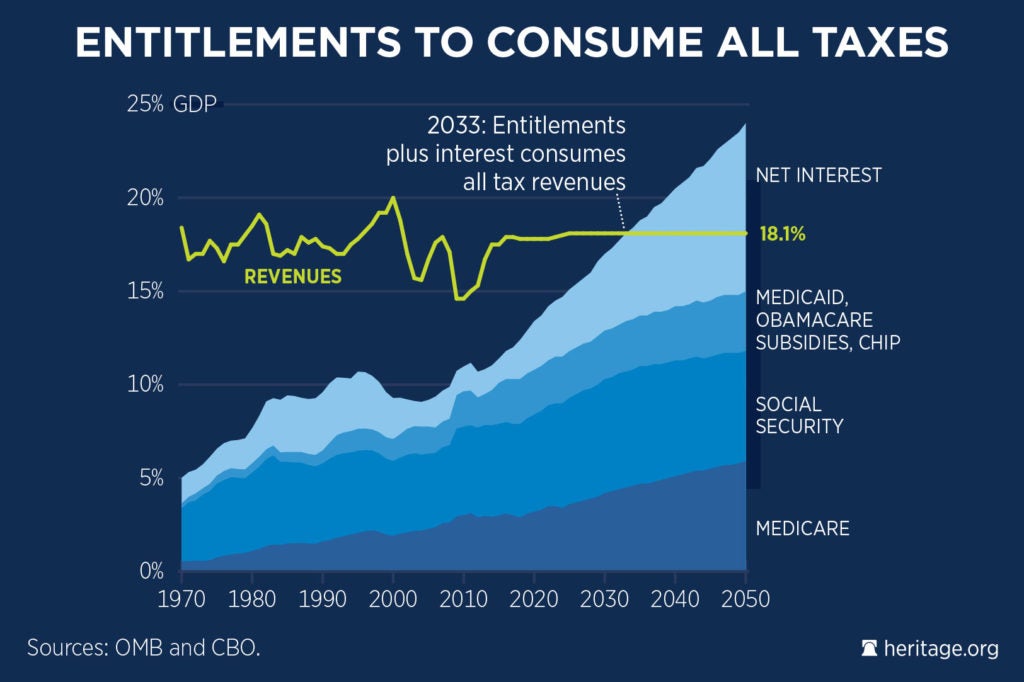
Autopilot entitlement spending on federal health care programs and Social Security, along with the net interest the nation must pay on the federal debt, are projected to consume all federal tax revenues by 2033.

Under this scenario, there would be no revenue left to fund other national priorities without significant tax hikes or immense debt burdens.chart

Congress masks much of this entitlement spending in the budget
by classifying it as “mandatory,” which allows spending on these programs to grow on autopilot every year without the need for an annual appropriation. Spending on federal health care programs and Social Security has grown so rapidly that these programs now make up a majority of the federal budget and will comprise an even greater portion of the budget in the coming years.


In 2015, major entitlement programs—Social Security, Medicare, Medicaid, Obamacare, and other health care programs—consumed 52 percent of all federal spending. Conversely, spending for other national priorities like defense declined.

Moreover, spending on both Social Security and federal health care programs is projected to drive more than half of the projected increase in spending over the next decade (assuming discretionary spending is not increased above current law). Younger generations stand to lose the most in the future as a result of fiscally irresponsible government policies.

It’s critical to addressing the root causes of high deficits and debt to recognize that the federal government has a spending problem, not a revenue problem. Although there is a need for comprehensive tax reform to create a simpler and less complex tax code, higher taxes will not solve the nation’s fiscal crisis because entitlement programs are outpacing economic growth and revenue cannot grow faster than the economy in the long run.

America’s next president should acknowledge the problem at hand and exhibit leadership to build support for necessary changes to America’s most popular, but also most unsustainable, programs.

[bold, italics, and colored emphasis mine]

Christian Chelak is a member of the Young Leaders Program at The Heritage Foundation. Romina Boccia focuses on federal spending and the national debt as the deputy director of Thomas A. Roe Institute for Economic Policy Studies and the Grover M. Hermann fellow in federal budgetary affairs at The Heritage Foundation. 
"Social Security Programs Face Depletion in Near Future" - Romina Boccia / Rachel Greszler / June 28, 2016; http://dailysignal.com/2016/06/28/social-security-programs-face-depletion-in-near-future/

Monday, July 11, 2016

#1646 (7/11) "The Gospel in the Aftermath of Dallas, Baton Rouge, and Falcon Heights - WHERE TO FROM HERE?"

Political Cartoons by Michael Ramirez
"The Gospel in the Aftermath of Dallas, Baton Rouge, and Falcon Heights - WHERE TO FROM HERE?" - John Stonestreet|
Breakpoint.org: 7/11/ 2016; http://www.breakpoint.org/bpcommentaries/breakpoint-commentaries-archive/entry/13/29547 [AS I SEE IT: The one place I would diverge from this commentary is the flat statement that we have "a race problem." I think that we must be sure to acknowledge that "race problems" exist in some form everywhere in our world and that in the past half century America has come a long way in addressing it's race problem. I think we need to be aware that there are a few who only want to stir the passions of hate rather than trying to bring about real peace among the races. Hopefully those few will be noted for who they are while the rest of us seek to bring about real peace and reconciliation. - Stan]
daily_commentary_07_11_16
Last week seems like a bad dream, but it wasn’t. Is it even possible to make sense of such cultural chaos?

We wake up this day as a nation wishing the events of last week didn’t actually happen—the shooting deaths of Alton Sterling in Baton Rouge, of Philando Castile in Minnesota, and five police officers, still unnamed as I write this, in Dallas. A demonically insidious string of events, hitting our nation like a series of pounding waves.

The endless articles, tweets, blog postings, and conversations reveal just how bewildered we are. Honestly, it reminds me of mentally trying to muddle through the events of 9-11. Only, this is different. Not worse, just different. On 9-11, we were reeling from an outside attack. Today, we reel from a brokenness within.

While confirmation bias tempts us to retreat to our pet causes, explanations, and scapegoats, we’d be wiser to listen to the tweeted words of Florida Pastor H.B. Charles, “The Bible exhorts us to weep with those who weep. It doesn’t tell us to judge whether they should be weeping.” In particular, two communities in our midst weep: African-Americans and law enforcement officials. We can and ought to be distressed by the brokenness on both sides.

Let us first and unequivocally say every human life is precious and valuable because it bears the very image of God. C.S. Lewis wrote in The Weight of Glory, “You’ve never met a mere mortal… Nations, cultures, arts, civilizations are mortal, and their life is to ours as the life of a gnat. But it is immortals whom we joke with, work with, marry, snub, and exploit.”

Let’s also say that the week’s events are a surface explosion of issues long present in our society. As my friend Pastor Chris Brooks said to me Friday, those asking “where did this come from?” reveal they’ve not been watching or listening. Alexander Solzhenitsyn saw it back in 1978, when he remarked (in a speech fittingly called “A World Split Apart”) the smooth surface film of our society was thin indeed, with only illusions of stability and health.

We’re not okay, folks, and we haven’t been in quite a while. These horrible events are not creating unrest; rather they are revealing it. Our society is weak in its middle—at the “social glue” level of local communities and civil society. And, we have a race problem. We might disagree on why, but it won’t do us any good to say it doesn’t exist. Here we are – and there’s no way out of this except by confronting it.

Third, and most important, let us proclaim, “Christ has risen!” It is true about this moment as it is about every other moment of history – good or bad.

And now, Christian, what might we do?
     First, pray. It sounds trite and expected, but it isn’t. I’m spending today praying for the pastors tasked with shepherding congregations through this on Sunday. I’m thankful Russell Moore has pointed out that happy, clappy worship songs in church won’t do at such a cultural moment. There are times to lament. This is one of them.
     I am also praying for Christians tasked with talking about this with colleagues, families, and neighbors on Monday. I am praying we will be Gospel-shaped in our words and tone.
     But mostly, I pray today for mercy using ancient, tried, and tested words: Lord, have mercy on us. Christ, have mercy on us. Lord, have mercy on us.

Second, we can, in the words of the Apostle James, be quick to listen and slow to speak (1:19), particularly to those with whom we agree on the Gospel but differ in experiences as citizens.

Third, we can focus efforts on rebuilding those institutions able to address the problems we face. Government has a role, but the state cannot lead us in reconciliation, virtue formation, or trust building. God has uniquely equipped the home and the church for those tasks.

It looks bleak, but we worship the same Christ whose Gospel has brought healing to post-adultery marriages, post-riot cities, even post-genocide Rwanda. It can here too. There is, in fact, no other place to look.

[bold, italics, and colored emphasis mine]

RESOURCES
"How Pastors Can Address the Shootings This Sunday" - Russell Moore | RussellMoore.com | July 8, 2016; http://www.russellmoore.com/2016/07/08/preach-shootings-sunday/

"Biblical Thinking in Tragic Days, audio link" - Chris Brooks | Equipped Radio Program | July 8, 2016; http://www.moodyradio.org/Equipped-with-Chris-Brooks/2016/07-2016/2016-07-08-Biblical-Thinking-in-Tragic-Days/

"Lamenting, listening, praying and participating our way to change" - Anthony Bradley | WORLD Magazine | July 9, 2016; https://world.wng.org/2016/07/lamenting_listening_praying_and_participating_our_way_to_change

"A World Split Apart" - Alexander Solzhenitsyn | Harvard Commencement address | June 8, 1978; http://www.americanrhetoric.com/speeches/alexandersolzhenitsynharvard.htm

As We Forgive: Stories of Reconciliation from Rwanda - Catherine Claire | Zondervan | February 2009

"BreakPoint This Week" - John Stonestreet and Ed Stetzer | BreakPoint.org | July 8, 2016; http://www.breakpoint.org/features-columns/discourse/entry/15/29551
--------------------------------------------------------------------------------------
"An Act of Terror Against the Men and Women of Law Enforcement" - Scott Erickson /  July 08, 2016; http://dailysignal.com/2016/07/08/an-act-of-terror-against-the-men-and-women-of-law-enforcement/?utm_source=TDS_Email&utm_medium=email&utm_campaign=CapitolBell&mkt_tok=eyJpIjoiWlRNME9ERmhObUl3WVdOayIsInQiOiJvZVRQQkM3TUtCeHBIWDVTY2d5bjhQdmF5YWkrRkNWQ3NTN0x4clNFZlhrblR1aE9sS040SVE5d0Z6dHZqU1o0TnJnYnJrM0pXbmdhYU91cko3SlA1RldScDFodndWUkhJUG1hWm0xNCs2Zz0ifQ%3D%3D

Sunday, July 10, 2016

#1271 (7/10) SUNDAY SPECIAL: "When the Good News Isn't Proclaimed - EVANGELIZATION ON THE WANE?"

"When the Good News Isn't Proclaimed - EVANGELIZATION ON THE WANE?" - By: John Stonestreet| Breakpoint.org: March 10, 2015; http://www.breakpoint.org/bpcommentaries/entry/13/27005?spMailingID=10839360&spUserID=MTMyMjM2ODE5OQS2&spJobID=500642403&spReportId=NTAwNjQyNDAzS0 [AS I SEE IT: (This was a post I neglected to publish last year but the subject is still quite relevant.) As I shared in my church neighborhood group, we are all missionaries - with just a relatively few of us that mission field is in another country. For the vast majority of us here in post-Christian America, our mission field is wherever God has placed us - whether our neighbors, co-workers, classmates, the person we "happen" to sit next to at a sporting event (for hours!) or on a plane, or whoever. Everywhere we are in contact with a non-Christian for more than a few minutes we have an opportunity - given to us by a sovereign God - to share the gospel. Unfortunately, for too many of us, we don't have a sense of urgency or an understanding that - like the man pictured falling off the edge of the cliff in the picture below - anyone without a relationship with Christ at any time can slip into a Christ-less eternity. Christ's Great Commission will never be fulfilled until every believer sees the mission field around him/her and determines to reach as many as possible with the Good News. - Stan]
daily_commentary_03_10_15
While we rightly work at cultural restoration, we mustn’t forget the necessity of changing hearts and minds too.

Here’s an uncomfortable question for all of us: When was the last time we shared the good news of salvation in Jesus Christ with anyone? [The last time we told someone that Jesus died so that God could forgive their sins, and that we must receive that gift in trusting faith?] According to the Barna Group, although 100 percent of “evangelicals” believe they have a personal responsibility to evangelize, a full 31 percent admit to not having done so in the past 12 months.

Thom Rainer, president and CEO of LifeWay Christian Resources, notes that his church—the Southern Baptist Convention—is reaching non-Christians only half as effectively as it did 50 years ago. Rainer calls the trend “disturbing.” And indeed it is. “By almost any metric,” he says, “the churches in our nation are much less evangelistic today than they were in the recent past.”

Southern Baptists say that reported baptisms have fallen in seven of the last nine years. “I am grieved we are clearly losing our evangelistic effectiveness,” Rainer told Baptist Press. “May God renew all of us, including me, with a greater heart for the lost.”

To find out why this is happening, Rainer conducted an unscientific Twitter poll, with the question, “Why do you think many churches aren’t as evangelistic as they once were?” I’ll give you the top five, and you can come to BreakPoint.org for a link to the rest. It’s painful to read. #1, “Christians have no sense of urgency to reach lost people.” #2, “Many Christians and church members do not befriend and spend time with lost persons.” #3, “Many Christians and church members are lazy and apathetic.” #4, “We are more known for what we are against than what we are for.” And #5, the churches too often are using ineffective evangelistic strategies. Ouch!

It’s not just Southern Baptists, of course. Barna found that the practice of evangelism is falling among self-identified “born-again” “Baby Boomers” and “Baby Busters.” However, evangelism is actually growing among a group you might not expect—“born again” Millennials. Some 65 percent of Millennials shared the Gospel in 2013, compared to 56 percent in 2010. That’s a good trend!

So what do we do? Well, Ed Stetzer of Lifeway says in Christianity Today that while the message of evangelism should never change, our methods—in response to a changing culture—must change. Stetzer points out that in past decades, radio ministries, bus ministries, and evangelistic crusades reached many—and of course still do. But one thing that’s always been constant, and is more important today than ever, is relational approaches. As Stetzer says, “I lead a small group in my neighborhood every Sunday night . . . I might not be able to take them to a Billy Graham crusade, but I can invite them to my home because they already know me and trust me.”

Also, the Billy Graham Evangelistic Association reports very encouraging results using online evangelism. According to CT, “Of the 1.6 million people who told the BGEA they prayed ‘to accept Jesus Christ as [their] Savior’ in 2014, less than 15,000 did so in person, while more than 1.5 million did so with the click of a mouse.”

Of course, evangelism is not the ultimate goal—discipleship is, seeing hearts and minds changed by the increasing realization of the Lordship and sufficiency of Christ which leads to a life of obedience—that’s the summary of the Great Commission. But there’s a first step, isn’t there? So let’s all recommit ourselves to sharing the Gospel with friends and neighbors—in whatever way the Lord leads and however He has equipped us.

[ bold and italics emphasis mine]

FURTHER READING AND INFORMATION
     As John pointed out, our first step is sharing Christ's love and forgiveness, and encouraging others to be His followers. After all, Jesus' command to us is pretty clear, "Go into all the world and preach the gospel to all creation." (Mark 16:15) And Paul urged us to proclaim the good news of Christ, professing "For I am not ashamed of the gospel, for it is the power of God for salvation to everyone who believe" (Romans 1:16).
RESOURCES
"Fifteen Reasons Our Churches Are Less Evangelistic Today" - Thom Rainer | theaquilareport.org | February 24, 2015; http://theaquilareport.com/fifteen-reasons-our-churches-are-less-evangelistic-today/
"Evangelism Never Changes, But the Methods Do" - Ed Stetzer | Christianity Today | February 6, 2015; http://www.christianitytoday.com/edstetzer/2015/february/evangelism-never-changes-but-never-stays-same.html
Love, the Ultimate Apologetic: The Heart of Christian Witness - Art Lindsley | IVP Books | May 2008
Just Walk Across the Room: Simple Steps Pointing People to Faith - Bill Hybels | Zondervan | July 2012
The Mark of the Christian - Francis Schaeffer | IVP Books | January 2007